 Uyiyiphi idayinaso? Ikwizi
 Idabi leedayinaso
 Ugqatso lweedayinaso
 Imidlalo emincinci yeedayinaso
 I-albhamu yezitikha
 Iilisti ze-TOP zeedayinaso
 Ndothuse!
Yaphila nini?

Yayikhawuleza kangakanani?


Iinyani ezimnandi
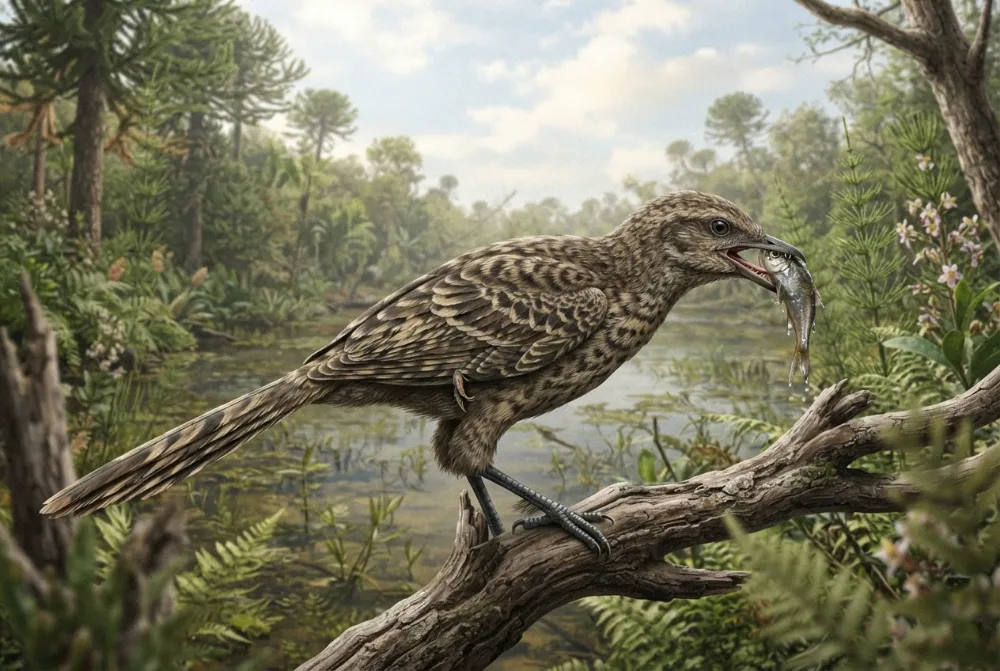
Cratoavis is one of the earliest known fossil birds from South America, living about 117 million years ago.2
Its fossil includes feathers attached to the wings and around the body, showing what it looked like.1
Fish bones from at least two small fish called Dastilbe crandalli were found inside the bird's digestive tract.2
This is the first direct evidence of what any Mesozoic bird from the Southern Hemisphere ate.2
Cratoavis had a short beak, but it still caught and ate fish.2
Eyona mibuzo ibuzwa kakhulu: Cratoavis
?How big was Cratoavis?
It was a very small bird, about the size of a sparrow. The fossil shows it had a short beak and long tail feathers.13
?What did Cratoavis eat?
It ate fish. Fish bones from at least two small fish called Dastilbe crandalli were found inside its digestive tract.21
Kwiingcali zeedayinaso
- Igama lenzululwazi
- Cratoavis
- Inikwe igama ngu:
- Carvalho et al. 20154
- Iqela
- Iintaka zokuqala
- Usapho / iclade
- Euenantiornithes4
- Ukuhlelwa
- Theropoda > Avialae4
- Ubudala bamatye
- 120 ukuya ku-113 izigidi zeminyaka (Aptian)4
- Izakhiwo zamatye
- Crato4
- Amazwe
- iBrazil4
- Iirekhodi zeefosili
- 1 kwi-Paleobiology Database4
- Ukufunyanwa
- Cratoavis was named in 2015 by Carvalho and colleagues. The fossil was found in the Crato Formation in Brazil.41
- Kusaxoxwa ngayo
- Scientists are not sure exactly how big Cratoavis was, because only one fossil has been found.1
Apho iinyani zivela khona
- Cratoavis (en.wikipedia.org)
- Evidence of piscivorous diet in an enantiornithine bird from the Lower Cretaceous of Brazil (igeo.ufrj.br)
- Brasil - A new genus and species of enantiornithine bird from the Early Cretaceous of Brazil A new genus and species of enantiornithine bird from the Early Cretaceous of Brazil (scielo.br)
- Cratoavis in The Paleobiology Database (CC BY 4.0): ubudala, iindawo, izakhiwo zamatye, ukuhlelwa.
Yonke inyani ekweli phepha inenombolo ebonisa umthombo wayo. Ukuba siphosisile, uxolo, sithanda iidayinaso, asiyojenali yenzululwazi. Sixelele apha: [email protected], siya kuyilungisa.
 URex ulambile! I-Dino Wiki yiprojekthi katata ukwenzela unyana wakhe othanda iidayinaso, isimahla, ayinazintengiso, ayinazilandeli. Abantu abadala banokuphakela uRex isidlwana ukuze incede ihlale kwi-intanethi.Phakela uRex
 Archaeopteryx
 Hesperornis
 Ichthyornis
 Baptornis
 Jurapteryx
 Gobipteryx
 Stegosaurus
 Iguanodon
 Giganotosaurus
 Microraptor
 Deinonychus
 Baryonyx