 Uyiyiphi idayinaso? Ikwizi
 Idabi leedayinaso
 Ugqatso lweedayinaso
 Imidlalo emincinci yeedayinaso
 I-albhamu yezitikha
 Iilisti ze-TOP zeedayinaso
 Ndothuse!
Darwinopterus
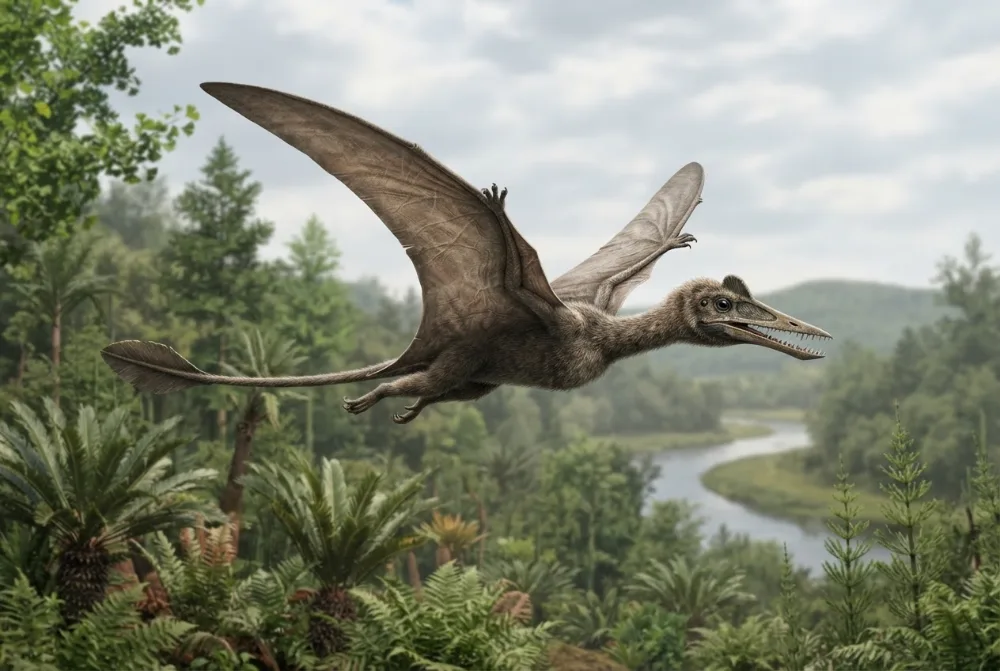
Imagine a flying reptile that looks like it got its head from one group and its tail from another. That is Darwinopterus. It lived in the middle Jurassic period, about 160 million years ago, in what is now China.12
Yaphila nini?
Yayinkulu kangakanani?
Yayinde kangakanani?
Darwinopterus wayemkhulu kangakanani xa ethelekiswa NAWE?
Yimathematika nje kwibhrawuza yakho. Akukho nto igcinwayo okanye ithunyelwe naphi na.
Yayikhawuleza kangakanani?


Iinyani ezimnandi
Darwinopterus was a 'transitional fossil' because it had a head and neck like later short-tailed pterosaurs, but a long tail like earlier ones.12
More than 30 fossils of Darwinopterus have been found, all from the same rock layer in China.1
The name Darwinopterus honors Charles Darwin, the famous scientist who came up with the idea of evolution by natural selection.12
Darwinopterus had a very long tail, made of more than 20 vertebrae, with thin bony rods wrapping around it.2
Its skull was huge, almost twice as long as the bones of its back. That's even bigger than many later pterosaurs.2
Darwinopterus had about 15 pairs of slender, spike-like teeth in its mouth, good for gripping prey.2
Eyona mibuzo ibuzwa kakhulu: Darwinopterus
?Was Darwinopterus a dinosaur?
No, Darwinopterus was a pterosaur, a flying reptile that lived while dinosaurs walked on land. Pterosaurs are not dinosaurs.41
?How big was Darwinopterus?
It was a relatively small pterosaur. Its skull was about 0.14 to 0.19 metres long, and its forelimbs were about 0.34 to 0.46 metres long.2
Kwiingcali zeedayinaso
- Igama lenzululwazi
- Darwinopterus
- Inikwe igama ngu:
- Lü et al. 20105
- Iqela
- Izirhubuluzi ezibhabhayo
- Usapho / iclade
- Monofenestrata5
- Ukuhlelwa
- Pterosauria5
- Ubudala bamatye
- 168 ukuya ku-152 izigidi zeminyaka (Bathonian / Kimmeridgian)5
- Izakhiwo zamatye
- Tiaojishan5
- Amazwe
- iTshayina5
- Iirekhodi zeefosili
- 4 kwi-Paleobiology Database5
- Ukufunyanwa
- The first Darwinopterus fossil was found at Linglongta, Liaoning Province, China, in rocks of the Tiaojishan Formation. Scientists Lü Junchang, David Unwin, and others named it in 2010. It was described in the journal Proceedings of the Royal Society B.12
- Kusaxoxwa ngayo
- Scientists are still debating whether Darwinopterus was a fast aerial hunter or mainly an insectivore that hopped on the ground.1
Apho iinyani zivela khona
- Darwinopterus (en.wikipedia.org)
- Evidence for modular evolution in a long-tailed pterosaur with a pterodactyloid skull (pmc.ncbi.nlm.nih.gov)
- Brazil - A new species of Darwinopterus (Wukongopteridae, Pterosauria) from western Liaoning provides some new information on the ontogeny of this clade A new species of <i>Darwinopterus</i> (Wukongopteridae, Pterosauria) from western Liaoning provides some new information on the ontogeny of this clade (scielo.br)
- Darwinopterus, a Transitional Pterosaur (smithsonianmag.com)
- Darwinopterus in The Paleobiology Database (CC BY 4.0): ubudala, iindawo, izakhiwo zamatye, ukuhlelwa.
Yonke inyani ekweli phepha inenombolo ebonisa umthombo wayo. Ukuba siphosisile, uxolo, sithanda iidayinaso, asiyojenali yenzululwazi. Sixelele apha: [email protected], siya kuyilungisa.
 URex ulambile! I-Dino Wiki yiprojekthi katata ukwenzela unyana wakhe othanda iidayinaso, isimahla, ayinazintengiso, ayinazilandeli. Abantu abadala banokuphakela uRex isidlwana ukuze incede ihlale kwi-intanethi.Phakela uRex
 Pteranodon
 Quetzalcoatlus
 Dorygnathus
 Rhamphorhynchus
 Anhanguera
 Pterodactylus
 Brachiosaurus
 Diplodocus
 Allosaurus
 Brontosaurus
 Compsognathus
 Camarasaurus