 Uyiyiphi idayinaso? Ikwizi
 Idabi leedayinaso
 Ugqatso lweedayinaso
 Imidlalo emincinci yeedayinaso
 I-albhamu yezitikha
 Iilisti ze-TOP zeedayinaso
 Ndothuse!
Dearc
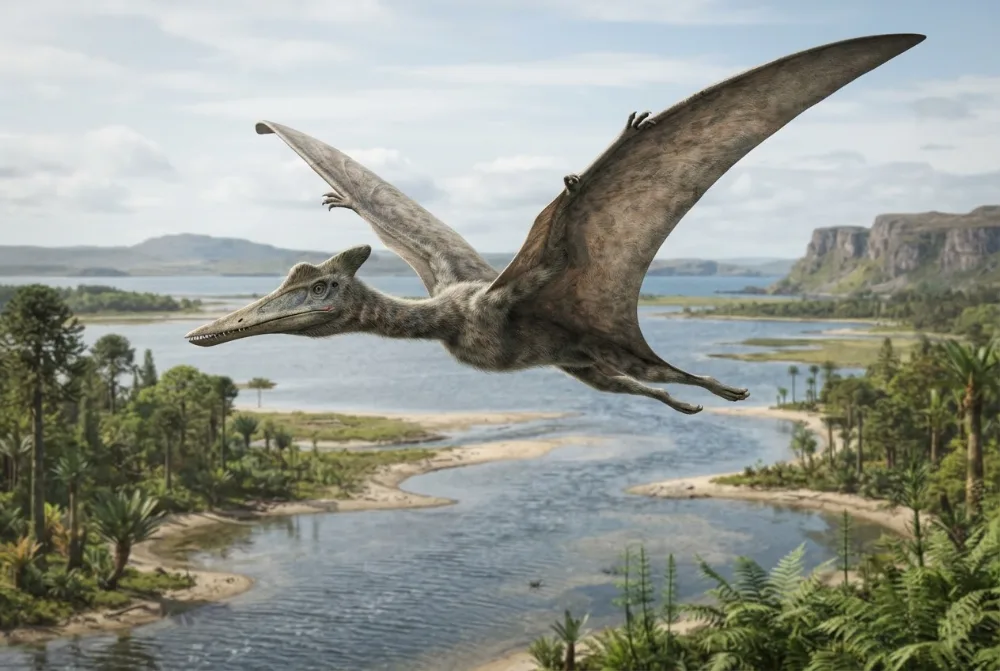
Dearc was a flying reptile that lived in the Middle Jurassic, about 167 million years ago. It was one of the biggest flying animals of its time, with wings as wide as a small car! It soared over the lagoons of what is now Scotland.1
Yaphila nini?
Yayinkulu kangakanani?
Amaphiko ayo ayebanzi kangakanani?
 amaphiko abanzi njengeebhayisikile ezingama-1.5 zilandelelana⚽ibinokubhabha inqumle ibala lebhola ekhatywayo lonke ngemizuzwana engama-7.3
Dearc wayemkhulu kangakanani xa ethelekiswa NAWE?
Yimathematika nje kwibhrawuza yakho. Akukho nto igcinwayo okanye ithunyelwe naphi na.
Yayikhawuleza kangakanani?


Iinyani ezimnandi
Dearc was not fully grown when it died. It was a juvenile or subadult, still actively growing, so adults might have been even bigger.13
Its wingspan was about 2.5 to 3 metres (8 to 10 feet), as wide as a wandering albatross, the largest flying bird today.1
Before Dearc was discovered, scientists thought pterosaurs stayed small until the Cretaceous period. Dearc shows they got big much earlier.13
The fossil was found at Brothers' Point on the Isle of Skye in 2017, during a National Geographic-funded field trip.1
Its name comes from Scottish Gaelic and means both 'winged reptile' and 'reptile from Skye', because Skye is called the 'winged isle'.1
Dearc had a long, low skull and a slender upper arm bone, which helped it fly.1
Eyona mibuzo ibuzwa kakhulu: Dearc
?How big was Dearc?
Dearc had a wingspan of about 2.5 to 3 metres, as wide as a wandering albatross, the largest flying bird today. It was not fully grown when it died, so adults might have been even bigger.34
?When did Dearc live?
Dearc lived in the Middle Jurassic, about 167 million years ago.3
?Where was Dearc found?
The fossil was found at Brothers' Point on the Isle of Skye in Scotland in 2017.3
?What did Dearc eat?
Dearc had two types of teeth: long fangs at the front and peg-like teeth further back, which suggests it ate fish or other small animals.3
?Is Dearc a dinosaur?
No, Dearc is a pterosaur, a flying reptile, not a dinosaur.3
Kwiingcali zeedayinaso
- Igama lenzululwazi
- Dearc
- Inikwe igama ngu:
- Jagielska et al. 20226
- Iqela
- Izirhubuluzi ezibhabhayo
- Usapho / iclade
- Rhamphorhynchidae6
- Ukuhlelwa
- Pterosauria > Rhamphorhynchidae6
- Ubudala bamatye
- 168 ukuya ku-165 izigidi zeminyaka (Bathonian)6
- Izakhiwo zamatye
- Lealt Shale6
- Amazwe
- iUnited Kingdom6
- Iirekhodi zeefosili
- 1 kwi-Paleobiology Database6
- Ukufunyanwa
- The first Dearc fossil was discovered on May 23, 2017, at Brothers' Point on the Isle of Skye, Scotland, by a team led by Stephen Brusatte. It was named Dearc sgiathanach by Jagielska and colleagues in 2022.1
- Kusaxoxwa ngayo
- Scientists are not sure exactly how big Dearc could grow, because the only known fossil is from a young animal that was still growing.1
Apho iinyani zivela khona
- A skeleton from the Middle Jurassic of Scotland illuminates an earlier origin of large pterosaurs: Current Biology (cell.com)
- PBDB Taxon (paleobiodb.org)
- Dearc (en.wikipedia.org)
- Report A skeleton from the Middle Jurassic of Scotland illuminates an earlier origin of large pterosaurs (sciencedirect.com)
- Jurassic Dearc | Nature Ecology & Evolution (nature.com)
- Dearc in The Paleobiology Database (CC BY 4.0): ubudala, iindawo, izakhiwo zamatye, ukuhlelwa.
Yonke inyani ekweli phepha inenombolo ebonisa umthombo wayo. Ukuba siphosisile, uxolo, sithanda iidayinaso, asiyojenali yenzululwazi. Sixelele apha: [email protected], siya kuyilungisa.
 URex ulambile! I-Dino Wiki yiprojekthi katata ukwenzela unyana wakhe othanda iidayinaso, isimahla, ayinazintengiso, ayinazilandeli. Abantu abadala banokuphakela uRex isidlwana ukuze incede ihlale kwi-intanethi.Phakela uRex
 Pteranodon
 Quetzalcoatlus
 Dorygnathus
 Rhamphorhynchus
 Anhanguera
 Pterodactylus
 Ichthyosaurus
 Khudiakovia
 Ophthalmosaurus
 Peloneustes
 Gongbusaurus
 Shunosaurus