 Uyiyiphi idayinaso? Ikwizi
 Idabi leedayinaso
 Ugqatso lweedayinaso
 Imidlalo emincinci yeedayinaso
 I-albhamu yezitikha
 Iilisti ze-TOP zeedayinaso
 Ndothuse!
Yaphila nini?

Yayinkulu kangakanani?
Yayinde kangakanani?
Yayiphakame kangakanani?
uqikelelo
Yayinzima kangakanani?

 inde njengezinja ezingama-6, impumlo ukuya emsileni🍌inde njengeebhanana ezingama-36 zilandelelana
 malunga nobunzima bendlovu🍉inzima njengamavatala angama-1000🎒inzima njengamagumbi okufundela apheleleyo abantwana angama-6🐻❄️inzima njengeebhere ezimhlophe ezingama-11🏃ibinokubaleka iimitha ezili-100 ngemizuzwana engama-28 (oyena mntu ukhawulezayo udinga i-9,6)
Hesperosaurus wayemkhulu kangakanani xa ethelekiswa NAWE?
Yimathematika nje kwibhrawuza yakho. Akukho nto igcinwayo okanye ithunyelwe naphi na.
Yayikhawuleza kangakanani?


Iinyani ezimnandi
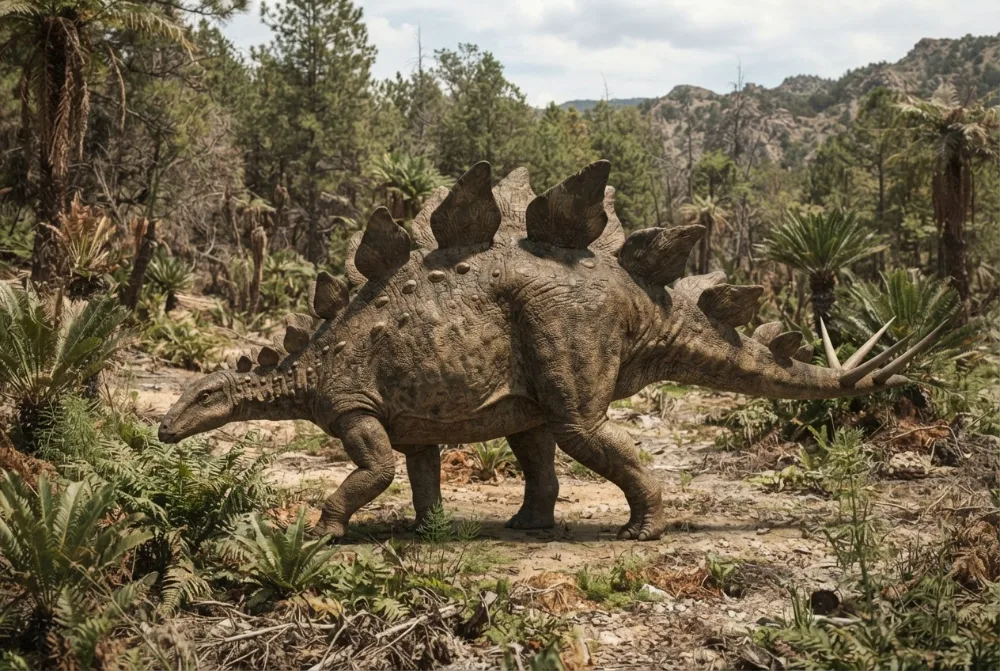
Hesperosaurus is known from a nearly complete skeleton and skull, which is rare for stegosaurs.3
One fossil preserves the first known impression of the horn sheath on a stegosaur back plate.1
Its back plates were longer and lower than those of its close relative Stegosaurus.1
Hesperosaurus lived a little earlier than other stegosaurs from the Morrison Formation.1
The tail spikes, called a thagomizer, had two pairs: the front pair thicker and the rear pair thinner and more horizontal.1
Scientists have debated whether Hesperosaurus should be its own genus or a species of Stegosaurus.1
Eyona mibuzo ibuzwa kakhulu: Hesperosaurus
?How big was Hesperosaurus?
Hesperosaurus was a large stegosaur, reaching about 6.5 metres (21 feet) in length and weighing around 3.5 metric tons (3.9 short tons). Some large individuals may have reached 5 metric tons (5.5 short tons).1
?What did Hesperosaurus eat?
Hesperosaurus was a herbivore, meaning it ate plants. It was a quadrupedal plant-eater, like other stegosaurs.13
?When did Hesperosaurus live?
Hesperosaurus lived during the Late Jurassic period, about 156 million years ago. It lived a little earlier than other stegosaurs from the Morrison Formation.13
?Where was Hesperosaurus found?
Fossils of Hesperosaurus have been found in the states of Wyoming and Montana in the United States of America. They were first discovered in 1985.1
?Did Hesperosaurus have plates or spikes?
Hesperosaurus had two rows of bony plates on its back and four spikes on its tail. The tail spikes, called a thagomizer, had two pairs: the front pair thicker and the rear pair thinner and more horizontal.1
Kwiingcali zeedayinaso
- Igama lenzululwazi
- Hesperosaurus
- Inikwe igama ngu:
- Carpenter et al. 20014
- Iqela
- Iidayinaso ezinamacwecwe
- Usapho / iclade
- Stegosauridae4
- Ukuhlelwa
- Ornithischia > Stegosauria > Thyreophora4
- Ubudala bamatye
- 158 ukuya ku-143 izigidi zeminyaka ()4
- Izakhiwo zamatye
- Morrison4
- Amazwe
- iUSA4
- Iirekhodi zeefosili
- 8 kwi-Paleobiology Database4
- Ukufunyanwa
- Hesperosaurus was named in 2001 by Kenneth Carpenter, Clifford Miles, and Karen Cloward. The first fossils were found in 1985 on a ranch in Johnson County, Wyoming, USA.1
- Kusaxoxwa ngayo
- Scientists still debate whether Hesperosaurus is a separate genus from Stegosaurus or just a species of Stegosaurus.1
Apho iinyani zivela khona
- Hesperosaurus (en.wikipedia.org)
- PBDB Taxon (paleobiodb.org)
- Hesperosaurus | Natural History Museum (nhm.ac.uk)
- Hesperosaurus in The Paleobiology Database (CC BY 4.0): ubudala, iindawo, izakhiwo zamatye, ukuhlelwa.
Yonke inyani ekweli phepha inenombolo ebonisa umthombo wayo. Ukuba siphosisile, uxolo, sithanda iidayinaso, asiyojenali yenzululwazi. Sixelele apha: [email protected], siya kuyilungisa.
 URex ulambile! I-Dino Wiki yiprojekthi katata ukwenzela unyana wakhe othanda iidayinaso, isimahla, ayinazintengiso, ayinazilandeli. Abantu abadala banokuphakela uRex isidlwana ukuze incede ihlale kwi-intanethi.Phakela uRex
 Stegosaurus
 Diracodon
 Hypsirophus
 Dacentrurus
 Miragaia
 Kentrosaurus
 Brachiosaurus
 Diplodocus
 Allosaurus
 Brontosaurus
 Compsognathus
 Camarasaurus