 Uyiyiphi idayinaso? Ikwizi
 Idabi leedayinaso
 Ugqatso lweedayinaso
 Imidlalo emincinci yeedayinaso
 I-albhamu yezitikha
 Iilisti ze-TOP zeedayinaso
 Ndothuse!
Miragaia
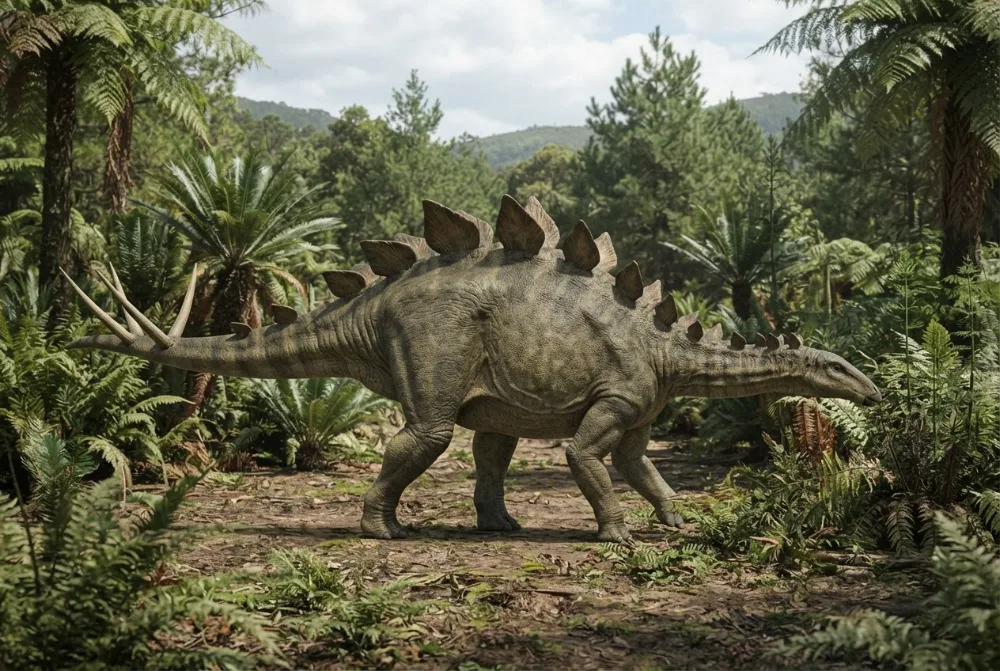
Miragaia was a stegosaur, a plant-eating dinosaur with plates and spines on its back. It had an unusually long neck, much longer than most other stegosaurs. This gentle giant lived in what is now Portugal and the United States during the Late Jurassic period.12
Yaphila nini?
Yayinkulu kangakanani?
Yayinde kangakanani?
Yayiphakame kangakanani?
uqikelelo
 inde njengezinja ezingama-6, impumlo ukuya emsileni🍌inde njengeebhanana ezingama-36 zilandelelana🏃ibinokubaleka iimitha ezili-100 ngemizuzwana engama-24 (oyena mntu ukhawulezayo udinga i-9,6)
Miragaia wayemkhulu kangakanani xa ethelekiswa NAWE?
Yimathematika nje kwibhrawuza yakho. Akukho nto igcinwayo okanye ithunyelwe naphi na.
Yayikhawuleza kangakanani?


Iinyani ezimnandi
Miragaia had at least 17 neck vertebrae, giving it a very long neck for a stegosaur. Most stegosaurs had fewer than 13.1
The name Miragaia comes from the village where it was found, Miragaia in Portugal, and also means 'wonderful goddess of the Earth'.1
Miragaia belonged to a group called Dacentrurinae, which includes its close relative Dacentrurus. Scientists used to think many stegosaur fossils from Portugal and Spain were Dacentrurus, but now they know some are Miragaia.1
A nearly complete skeleton of Miragaia was discovered in 1959 in Atouguia da Baleia, Peniche, Portugal, but it was not described until many years later.1
Miragaia shared features with a stegosaur from Wyoming called Alcovasaurus longispinus, suggesting that a land bridge once connected North America and Iberia (Portugal and Spain).1
The plates on Miragaia's back were probably used for display, and the spines on its tail (called a thagomizer) could have been a weapon against predators.1
Inyaniso ngeentsomi
Intsomi: Miragaia is sometimes thought to be a species of Dacentrurus.
Inyaniso: Scientists now agree that Miragaia is a separate, valid genus, different from Dacentrurus in many ways, such as its longer neck and different vertebrae.1
Kwiingcali zeedayinaso
- Igama lenzululwazi
- Miragaia
- Inikwe igama ngu:
- Mateus et al. 20093
- Iqela
- Iidayinaso ezinamacwecwe
- Usapho / iclade
- Stegosauridae3
- Ukuhlelwa
- Ornithischia > Stegosauria > Thyreophora3
- Ubudala bamatye
- 155 ukuya ku-121 izigidi zeminyaka (Kimmeridgian / Barremian)3
- Izakhiwo zamatye
- Morrison3
- Amazwe
- iUSA3
- Iirekhodi zeefosili
- 31 kwi-Paleobiology Database3
- Ukufunyanwa
- Miragaia was named in 2009 by Octávio Mateus and colleagues, based on a partial skeleton found near the village of Miragaia in the Lourinhã Formation of Portugal. The holotype specimen includes much of the front half of the skeleton.1
- Kusaxoxwa ngayo
- Scientists still debate exactly how many species of Miragaia existed, and whether some fossils from North America belong to this genus or to its close relative Dacentrurus.2
Apho iinyani zivela khona
- Dacentrurine stegosaurs (Dinosauria): A new specimen of Miragaia longicollum from the Late Jurassic of Portugal resolves taxonomical validity and shows the occurrence of the clade in North America (pmc.ncbi.nlm.nih.gov)
- Dacentrurine Stegosaurs in North America: New Occurrences from the Upper Jurassic of USA (Morrison Formation) (dinodata.de)
- Miragaia in The Paleobiology Database (CC BY 4.0): ubudala, iindawo, izakhiwo zamatye, ukuhlelwa.
Yonke inyani ekweli phepha inenombolo ebonisa umthombo wayo. Ukuba siphosisile, uxolo, sithanda iidayinaso, asiyojenali yenzululwazi. Sixelele apha: [email protected], siya kuyilungisa.
 URex ulambile! I-Dino Wiki yiprojekthi katata ukwenzela unyana wakhe othanda iidayinaso, isimahla, ayinazintengiso, ayinazilandeli. Abantu abadala banokuphakela uRex isidlwana ukuze incede ihlale kwi-intanethi.Phakela uRex
 Stegosaurus
 Diracodon
 Hypsirophus
 Dacentrurus
 Kentrosaurus
 Hesperosaurus
 Iguanodon
 Archaeopteryx
 Giganotosaurus
 Microraptor
 Deinonychus
 Baryonyx