 Uyiyiphi idayinaso? Ikwizi
 Idabi leedayinaso
 Ugqatso lweedayinaso
 Imidlalo emincinci yeedayinaso
 I-albhamu yezitikha
 Iilisti ze-TOP zeedayinaso
 Ndothuse!
Longipteryx
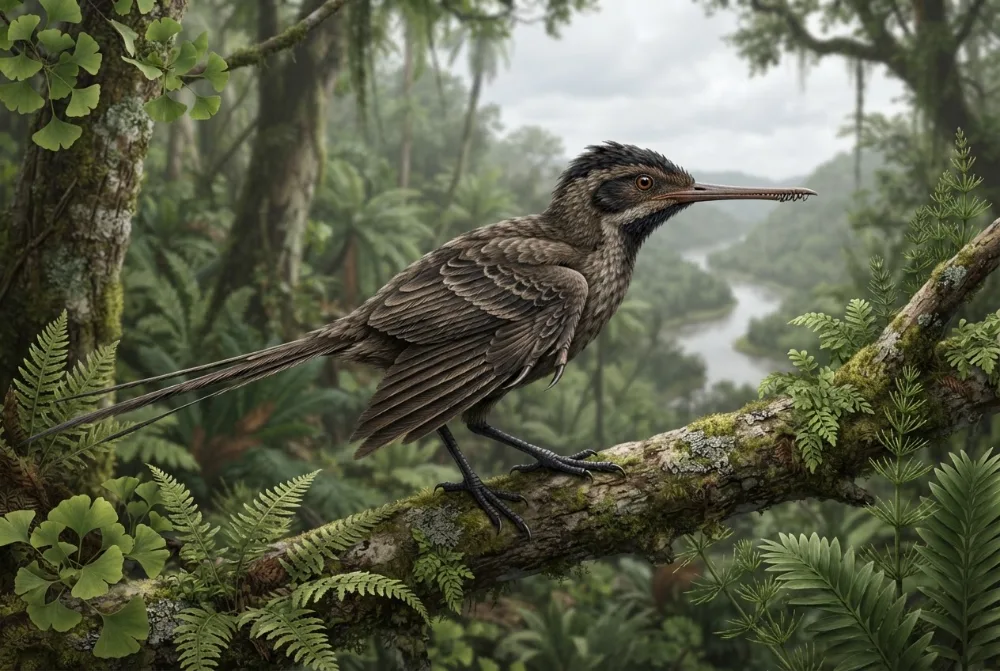
Longipteryx was a tiny bird that lived about 120 million years ago in what is now China. It had long, strong wings and a very long snout with hooked teeth at the tip. This little bird was a great flyer and could perch on branches like modern birds.12
Yaphila nini?
Yayinkulu kangakanani?
Amaphiko ayo ayebanzi kangakanani?
Yayinzima kangakanani?
Longipteryx wayemkhulu kangakanani xa ethelekiswa NAWE?
Yimathematika nje kwibhrawuza yakho. Akukho nto igcinwayo okanye ithunyelwe naphi na.
Yayikhawuleza kangakanani?


Iinyani ezimnandi
Longipteryx had a very long snout that was longer than the rest of its head, with a few hooked teeth at the tip.1
Its wings were much longer than its legs, with the upper arm bone (humerus) being 1.56 times the length of the thigh bone (femur).1
Unlike most other early birds, Longipteryx had uncinate processes on its ribs, which helped strengthen its ribcage and improve breathing.12
Its feet were built for perching, with all four toe bones (metatarsals) ending at nearly the same level, just like modern perching birds.2
Scientists once thought Longipteryx ate fish or insects, but in 2024 a study found it actually ate seeds and fruits.1
Longipteryx had a big breastbone with a well-developed keel, which gave it powerful flight muscles.2
Eyona mibuzo ibuzwa kakhulu: Longipteryx
?How big was Longipteryx?
Longipteryx was very small, with a wingspan of about 46.3 cm (1.52 ft) and a body mass of about 193 g (6.8 oz).1
?What did Longipteryx eat?
Longipteryx ate fish. A 2024 study found fish remains in its stomach, showing it was a piscivore.13
?Did Longipteryx have feathers?
Yes, Longipteryx had feathers. The holotype preserves body feathers, wing coverts and down, but no long tail feathers.1
?Could Longipteryx fly?
Yes, Longipteryx was a good flyer. It had long, strong wings and a well-developed breastbone with a keel for powerful flight muscles.1
Inyaniso ngeentsomi
Intsomi: Longipteryx was a fish-eater because of its long snout and teeth.
Inyaniso: Scientists now know from fossil evidence that Longipteryx ate seeds and fruits, not fish.1
Kwiingcali zeedayinaso
- Igama lenzululwazi
- Longipteryx
- Inikwe igama ngu:
- Zhang et al. 20004
- Iqela
- Iintaka zokuqala
- Usapho / iclade
- Longipterygidae4
- Ukuhlelwa
- Theropoda > Avialae4
- Ubudala bamatye
- 121 ukuya ku-113 izigidi zeminyaka (Aptian)4
- Izakhiwo zamatye
- Jiufotang4
- Amazwe
- iTshayina4
- Iirekhodi zeefosili
- 3 kwi-Paleobiology Database4
- Ukufunyanwa
- Longipteryx was named in 2000 by Zhang Fucheng and colleagues from a nearly complete skeleton found in the Jiufotang Formation in Chaoyang, China.42
- Kusaxoxwa ngayo
- Scientists are not sure whether Longipteryx used its long snout and teeth to catch prey or for some other purpose.1
Apho iinyani zivela khona
- Longipteryx (en.wikipedia.org)
- Early diversification of birds: Evidence from a new opposite bird (ivpp.cas.cn)
- Direct evidence of frugivory in the Mesozoic bird Longipteryx contradicts morphological proxies for diet (cell.com)
- Longipteryx in The Paleobiology Database (CC BY 4.0): ubudala, iindawo, izakhiwo zamatye, ukuhlelwa.
Yonke inyani ekweli phepha inenombolo ebonisa umthombo wayo. Ukuba siphosisile, uxolo, sithanda iidayinaso, asiyojenali yenzululwazi. Sixelele apha: [email protected], siya kuyilungisa.
 URex ulambile! I-Dino Wiki yiprojekthi katata ukwenzela unyana wakhe othanda iidayinaso, isimahla, ayinazintengiso, ayinazilandeli. Abantu abadala banokuphakela uRex isidlwana ukuze incede ihlale kwi-intanethi.Phakela uRex
 Archaeopteryx
 Hesperornis
 Ichthyornis
 Baptornis
 Jurapteryx
 Gobipteryx
 Stegosaurus
 Iguanodon
 Giganotosaurus
 Microraptor
 Deinonychus
 Baryonyx