 Uyiyiphi idayinaso? Ikwizi
 Idabi leedayinaso
 Ugqatso lweedayinaso
 Imidlalo emincinci yeedayinaso
 I-albhamu yezitikha
 Iilisti ze-TOP zeedayinaso
 Ndothuse!
Sericipterus
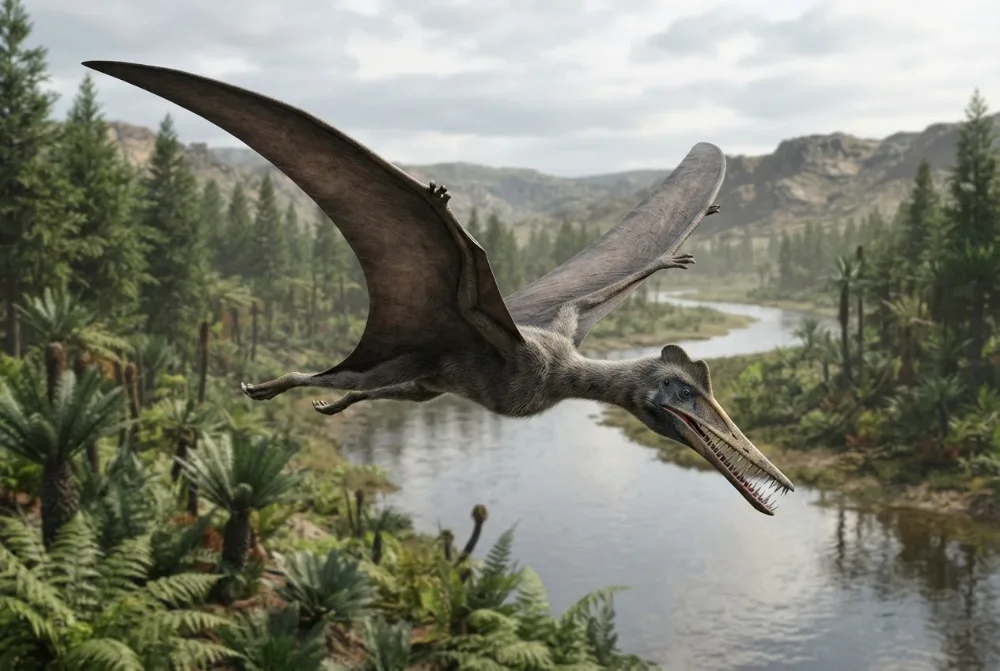
Sericipterus was a flying reptile that lived about 160 million years ago in what is now China. It had a wingspan of at least 1.73 meters (5.7 feet), making it one of the largest pterosaurs of its time. It probably soared over lakes and rivers, catching fish with its long, sharp teeth.12
Yaphila nini?
Yayinkulu kangakanani?
Amaphiko ayo ayebanzi kangakanani?
 inde njengeekati zasekhaya ezingama-3, impumlo ukuya emsileni⚽ibinokubhabha inqumle ibala lebhola ekhatywayo lonke ngemizuzwana engama-8.4
Sericipterus wayemkhulu kangakanani xa ethelekiswa NAWE?
Yimathematika nje kwibhrawuza yakho. Akukho nto igcinwayo okanye ithunyelwe naphi na.
Yayikhawuleza kangakanani?


Iinyani ezimnandi
Sericipterus had three bony crests on its head: one on the snout, one on top of the skull, and a short crest at the front of the skull.1
It was one of the largest non-pterodactyloid pterosaurs, meaning it belonged to an early group of pterosaurs that did not have the short tails and long heads of later forms.2
The name Sericipterus comes from the Silk Road, the ancient trade route that passed through the region where it was found.1
Its teeth were curved, sharply pointed, and had two keels (sharp edges) for cutting, like steak knives.1
The holotype specimen (IVPP V14725) includes a disarticulated skull, partial lower jaw, many teeth, parts of the spine, wing bones, and other fragments.2
Sericipterus lived in a terrestrial (land) environment, unlike many pterosaurs that lived near the sea.2
Eyona mibuzo ibuzwa kakhulu: Sericipterus
?How big was Sericipterus?
Sericipterus had a wingspan of at least 1.73 meters, making it one of the largest non pterodactyloid pterosaurs.12
?What did Sericipterus eat?
It likely ate small tetrapods, as it lived inland and had sharp, curved teeth with cutting edges, similar to other rhamphorhynchids.12
?When did Sericipterus live?
Sericipterus lived during the Late Jurassic, about 160 million years ago, in what is now China.12
?Was Sericipterus a dinosaur?
No, Sericipterus was a pterosaur, a flying reptile, not a dinosaur.1
Kwiingcali zeedayinaso
- Igama lenzululwazi
- Sericipterus
- Inikwe igama ngu:
- Andres et al. 20103
- Iqela
- Izirhubuluzi ezibhabhayo
- Usapho / iclade
- Rhamphorhynchidae3
- Ukuhlelwa
- Pterosauria > Rhamphorhynchidae3
- Ubudala bamatye
- 162 ukuya ku-155 izigidi zeminyaka (Oxfordian)3
- Izakhiwo zamatye
- Shishugou3
- Amazwe
- iTshayina3
- Iirekhodi zeefosili
- 1 kwi-Paleobiology Database3
- Ukufunyanwa
- Sericipterus was named and described in 2010 by Brian Andres, James Clark, and Xu Xing. The fossils were found during joint expeditions from 2001 to 2006 in the Wucaiwan area of the Junggar Basin in China.12
- Kusaxoxwa ngayo
- Scientists are not sure how many teeth Sericipterus had in its lower jaw, because the lower jaw bones were not fully preserved.1
Apho iinyani zivela khona
- Sericipterus (en.wikipedia.org)
- Full article: A new rhamphorhynchid pterosaur from the Upper Jurassic of Xinjiang, China, and the phylogenetic relationships of basal pterosaurs (tandfonline.com)
- Sericipterus in The Paleobiology Database (CC BY 4.0): ubudala, iindawo, izakhiwo zamatye, ukuhlelwa.
Yonke inyani ekweli phepha inenombolo ebonisa umthombo wayo. Ukuba siphosisile, uxolo, sithanda iidayinaso, asiyojenali yenzululwazi. Sixelele apha: [email protected], siya kuyilungisa.
 URex ulambile! I-Dino Wiki yiprojekthi katata ukwenzela unyana wakhe othanda iidayinaso, isimahla, ayinazintengiso, ayinazilandeli. Abantu abadala banokuphakela uRex isidlwana ukuze incede ihlale kwi-intanethi.Phakela uRex
 Pteranodon
 Quetzalcoatlus
 Dorygnathus
 Rhamphorhynchus
 Anhanguera
 Pterodactylus
 Brachiosaurus
 Diplodocus
 Allosaurus
 Brontosaurus
 Compsognathus
 Camarasaurus