 Uyiyiphi idayinaso? Ikwizi
 Idabi leedayinaso
 Ugqatso lweedayinaso
 Imidlalo emincinci yeedayinaso
 I-albhamu yezitikha
 Iilisti ze-TOP zeedayinaso
 Ndothuse!
Yaphila nini?

Yayinkulu kangakanani?
Yayinde kangakanani?
Yayiphakame kangakanani?
Yayinzima kangakanani?

 inde njengezinja ezingama-7, impumlo ukuya emsileni🍌inde njengeebhanana ezingama-39 zilandelelanainzima njengezinja ezingama-140🍉inzima njengamavatala angama-560🎒inzima njengamagumbi okufundela apheleleyo abantwana angama-4🐻❄️inzima njengeebhere ezimhlophe ezingama-6🏃ibinokubaleka iimitha ezili-100 ngemizuzwana engama-21 (oyena mntu ukhawulezayo udinga i-9,6)
Tuojiangosaurus wayemkhulu kangakanani xa ethelekiswa NAWE?
Yimathematika nje kwibhrawuza yakho. Akukho nto igcinwayo okanye ithunyelwe naphi na.
Yayikhawuleza kangakanani?


Iinyani ezimnandi
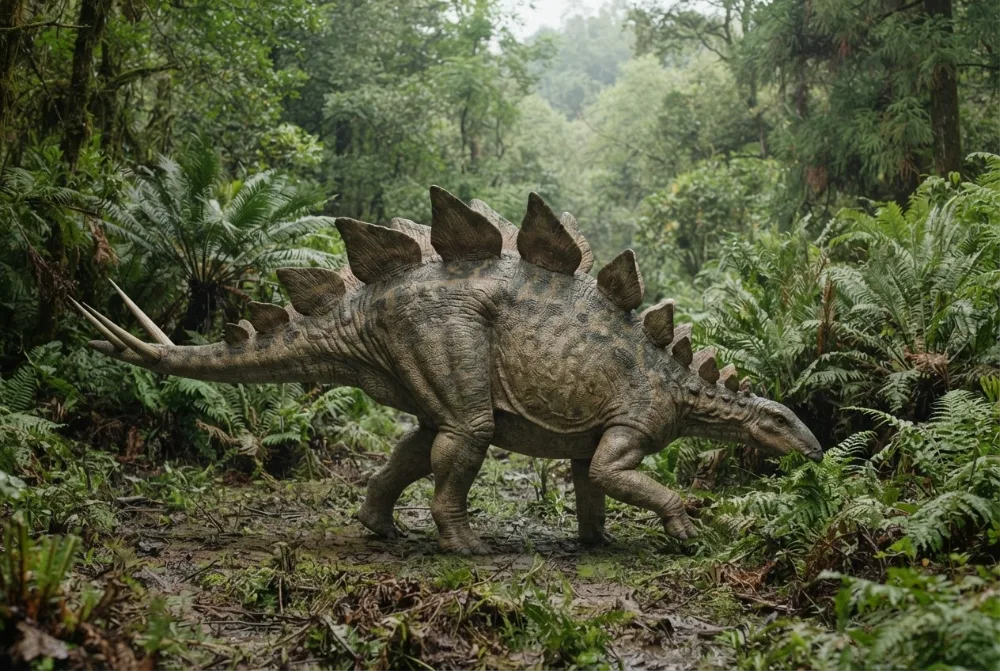
Tuojiangosaurus had about 17 pairs of plates and spikes along its back and tail.2
The spikes at the end of its tail pointed outward at about 45 degrees and are called a 'thagomizer'.2
Unlike Stegosaurus, the plates on Tuojiangosaurus were parallel to each other, not alternating.2
Its front legs were quite short compared to its back legs.2
Tuojiangosaurus lived during the Late Jurassic, about 157 to 154 million years ago.1
The first fossil was found in 1974 during construction of a dam in Zigong, Sichuan.2
Eyona mibuzo ibuzwa kakhulu: Tuojiangosaurus
?How big was Tuojiangosaurus?
It was about 6.5 to 7 metres long (21 to 23 feet) and weighed around 2.8 metric tons (3.1 short tons).2
?What did Tuojiangosaurus eat?
It ate low-lying plants like ferns, horsetails, and cycads. It had small snipping teeth and a beaked mouth for plucking vegetation.21
?Did Tuojiangosaurus have a thagomizer?
Yes, it had at least two spikes on each side of its tail tip, pointing outward at about 45 degrees. This spike cluster is called a thagomizer.2
?Where was Tuojiangosaurus found?
Its fossils were discovered in Sichuan Province, China, in 1974 during construction of the Wujiaba dam.2
?Could Tuojiangosaurus stand on its hind legs?
Probably not. Its backbone lacked the special vertebrae needed to rear up, so it likely only ate plants close to the ground.4
?How many plates did Tuojiangosaurus have?
It had about 17 pairs of plates and spikes running along its back and tail. The plates were parallel to each other, unlike Stegosaurus.2
Kwiingcali zeedayinaso
- Igama lenzululwazi
- Tuojiangosaurus
- Inikwe igama ngu:
- Dong et al. 19775
- Iqela
- Iidayinaso ezinamacwecwe
- Usapho / iclade
- Stegosauridae5
- Ukuhlelwa
- Ornithischia > Stegosauria > Thyreophora5
- Ubudala bamatye
- 168 ukuya ku-162 izigidi zeminyaka (Bathonian / Callovian)5
- Izakhiwo zamatye
- Shaximiao5
- Amazwe
- iTshayina5
- Iirekhodi zeefosili
- 1 kwi-Paleobiology Database5
- Ukufunyanwa
- Tuojiangosaurus was named and described in 1977 by Dong Zhiming, Zhou Shiwu, Li Xuanmin and Chang Yijong, exactly 100 years after Stegosaurus was named. The holotype skeleton is one of the most complete stegosaur skeletons found in Asia.2
- Kusaxoxwa ngayo
- Scientists are not sure exactly where Tuojiangosaurus fits in the stegosaur family tree. Some studies place it outside Stegosauridae, while others group it with Huayangosaurus.2
Apho iinyani zivela khona
- Tuojiangosaurus | Natural History Museum (nhm.ac.uk)
- Tuojiangosaurus (en.wikipedia.org)
- Tuojiangosaurus - Wikidata (wikidata.org)
- Tuojiangosaurus | Earth and Atmospheric Sciences | Research Starters | EBSCOhost (ebsco.com)
- Tuojiangosaurus in The Paleobiology Database (CC BY 4.0): ubudala, iindawo, izakhiwo zamatye, ukuhlelwa.
Yonke inyani ekweli phepha inenombolo ebonisa umthombo wayo. Ukuba siphosisile, uxolo, sithanda iidayinaso, asiyojenali yenzululwazi. Sixelele apha: [email protected], siya kuyilungisa.
 URex ulambile! I-Dino Wiki yiprojekthi katata ukwenzela unyana wakhe othanda iidayinaso, isimahla, ayinazintengiso, ayinazilandeli. Abantu abadala banokuphakela uRex isidlwana ukuze incede ihlale kwi-intanethi.Phakela uRex
 Stegosaurus
 Diracodon
 Hypsirophus
 Dacentrurus
 Miragaia
 Kentrosaurus
 Ichthyosaurus
 Khudiakovia
 Ophthalmosaurus
 Pterodactylus
 Peloneustes
 Rhamphocephalus