 Uyiyiphi idayinaso? Ikwizi
 Idabi leedayinaso
 Ugqatso lweedayinaso
 Imidlalo emincinci yeedayinaso
 I-albhamu yezitikha
 Iilisti ze-TOP zeedayinaso
 Ndothuse!
Zhongjianornis
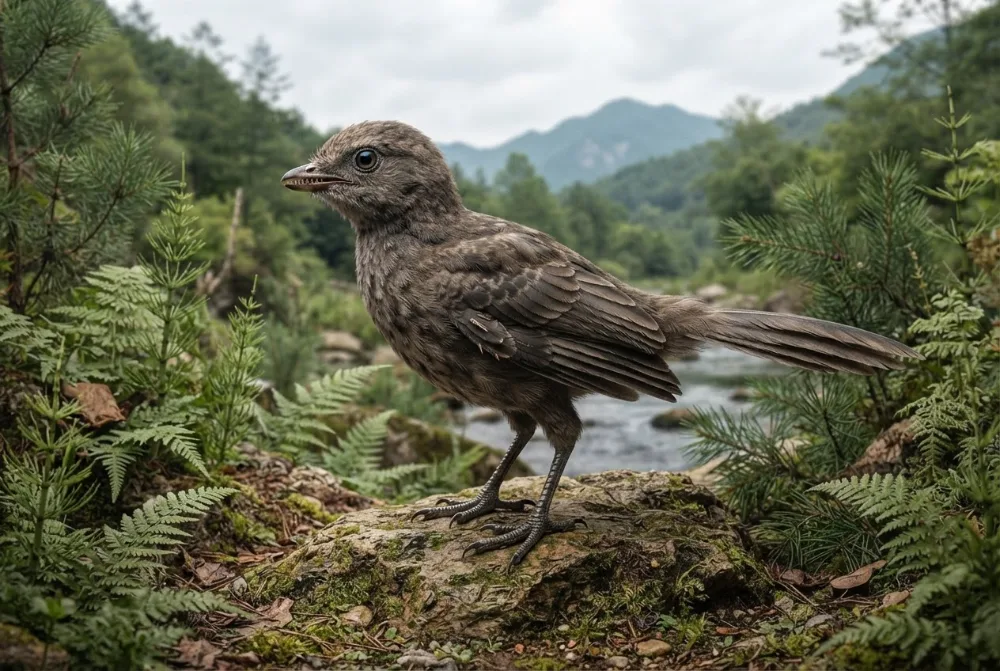
Zhongjianornis was a pigeon-sized bird that lived in China during the Early Cretaceous, about 120 million years ago. It had a toothless beak and strong wing muscles, making it a good flier. This little bird helps scientists understand how early birds evolved and lost their teeth.12
Yaphila nini?
Yayinkulu kangakanani?
Yayinde kangakanani?
Yayiphakame kangakanani?
uqikelelo
Yayinzima kangakanani?
Zhongjianornis wayemkhulu kangakanani xa ethelekiswa NAWE?
Yimathematika nje kwibhrawuza yakho. Akukho nto igcinwayo okanye ithunyelwe naphi na.
Yayikhawuleza kangakanani?


Iinyani ezimnandi
Zhongjianornis is one of the most primitive birds known to have completely lost its teeth, developing a beak instead.2
Its humerus had a large, robust deltopectoral crest, which was as wide as the bone shaft and more than one-third the total length of the humerus, indicating strong flight muscles.3
The only known fossil of Zhongjianornis is a nearly complete skeleton with some poorly preserved feather imprints.3
Zhongjianornis lived during the Aptian age of the Early Cretaceous, about 121 to 113 million years ago.3
Scientists initially thought Zhongjianornis was very primitive, but later research in 2012 suggested it was more similar to advanced euornithean birds like Chaoyangia.1
The species name yangi honors Yang Zhongjian, the founder of the Institute of Vertebrate Paleontology and Paleoanthropology in Beijing.1
Eyona mibuzo ibuzwa kakhulu: Zhongjianornis
?How big was Zhongjianornis?
About the size of a pigeon. It was a small bird.1
?Did Zhongjianornis have teeth?
No, it had a toothless beak. It is one of the most primitive birds known to have completely lost its teeth.12
?What did Zhongjianornis eat?
Scientists are not sure, but its toothless beak suggests it may have eaten seeds or small insects.1
Inyaniso ngeentsomi
Intsomi: Zhongjianornis was the most primitive toothless bird.
Inyaniso: While initially thought to be very primitive, later analysis in 2012 showed that Zhongjianornis is more closely related to advanced euornithean birds, not the most primitive.1
Kwiingcali zeedayinaso
- Igama lenzululwazi
- Zhongjianornis
- Inikwe igama ngu:
- Zhou et al. 20104
- Iqela
- Iintaka zokuqala
- Usapho / iclade
- Ornithuromorpha4
- Ukuhlelwa
- Theropoda > Avialae4
- Ubudala bamatye
- 121 ukuya ku-113 izigidi zeminyaka (Aptian)4
- Izakhiwo zamatye
- Jiufotang4
- Amazwe
- iTshayina4
- Iirekhodi zeefosili
- 1 kwi-Paleobiology Database4
- Ukufunyanwa
- Zhongjianornis was named and described by Zhou, Zhang, and Li in a paper published in January 2010 (though it appeared online in 2009). The only fossil, a nearly complete skeleton, was found at Jianchang in Liaoning Province, China.12
- Kusaxoxwa ngayo
- Scientists still debate whether Zhongjianornis was a very primitive bird or a more advanced euornithean, due to conflicting interpretations of its fossil's anatomy.1
Apho iinyani zivela khona
- Zhongjianornis (en.wikipedia.org)
- A new Lower Cretaceous bird from China and tooth reduction in early avian evolution (royalsocietypublishing.org)
- PBDB Taxon (paleobiodb.org)
- Zhongjianornis in The Paleobiology Database (CC BY 4.0): ubudala, iindawo, izakhiwo zamatye, ukuhlelwa.
Yonke inyani ekweli phepha inenombolo ebonisa umthombo wayo. Ukuba siphosisile, uxolo, sithanda iidayinaso, asiyojenali yenzululwazi. Sixelele apha: [email protected], siya kuyilungisa.
 URex ulambile! I-Dino Wiki yiprojekthi katata ukwenzela unyana wakhe othanda iidayinaso, isimahla, ayinazintengiso, ayinazilandeli. Abantu abadala banokuphakela uRex isidlwana ukuze incede ihlale kwi-intanethi.Phakela uRex
 Archaeopteryx
 Hesperornis
 Ichthyornis
 Baptornis
 Jurapteryx
 Gobipteryx
 Stegosaurus
 Iguanodon
 Giganotosaurus
 Microraptor
 Deinonychus
 Baryonyx