 Woyɛ dino bɛn? Nsɛmmisa agoro
 Dino ko
 Dino mmirikatuo
 Dino agodie nketewa
 Stika nwoma
 Dino TOP nhyehyɛeɛ
 Ma me nwanwa!
Douzhanopterus
Douzhanopterus was a small flying reptile that lived during the Jurassic Period. It had a tail that was shorter than older pterosaurs but longer than later ones, making it a link between the two groups.21
Berɛ bɛn na ɛtenaa ase?
Na ne kɛseɛ yɛ sɛn?
Na ne ntaban trɛ sɛn?
Douzhanopterus kɛseɛ yɛ sɛn sɛ wode toto WO ho a?
Akontaa nko ara wɔ wo browser mu. Yɛnkora biribiara so, na yɛmmfa biribiara nkɔ baabiara.
Na ɛyɛ ntɛm sɛn?


Nsɛm a ɛyɛ anigye
Douzhanopterus had a tail that was 173% the length of its upper arm bone (humerus), which is shorter than older pterosaurs but still longer than later pterodactyloids.2
Its fifth toe on the foot was reduced, with the first toe bone only about 20% the length of the third foot bone.2
The only known fossil of Douzhanopterus is a skeleton without a skull, stored at the Shandong Tianyu Museum of Nature in China.1
Douzhanopterus lived about 160 to 161 million years ago, during the Oxfordian stage of the Jurassic Period.2
Its name comes from a Chinese legend: Douzhan refers to a Buddha title given to the Monkey King Sun Wukong.1
Douzhanopterus is considered a transitional form, meaning it shows features between older long-tailed pterosaurs and newer short-tailed pterodactyloids.2
The fossil was bought from a local farmer who said it came from Toudaoyingzi, but scientists think it actually came from Linglongta in Liaoning, China.1
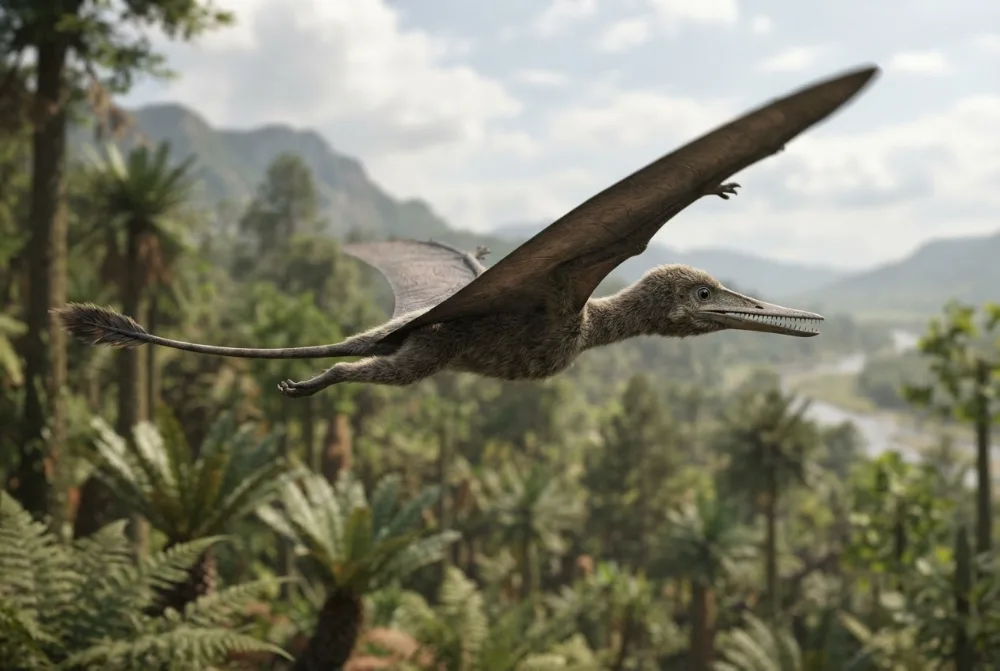
Ma dino ho animdefoɔ
- Nyansahu din
- Douzhanopterus
- Obi a ɔtoo din
- Wang et al. 20174
- Kuo
- Wim mmoa a wɔwea
- Abusua / kuo kɛseɛ
- Monofenestrata4
- Nkyekyɛmu
- Pterosauria4
- Abotan no mfeɛ
- mfeɛ ɔpepem 168 kɔsi 152 (Bathonian / Kimmeridgian)4
- Abotan nhyehyɛeɛ
- Tiaojishan4
- Aman
- Kyaena4
- Fɔsil nkyerɛwee
- 1 wɔ The Paleobiology Database mu4
- Nhunumu
- Douzhanopterus was named in 2017 by Wang Xiaoli and colleagues. The only known fossil was bought from a local farmer and is now stored at the Shandong Tianyu Museum of Nature.1
- Wɔda so gye ho akyinnye
- Scientists are not sure exactly how Douzhanopterus is related to other pterosaurs, but it is thought to be a close relative of the group that led to pterodactyloids.2
Baabi a nsɛm no firi
- Douzhanopterus (en.wikipedia.org)
- New evidence from China for the nature of the pterosaur evolutionary transition | Scientific Reports (nature.com)
- PBDB Taxon (paleobiodb.org)
- Douzhanopterus in The Paleobiology Database (CC BY 4.0): mfeɛ, mmeaeɛ, abotan nhyehyɛeɛ, nkyekyɛmu.
Asɛm biara a ɛwɔ krataafa yi so wɔ nɔma a ɛkyerɛ baabi a ɛfiri. Sɛ yɛfom biribi a, kafra, yɛyɛ dino dɔfoɔ, yɛnyɛ nyansahu nsɛmma krataa. Ka kyerɛ yɛn wɔ [email protected] na yɛbɛsiesie.
 Ɔkɔm de Rex! Dino Wiki yɛ agya bi adwuma a ɔyɛɛ maa ne babarima a ɔdɔ dino. Ɛyɛ kwa, dawurubɔ biara nni mu, akyidifoɔ biara nni mu. Mpanimfoɔ bɛtumi ama Rex aduane kakra, na aboa ama Dino Wiki atena intanɛt so.Ma Rex aduane
 Pteranodon
 Quetzalcoatlus
 Dorygnathus
 Rhamphorhynchus
 Anhanguera
 Pterodactylus
 Brachiosaurus
 Diplodocus
 Allosaurus
 Brontosaurus
 Compsognathus
 Camarasaurus