 Woyɛ dino bɛn? Nsɛmmisa agoro
 Dino ko
 Dino mmirikatuo
 Dino agodie nketewa
 Stika nwoma
 Dino TOP nhyehyɛeɛ
 Ma me nwanwa!
Guidraco
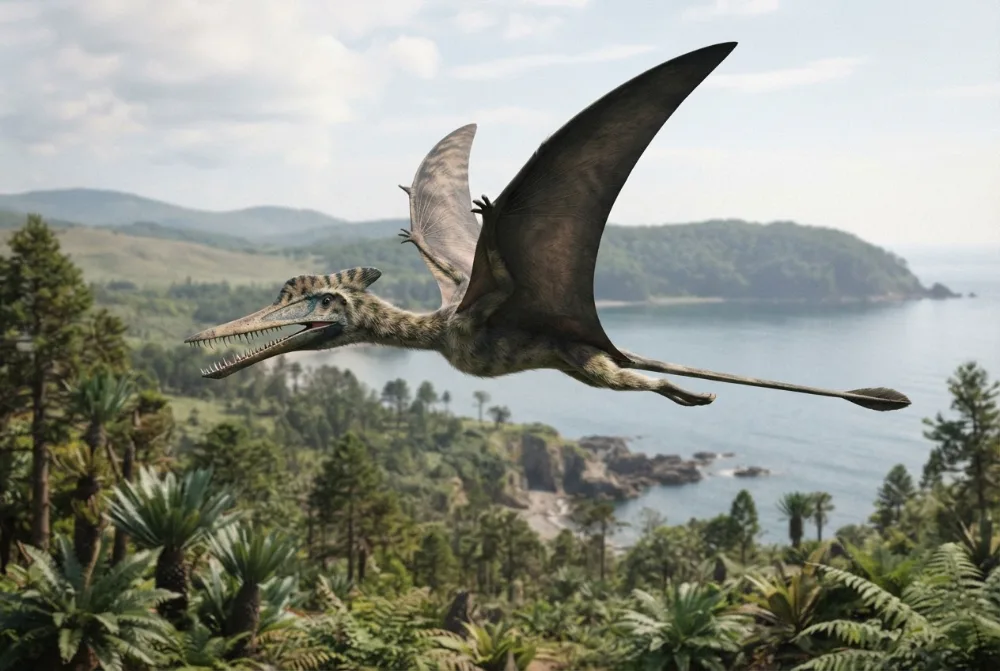
Guidraco was a flying reptile with a scary name meaning 'malicious ghost dragon'. It had a long beak full of sharp teeth that stuck out in all directions, perfect for snatching fish from the water.1
Berɛ bɛn na ɛtenaa ase?
Na ɛyɛ ntɛm sɛn?


Nsɛm a ɛyɛ anigye
Guidraco had 82 teeth in its head, with the front ones being very long and sticking out far beyond the beak.1
The first tooth in the upper jaw pointed almost straight forward, like a spear.1
Guidraco lived about 120 million years ago during the Early Cretaceous period.1
Its neck vertebrae had large holes that let air sacs enter the bones, making them lighter for flight.1
Guidraco is closely related to Ludodactylus, a pterosaur from Brazil, showing that pterosaurs moved between continents.1
The only fossil found so far is a partial skeleton including a nearly complete skull and neck bones.1
Nsɛm a wɔbisa bebree fa Guidraco ho
?How big was Guidraco?
Its skull was about 38 centimetres (15 inches) long. The rest of its body is not fully known, so its total size is an estimate.1
?What did Guidraco eat?
It ate fish. Its long, interlocking front teeth worked like a trap to grab slippery fish.1
?Where was Guidraco found?
It was found in Liaoning Province, northeast China, in the Jiufotang Formation.1
?Is Guidraco a dinosaur?
No, Guidraco is a pterosaur, a flying reptile that lived alongside dinosaurs but is not a dinosaur.1
?Why is it called Guidraco?
Its name means 'malicious ghost dragon' in Chinese and Latin. 'Gui' means ghost in Chinese, and 'draco' means dragon in Latin.1
?Did Guidraco have a crest?
Yes, it had a large, rounded crest on top of its skull, above the eye sockets. It pointed slightly forward.1
Ma dino ho animdefoɔ
- Nyansahu din
- Guidraco
- Obi a ɔtoo din
- Wang et al. 20122
- Kuo
- Wim mmoa a wɔwea
- Abusua / kuo kɛseɛ
- Ornithocheiroidea2
- Nkyekyɛmu
- Pterosauria > Pterodactyloidea2
- Abotan no mfeɛ
- mfeɛ ɔpepem 121 kɔsi 113 (Aptian)2
- Abotan nhyehyɛeɛ
- Jiufotang2
- Aman
- Kyaena2
- Fɔsil nkyerɛwee
- 1 wɔ The Paleobiology Database mu2
- Nhunumu
- Guidraco was named in 2012 by Wang Xiaolin, Alexander W.A. Kellner, Jiang Shunxing, and Xin Cheng. The fossil was found in the Jiufotang Formation in Liaoning, China.12
- Wɔda so gye ho akyinnye
- Scientists are not sure whether Guidraco belongs to the Anhangueridae family or the Boreopteridae family.1
Baabi a nsɛm no firi
- Guidraco (en.wikipedia.org)
- Guidraco in The Paleobiology Database (CC BY 4.0): mfeɛ, mmeaeɛ, abotan nhyehyɛeɛ, nkyekyɛmu.
Asɛm biara a ɛwɔ krataafa yi so wɔ nɔma a ɛkyerɛ baabi a ɛfiri. Sɛ yɛfom biribi a, kafra, yɛyɛ dino dɔfoɔ, yɛnyɛ nyansahu nsɛmma krataa. Ka kyerɛ yɛn wɔ [email protected] na yɛbɛsiesie.
 Ɔkɔm de Rex! Dino Wiki yɛ agya bi adwuma a ɔyɛɛ maa ne babarima a ɔdɔ dino. Ɛyɛ kwa, dawurubɔ biara nni mu, akyidifoɔ biara nni mu. Mpanimfoɔ bɛtumi ama Rex aduane kakra, na aboa ama Dino Wiki atena intanɛt so.Ma Rex aduane
 Pteranodon
 Quetzalcoatlus
 Dorygnathus
 Rhamphorhynchus
 Anhanguera
 Pterodactylus
 Stegosaurus
 Iguanodon
 Archaeopteryx
 Giganotosaurus
 Microraptor
 Deinonychus