 Home
 All dinos
 Dino groups
 Explore
 Dinos by country
 Dino vs dino
 How big were they?
 Dinos A to Z
 Who ate what?
 What dino are you? Quiz
 Dino games
 Dino battle
 Dino race
 Dino mini-games
 Sticker album
 Dino TOP lists
 Timeline
 Surprise me!
 Language: English

Albertonectes
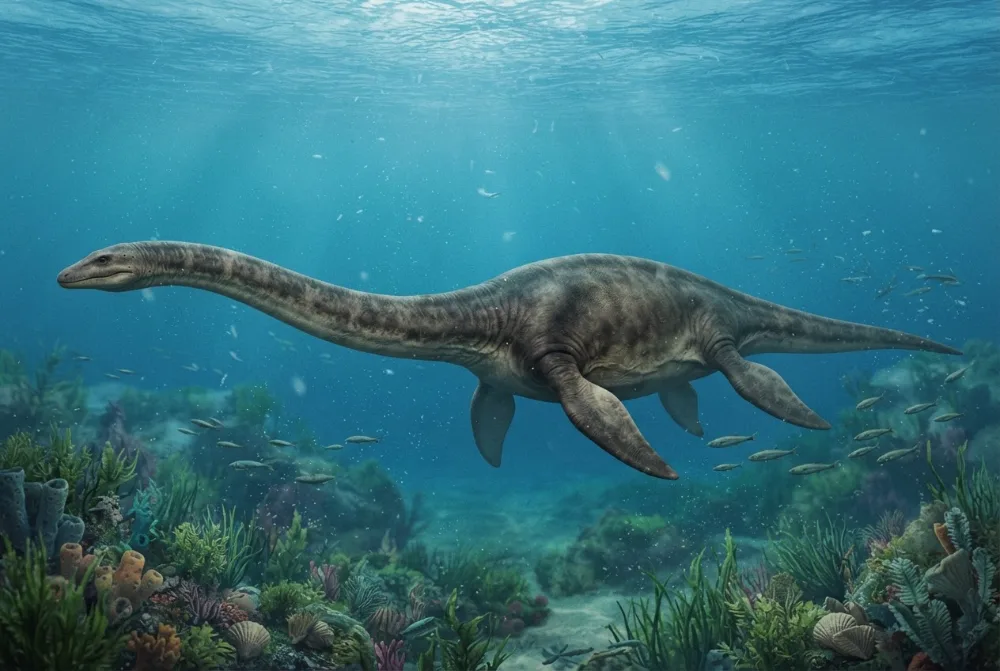
Albertonectes was a huge marine reptile that lived in the sea, not a dinosaur. It had an incredibly long neck, longer than a school bus, and swam with four flippers like paddles.12
 Canada
When did it live?
Albertonectes: 84 to 72 million years ago
How big was it?
How long was it?
How heavy was it?
 as long as 2.5 cars parked in a row🍌as long as 67 bananas end to end
 about as heavy as an elephant🍉as heavy as 960 watermelons🎒as heavy as 6 whole school classes of kids🐻❄️as heavy as 11 polar bears🏊could swim the length of a big swimming pool (50 m) in 8.2 seconds
How big was Albertonectes compared to YOU?
Just maths in your browser. Nothing is saved or sent anywhere.
How fast was it?


Fun facts
Albertonectes had 76 neck bones, more than any other known animal. Its neck was about 7 metres (23 feet) long.12
Its fossils were discovered by accident in 2007 during ammolite mining. An excavator broke part of the skeleton, and some stomach stones were lost.12
Albertonectes lived in the Western Interior Seaway, a huge inland sea that stretched from the Gulf of Mexico to the Arctic Ocean.2
No skull of Albertonectes has ever been found, so scientists can only guess what its head looked like based on other elasmosaurs.12
Over 97 stomach stones were found with the skeleton, but they are too small to help with buoyancy or digestion. Scientists are still not sure why plesiosaurs swallowed stones.12
Albertonectes was a plesiosaur, not a dinosaur. Dinosaurs lived on land, while plesiosaurs were air-breathing reptiles that lived in the sea.2
Most asked questions about Albertonectes
?How big was Albertonectes?
Albertonectes was about 12.1 metres (40 feet) long and weighed around 4.8 metric tons (5.3 short tons). Its neck alone was about 7 metres (23 feet) long.12
?Was Albertonectes a dinosaur?
No, Albertonectes was a plesiosaur, a marine reptile that lived in the sea. Dinosaurs lived on land.2
?What did Albertonectes eat?
Scientists think Albertonectes ate small fish and other small sea animals, like other elasmosaurs. Its skull and teeth have never been found.2
?How many neck bones did Albertonectes have?
Albertonectes had 76 neck bones, more than any other known animal. That is why its neck was so long.12
?When did Albertonectes live?
Albertonectes lived about 73.5 million years ago, during the Late Cretaceous period.1
Myth buster
Myth: Albertonectes was a dinosaur.
Truth: Albertonectes was a plesiosaur, a marine reptile that lived in the ocean, not a dinosaur. Dinosaurs were land animals.2
For dino experts
- Scientific name
- Albertonectes
- Named by
- Kubo et al. 20124
- Group
- Plesiosaurs
- Family / clade
- Elasmosauridae4
- Classification
- Plesiosauria > Elasmosauridae > Sauropterygia4
- Age of the rocks
- 84 to 72 million years (Campanian)4
- Rock formations
- Bearpaw Shale4
- Countries
- Canada4
- Fossil records
- 1 in the Paleobiology Database4
- Discovery
- The only known skeleton was found in 2007 by an ammolite mining company near Lethbridge, Alberta, Canada. It was named Albertonectes vanderveldei in 2012 by paleontologist Tai Kubo and his team.12
- Still debated
- Scientists are not sure why Albertonectes swallowed so many stomach stones, since they are too small to help with buoyancy or digestion.2
Where the facts come from
- Albertonectes (en.wikipedia.org)
- Albertonectes | The Canadian Encyclopedia (thecanadianencyclopedia.ca)
- PBDB Taxon (paleobiodb.org)
- Albertonectes in The Paleobiology Database (CC BY 4.0): age, places, rock formations, classification.
Every fact on this page has a number that points to its source. If we got something wrong, sorry, we are dino fans, not a science journal. Tell us at hello@dinowiki.app and we will fix it.
 Rex is hungry! Dino Wiki is a dad's project for his dino-loving son, free with no ads and no cookies. Grown-ups can feed Rex a snack to help keep it online.Feed Rex
 Elasmosaurus
 Pliosaurus
 Plesiosaurus
 Cimoliasaurus
 Colymbosaurus
 Trinacromerum
 Tyrannosaurus
 Triceratops
 Velociraptor
 Spinosaurus
 Ankylosaurus
 Parasaurolophus