
Alexandronectes
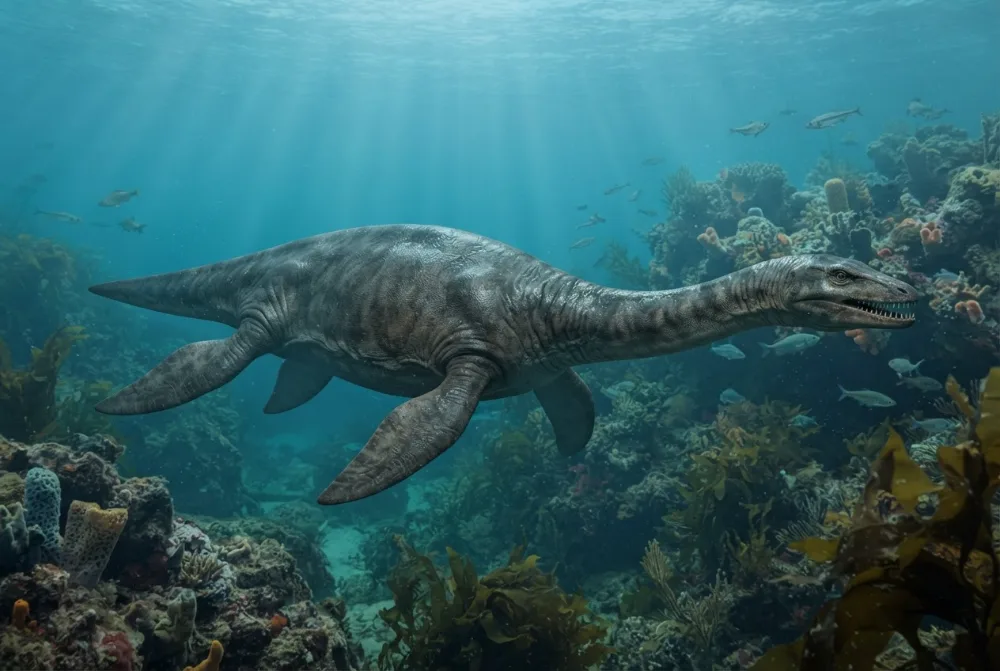
Alexandronectes was a long-necked marine reptile that swam in the seas around New Zealand near the end of the Age of Dinosaurs. It was a type of plesiosaur called an elasmosaurid, with a big head and a short neck compared to other elasmosaurids. It used its strong flippers to paddle through the water and hunt for fish and squid.12
When did it live?
Fun facts
Alexandronectes was a type of plesiosaur called an aristonectine, a group known for having unusually large skulls compared to other elasmosaurids.1
Its skull was smaller than those of other aristonectines like Kaiwhekea and Aristonectes, showing that not all members of this group were giants.1
The fossils of Alexandronectes were collected in 1872 by Alexander McKay, a famous New Zealand fossil hunter, but scientists did not name the animal until 2016.13
Its name means 'Alexander's swimmer from Zealandia', referring to the ancient continent that New Zealand is part of.1
Alexandronectes lived about 70 million years ago, during the early Maastrichtian stage of the Late Cretaceous.13
The only known fossils are two pieces of the back of the skull, which were originally thought to belong to two different animals.1
Most asked questions about Alexandronectes
?Was Alexandronectes a dinosaur?
No, it was a plesiosaur, a type of long-necked marine reptile that lived in the oceans, not a dinosaur.3
?How big was Alexandronectes?
Scientists do not know its exact size because only parts of its skull have been found. Its skull was smaller than those of other aristonectines like Kaiwhekea and Aristonectes.31
?What did Alexandronectes eat?
It likely ate fish and squid, using its strong flippers to paddle through the water and hunt.3
Ask Rex about Alexandronectes
Rex only answers questions about this page. 3 questions a day.
Rex is an AI and can make mistakes. He runs on servers in the EU and questions are never saved. Never type your name or other personal things.
For dino experts
- Scientific name
- Alexandronectes
- Named by
- Otero et al. 20164
- Group
- Plesiosaurs
- Family / clade
- Elasmosauridae4
- Classification
- Plesiosauria > Elasmosauridae > Sauropterygia4
- Age of the rocks
- 84 to 66 million years (Campanian / Maastrichtian)4
- Rock formations
- Conway4
- Countries
- New Zealand4
- Fossil records
- 1 in the Paleobiology Database4
- Discovery
- The fossils were found in 1872 by Alexander McKay near the Waipara River in New Zealand. They were stored at the Canterbury Museum for over 140 years before being studied and named Alexandronectes zealandiensis in 2016.13
- Still debated
- Scientists are not sure exactly how big Alexandronectes was, because only a partial skull has been found.1
Where the facts come from
- UJVP_A_1054494_O (sedici.unlp.edu.ar)
- PBDB Taxon (paleobiodb.org)
- Alexandronectes (en.wikipedia.org)
- Alexandronectes in The Paleobiology Database (CC BY 4.0): age, places, rock formations, classification.
Every fact on this page has a number that points to its source. If we got something wrong, sorry, we are dino fans, not a science journal. Tell us at [email protected] and we will fix it.
 Rex is hungry! Dino Wiki is a dad's project for his dino-loving son, free with no ads. Grown-ups can feed Rex a snack to help keep it online.Feed Rex
 Elasmosaurus
 Pliosaurus
 Plesiosaurus
 Cimoliasaurus
 Colymbosaurus
 Trinacromerum
 Tyrannosaurus
 Triceratops
 Velociraptor
 Spinosaurus
 Ankylosaurus
 Parasaurolophus