
Argentinonectes
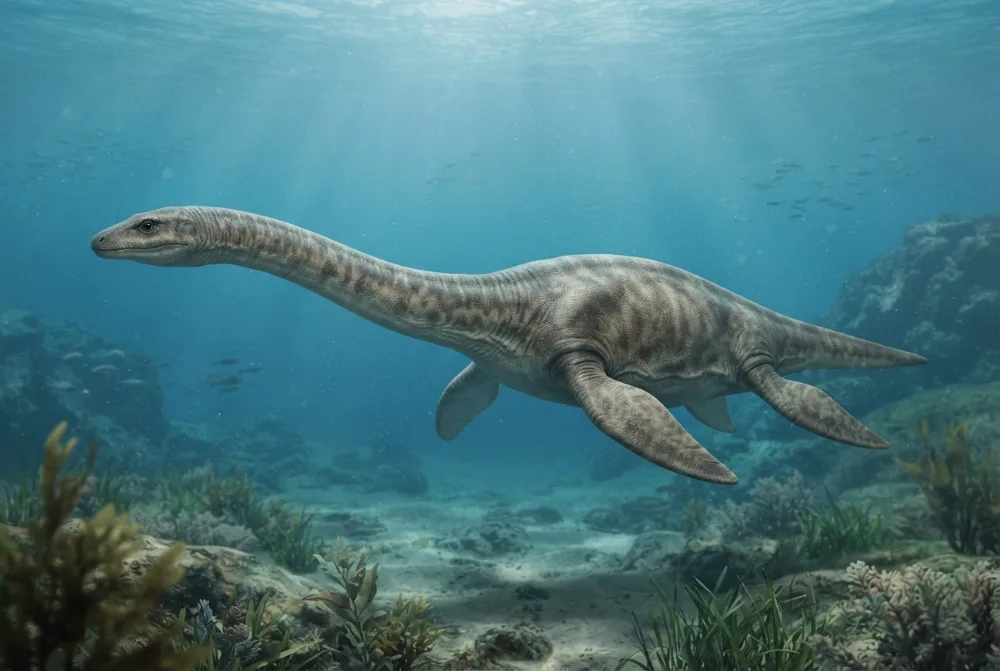
Argentinonectes was a huge, long-necked marine reptile that swam in the seas near Antarctica 66 million years ago. It had four flipper-like legs and a stiff tail that may have had a fin on the end. This plesiosaur is the most complete one ever found in Argentina!1
When did it live?
How big was it?
How long was it?
How big was Argentinonectes compared to YOU?
Just maths in your browser. Nothing is saved or sent anywhere.
Fun facts
The fossil was found under 50 cm (20 inches) of water in Lake Argentino, making it tricky to dig out.1
Its rib cage and belly bones were very stiff, which helped it dive without its lungs collapsing.1
Shark teeth and scratches on its bones show that sharks ate the dead plesiosaur's body.1
The tail had eight tightly locked vertebrae at the tip, probably supporting a small tail fin.1
Its forelimbs were about 1.8 metres (5.9 feet) long, and the hindlimbs were a bit shorter at 1.3 metres (4.3 feet).1
The skeleton is missing the skull and most of the neck, possibly because they floated away after death.1
Most asked questions about Argentinonectes
?How big was Argentinonectes?
It was about 7 to 9 metres (23 to 30 feet) long. That is roughly as long as a school bus.1
?What did Argentinonectes eat?
Scientists do not know for sure because the skull is missing. But like other plesiosaurs, it probably ate fish and squid.1
?When did Argentinonectes live?
It lived at the very end of the Cretaceous Period, about 66 million years ago.1
?Is Argentinonectes a dinosaur?
No, it is a plesiosaur, a marine reptile that swam in the ocean. It is not a dinosaur.1

Ask Rex about Argentinonectes
Rex only answers questions about this page. 3 questions a day.
Rex is an AI and can make mistakes. He runs on servers in the EU and questions are never saved. Never type your name or other personal things.
Myth buster
Myth: Some people think all plesiosaurs were slow and clumsy on land.
Truth: Argentinonectes and other plesiosaurs were fully aquatic and never came onto land. They were fast swimmers in the ocean.1
For dino experts
- Scientific name
- Argentinonectes
- Named by
- Novas et al. 20263
- Group
- Plesiosaurs
- Family / clade
- Elasmosauridae3
- Classification
- Plesiosauria > Elasmosauridae > Sauropterygia3
- Age of the rocks
- 72 to 66 million years (Maastrichtian)3
- Rock formations
- Calafate3
- Countries
- Argentina3
- Fossil records
- 1 in the Paleobiology Database3
- Discovery
- The fossil was found in 2009 in Lake Argentino, Argentina, and was named Argentinonectes calafatensis by Fernando Novas and colleagues in 2026.1
- Still debated
- Scientists are not sure why the skull and neck are missing. They may have been eroded by waves or detached when the body bloated and floated.1
Where the facts come from
- Argentinonectes (en.wikipedia.org)
- PBDB Taxon (paleobiodb.org)
- Argentinonectes in The Paleobiology Database (CC BY 4.0): age, places, rock formations, classification.
Every fact on this page has a number that points to its source. If we got something wrong, sorry, we are dino fans, not a science journal. Tell us at [email protected] and we will fix it.
 Rex is hungry! Dino Wiki is a dad's project for his dino-loving son, free with no ads. Grown-ups can feed Rex a snack to help keep it online.Feed Rex
 Elasmosaurus
 Pliosaurus
 Plesiosaurus
 Cimoliasaurus
 Colymbosaurus
 Trinacromerum
 Tyrannosaurus
 Triceratops
 Velociraptor
 Spinosaurus
 Ankylosaurus
 Parasaurolophus