
Cardiocorax
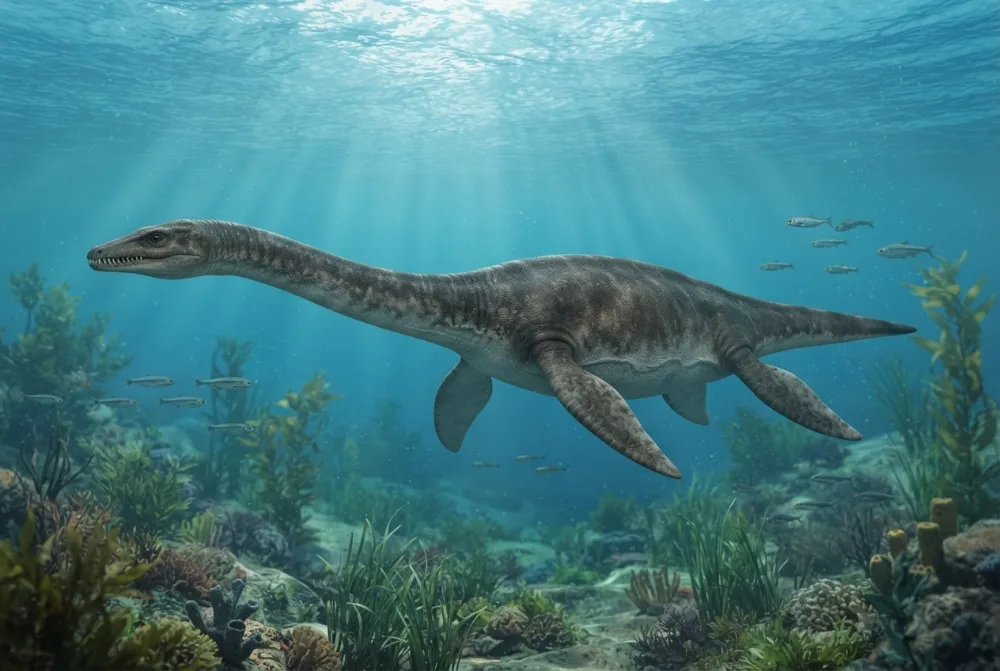
Cardiocorax was a long-necked marine reptile that swam in the seas near Africa 71 million years ago. It was not a dinosaur but a plesiosaur, with four flippers that helped it paddle through the water like a sea turtle. Scientists think it used a special rowing style to chase fish and other prey.12
When did it live?
Fun facts
Cardiocorax had a heart-shaped hole between its shoulder blades, which is why it is named 'heart raven'.1
Its shoulder blade had a very small upper part, unlike other elasmosaurids. This helped it swim with a special rowing motion.2
The first fossils of Cardiocorax were found in 2015 in Angola, Africa. They included a complete shoulder and hip girdle, neck bones, and part of a front flipper.1
A second specimen was found just 7 meters away from the first one. It had a more complete hip and a hind flipper.1
Cardiocorax lived about 71.4 to 71.6 million years ago, during the early Maastrichtian stage of the Late Cretaceous.1
Its species name 'mukulu' means 'ancestor' in Angolan Bantu languages.1
Cardiocorax is a type of elasmosaurid, a group of plesiosaurs with very long necks and small heads.1

Ask Rex about Cardiocorax
Rex only answers questions about this page. 3 questions a day.
Rex is an AI and can make mistakes. He runs on servers in the EU and questions are never saved. Never type your name or other personal things.
For dino experts
- Scientific name
- Cardiocorax
- Named by
- Araújo et al. 20154
- Group
- Plesiosaurs
- Family / clade
- Elasmosauridae4
- Classification
- Plesiosauria > Elasmosauridae > Sauropterygia4
- Age of the rocks
- 72 to 66 million years (Maastrichtian)4
- Rock formations
- Mocuio4
- Countries
- Angola4
- Fossil records
- 2 in the Paleobiology Database4
- Discovery
- Cardiocorax was named in 2015 by a team of scientists including Ricardo Araújo and Octávio Mateus. The fossils were found in the Mocuio Formation of Angola, Africa.13
- Still debated
- Scientists are still debating exactly how Cardiocorax used its flippers to swim, because its shoulder bones are different from other plesiosaurs.2
Where the facts come from
- Cardiocorax (en.wikipedia.org)
- S0016774614000444 109..120 (cambridge.org)
- PBDB Taxon (paleobiodb.org)
- Cardiocorax in The Paleobiology Database (CC BY 4.0): age, places, rock formations, classification.
Every fact on this page has a number that points to its source. If we got something wrong, sorry, we are dino fans, not a science journal. Tell us at [email protected] and we will fix it.
Rex is hungry! Dino Wiki is a dad's project for his dino-loving son, free with no ads. Grown-ups can feed Rex a snack to help keep it online.Feed Rex Elasmosaurus
 Pliosaurus
 Plesiosaurus
 Cimoliasaurus
 Colymbosaurus
 Trinacromerum
 Triceratops
 Velociraptor
 Spinosaurus
 Ankylosaurus
 Parasaurolophus