
Dolichorhynchops
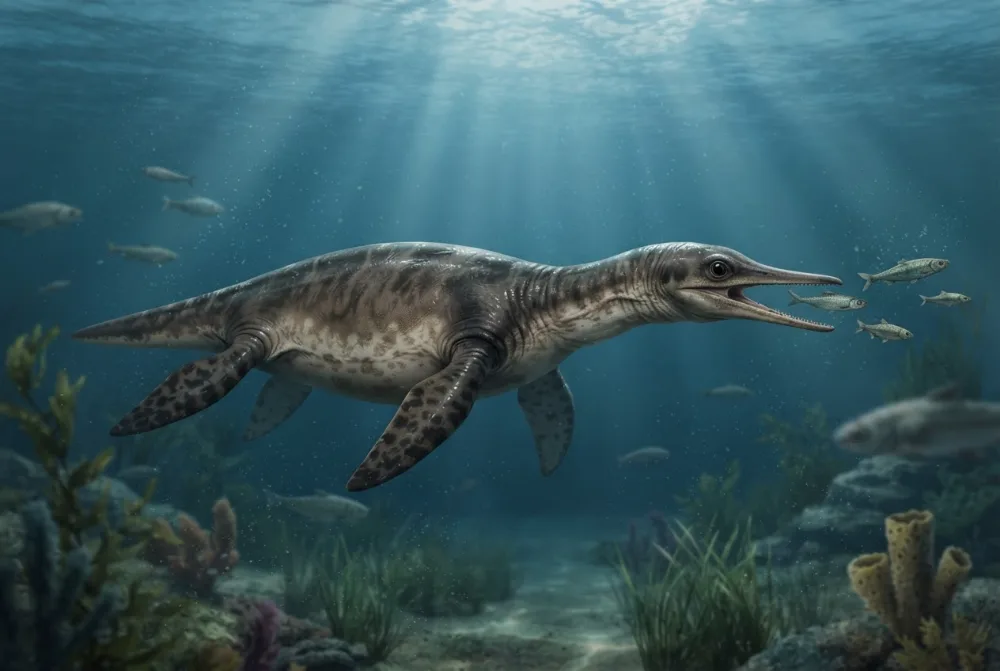
Dolichorhynchops was a small, fast-swimming marine reptile that lived in the Late Cretaceous seas. It had a long snout and a short neck, and it used its four flippers to chase after fish and squid.1
When did it live?
How big was it?
How long was it?
How heavy was it?
How big was Dolichorhynchops compared to YOU?
Just maths in your browser. Nothing is saved or sent anywhere.
Fun facts
Dolichorhynchops was a plesiosaur, but unlike the long-necked plesiosaurs, it had a short neck and a big head.1
The first fossil of Dolichorhynchops was found by a teenager, George Fryer Sternberg, in Kansas around 1900.1
Its name means 'long-nosed face' because of its long, narrow snout.1
Dolichorhynchops lived in the Western Interior Seaway, a shallow sea that split North America in two during the Cretaceous.1
Most asked questions about Dolichorhynchops
?How big was Dolichorhynchops?
Dolichorhynchops was a relatively small plesiosaur, measuring around 3 metres (9.8 ft) long. Some estimates range from 2.5 to 3 metres (8.2 to 9.8 ft).13
?What did Dolichorhynchops eat?
It ate fish and squid. Its long, narrow jaws were filled with sharp teeth to grab prey, which it swallowed whole.43
?Was Dolichorhynchops a dinosaur?
No, it was a marine reptile called a plesiosaur, not a dinosaur. It lived in the seas during the Late Cretaceous.14
?When did Dolichorhynchops live?
It lived during the Late Cretaceous, about 87 to 72 million years ago. Fossils are found in North America.1
?Could Dolichorhynchops swim fast?
Yes, it was a quick and agile swimmer. It used its long, paddle-like flippers to 'fly' through the water like a penguin.4
?Did Dolichorhynchops give birth to live young?
Yes, fossils have been found with unborn babies inside, strong evidence that it gave birth to live young.4

Ask Rex about Dolichorhynchops
Rex only answers questions about this page. 3 questions a day.
Rex is an AI and can make mistakes. He runs on servers in the EU and questions are never saved. Never type your name or other personal things.
For dino experts
- Scientific name
- Dolichorhynchops
- Named by
- Williston 19025
- Group
- Plesiosaurs
- Family / clade
- Polycotylidae5
- Classification
- Plesiosauria > Sauropterygia5
- Age of the rocks
- 94 to 66 million years (Turonian / Maastrichtian)5
- Rock formations
- Niobrara, Pierre Shale, Mesaverde5
- Countries
- USA, Canada, Poland, Russia5
- Fossil records
- 14 in the Paleobiology Database5
- Discovery
- The first specimen was found by teenage fossil hunter George Fryer Sternberg in Kansas around 1900. It was named Dolichorhynchops osborni by Samuel Wendell Williston in 1902.1
- Still debated
- Scientists still debate whether some large polycotylid specimens from Wyoming belong to Dolichorhynchops or to a different genus.1
Where the facts come from
- Dolichorhynchops (en.wikipedia.org)
- A new genus of small polycotylid plesiosaur from the Upper Cretaceous of the Western Interior Seaway and a clarification of the genus Dolichorhynchops (sciencedirect.com)
- Herschel Short-necked Plesiosaur (royalsaskmuseum.ca)
- Sea Monster Pictures, Dolichorhynchops Photos, Facts, Desktop Wallpaper, Animals Reports, News, Info - National Geographic | National Geographic (nationalgeographic.com)
- Dolichorhynchops in The Paleobiology Database (CC BY 4.0): age, places, rock formations, classification.
Every fact on this page has a number that points to its source. If we got something wrong, sorry, we are dino fans, not a science journal. Tell us at [email protected] and we will fix it.
 Rex is hungry! Dino Wiki is a dad's project for his dino-loving son, free with no ads. Grown-ups can feed Rex a snack to help keep it online.Feed Rex
 Elasmosaurus
 Pliosaurus
 Plesiosaurus
 Cimoliasaurus
 Colymbosaurus
 Trinacromerum
 Tyrannosaurus
 Triceratops
 Velociraptor
 Spinosaurus
 Ankylosaurus
 Parasaurolophus