
Eopolycotylus
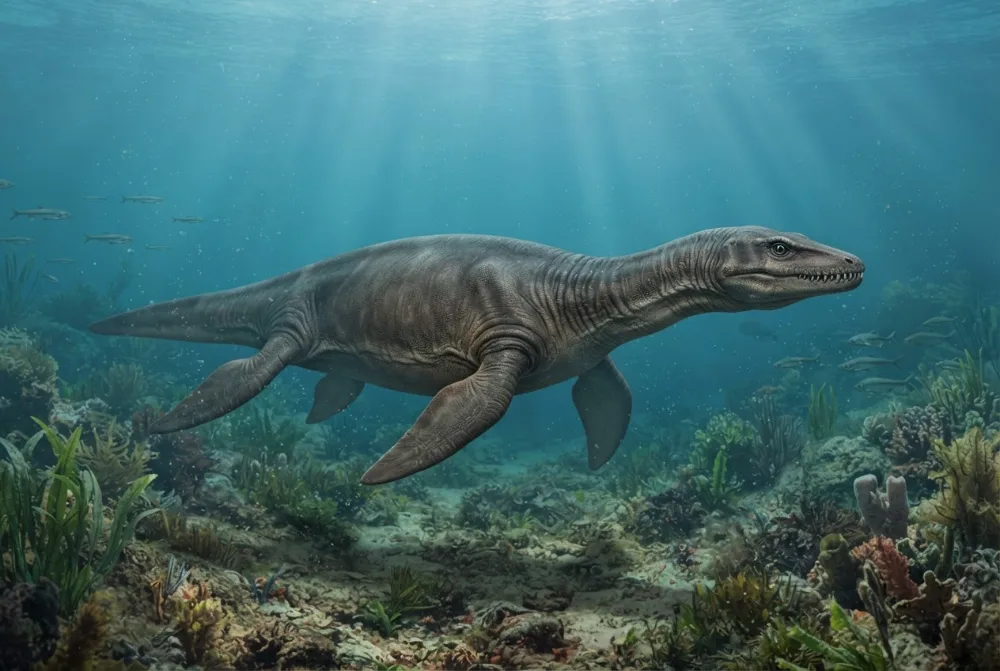
Eopolycotylus is a plesiosaur, a marine reptile that lived in the ocean during the time of dinosaurs. It had a long neck, a big body, and four flippers to swim. It was a fast hunter in the ancient seas of Utah.21
When did it live?
How big was it?
How long was it?
How heavy was it?
How big was Eopolycotylus compared to YOU?
Just maths in your browser. Nothing is saved or sent anywhere.
Fun facts
Eopolycotylus is a type of plesiosaur called a polycotylid, which had a short neck and a long snout.2
Its fossils were found in the Tropic Shale, a rock layer that formed from mud on an ancient seafloor about 91 million years ago.1
The only known specimen is a partial skeleton that includes parts of the skull, jaws, and flippers.1
Eopolycotylus lived during the Turonian stage of the Late Cretaceous, when the Western Interior Seaway covered much of central North America.1
It was a fast swimmer, using its four flippers to chase prey in the warm, shallow sea.2
Scientists think Eopolycotylus gave birth to live young in the water, just like modern whales and dolphins.1

Ask Rex about Eopolycotylus
Rex only answers questions about this page. 3 questions a day.
Rex is an AI and can make mistakes. He runs on servers in the EU and questions are never saved. Never type your name or other personal things.
For dino experts
- Scientific name
- Eopolycotylus
- Named by
- Albright et al. 20072
- Group
- Plesiosaurs
- Family / clade
- Polycotylidae2
- Classification
- Plesiosauria > Sauropterygia2
- Age of the rocks
- 94 to 90 million years (Turonian)2
- Rock formations
- Tropic Shale2
- Countries
- USA2
- Fossil records
- 1 in the Paleobiology Database2
- Discovery
- Eopolycotylus was named in 2007 by paleontologists Albright, Gillette, and Titus, based on a fossil found near Big Water, Utah.21
- Still debated
- Scientists are still unsure about the exact length and weight of Eopolycotylus because only one partial skeleton has been found.2
Where the facts come from
- PBDB Taxon (paleobiodb.org)
- Eopolycotylus in The Paleobiology Database (CC BY 4.0): age, places, rock formations, classification.
Every fact on this page has a number that points to its source. If we got something wrong, sorry, we are dino fans, not a science journal. Tell us at [email protected] and we will fix it.
 Rex is hungry! Dino Wiki is a dad's project for his dino-loving son, free with no ads. Grown-ups can feed Rex a snack to help keep it online.Feed Rex
 Elasmosaurus
 Pliosaurus
 Plesiosaurus
 Cimoliasaurus
 Colymbosaurus
 Trinacromerum
 Tyrannosaurus
 Triceratops
 Velociraptor
 Spinosaurus
 Ankylosaurus
 Parasaurolophus