
Gasparinisaura
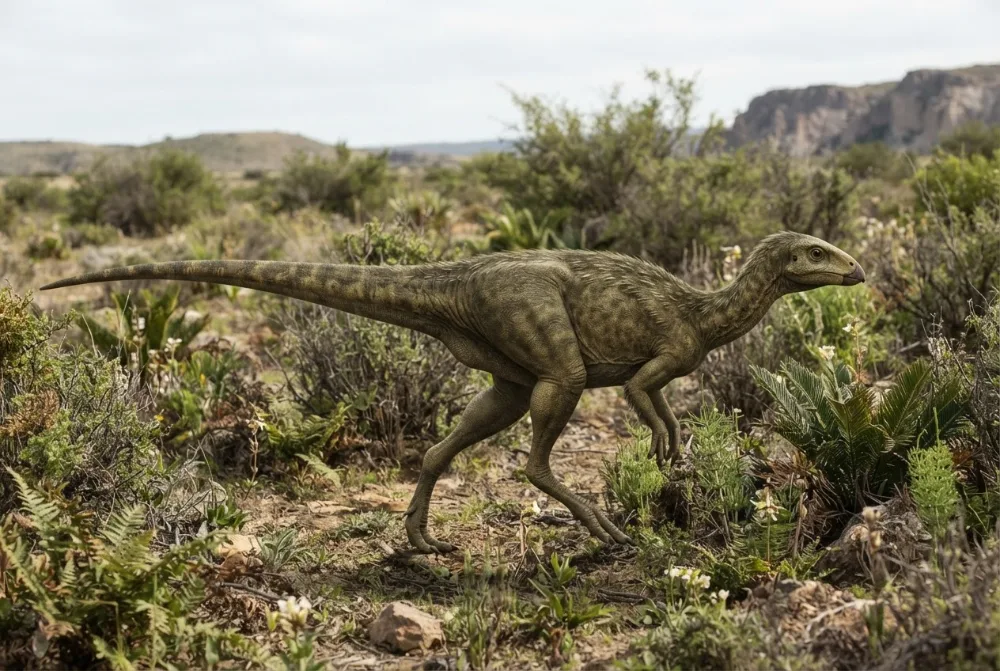
Gasparinisaura was a tiny, speedy plant-eater that lived in Argentina during the Late Cretaceous. It had a long tail with special triangular bones and swallowed little stones to help grind up tough plants in its stomach.1
When did it live?
How big was it?
How long was it?
How heavy was it?
How big was Gasparinisaura compared to YOU?
Just maths in your browser. Nothing is saved or sent anywhere.
How fast was it?
Fun facts
Gasparinisaura had a rounded head with very large eye sockets placed high on the skull.1
Its tail had low, plate-like triangular bones called chevrons that were expanded toward the back, a feature unique among euornithopods.1
Juvenile Gasparinisaura skeletons were found with clusters of up to 140 polished stones in their bellies, which acted as a gastric mill to grind food.1
The gastroliths made up about 0.3% of the dinosaur's body weight and were about 8 millimetres across on average.1
Gasparinisaura had long hindlimbs with a short thighbone and a long lower leg, making it a fast runner.1
Its first toe bone (metatarsal) was reduced to a splint, a specialized feature for running.1
Most asked questions about Gasparinisaura
?How big was Gasparinisaura?
Gasparinisaura was about 1.7 metres (5.6 ft) long and weighed about 13 kilograms (29 lb).1
?What did Gasparinisaura eat?
Gasparinisaura was a herbivore, meaning it ate plants. It swallowed small stones to help grind up tough plant material in its stomach.12
?When did Gasparinisaura live?
Gasparinisaura lived during the Late Cretaceous, about 86 to 71 million years ago.2
?Where was Gasparinisaura found?
Gasparinisaura fossils were found in Argentina, near the city of Cinco Saltos in Río Negro Province.1
?Why did Gasparinisaura swallow stones?
Gasparinisaura swallowed stones, called gastroliths, to help grind up tough plants in its stomach, like a bird's gizzard.13
?Was Gasparinisaura a fast runner?
Yes, Gasparinisaura had long hindlimbs with a short thighbone and a long lower leg, which made it a fast runner.1

Ask Rex about Gasparinisaura
Rex only answers questions about this page. 10 questions a month.
Rex is an AI and can make mistakes. He runs on servers in the EU and questions are never saved. Never type your name or other personal things.
For dino experts
- Scientific name
- Gasparinisaura
- Named by
- Coria and Salgado 19964
- Group
- Beaked plant-eaters
- Family / clade
- Elasmaria4
- Classification
- Ornithischia > Ornithopoda > Iguanodontia4
- Age of the rocks
- 84 to 72 million years (Campanian)4
- Rock formations
- Anacleto4
- Countries
- Argentina4
- Fossil records
- 3 in the Paleobiology Database4
- Discovery
- The first fossils were found in 1992 near Cinco Saltos, Argentina. The dinosaur was named and described in 1996 by Rodolfo Coria and Leonardo Salgado, who honored paleontologist Zulma Brandoni de Gasparini.1
- Still debated
- Scientists are still debating exactly where Gasparinisaura fits in the dinosaur family tree. Some studies place it as a basal member of the group Elasmaria, but its exact relationships are not fully settled.1
Where the facts come from
- Gasparinisaura (en.wikipedia.org)
- Gasparinisaura | Natural History Museum (nhm.ac.uk)
- Brief report: Gastroliths in an ornithopod dinosaur (app.pan.pl)
- Gasparinisaura in The Paleobiology Database (CC BY 4.0): age, places, rock formations, classification.
Every fact on this page has a number that points to its source. If we got something wrong, sorry, we are dino fans, not a science journal. Tell us at [email protected] and we will fix it.
 Rex is hungry! Dino Wiki is a dad's project for his dino-loving son, free with no ads. Grown-ups can feed Rex a snack to help keep it online.Feed Rex
 Iguanodon
 Tenontosaurus
 Thescelosaurus
 Zalmoxes
 Camptosaurus
 Rhabdodon
 Tyrannosaurus
 Triceratops
 Velociraptor
 Spinosaurus
 Ankylosaurus
 Parasaurolophus