
Gondwananectes
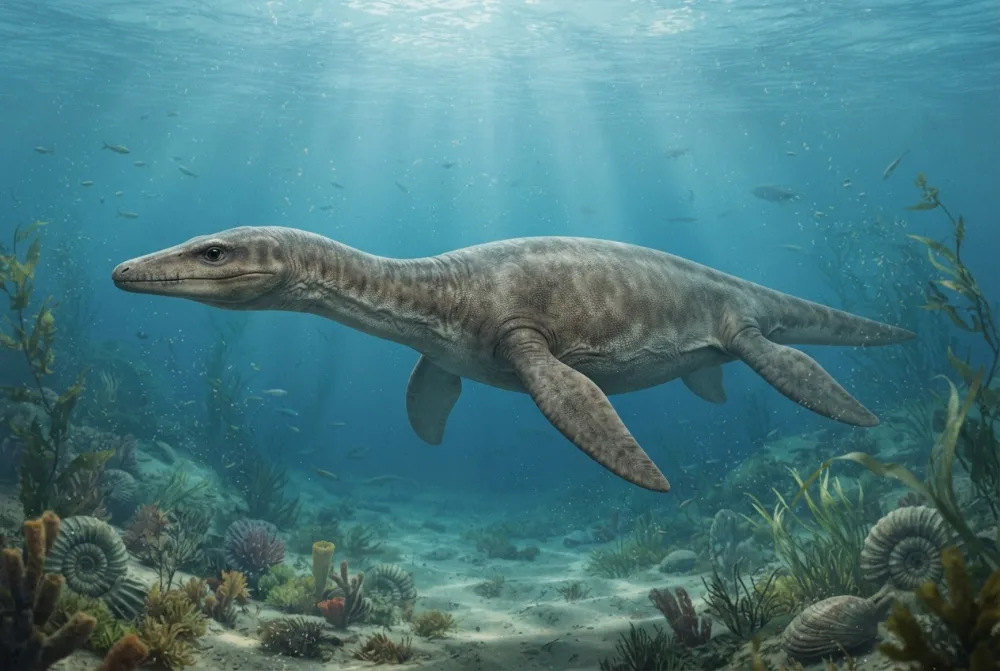
Gondwananectes was a medium-sized plesiosaur that swam in the warm seas of the Jurassic period. It had a long neck, a short tail, and four flippers that helped it glide through the water like a sea turtle. This marine reptile lived about 170 million years ago in what is now Chile.13
When did it live?
How big was it?
How big was Gondwananectes compared to YOU?
Just maths in your browser. Nothing is saved or sent anywhere.
Fun facts
Gondwananectes is one of the oldest plesiosaurs ever found in the southern supercontinent Gondwana, which is why it got its name.1
The only known fossil of Gondwananectes was discovered in 2014 by Osvaldo Rojas, a museum director, and his team.1
Scientists originally thought some of its bones were part of the hips, but later preparation showed they were actually from the shoulder area.1
Gondwananectes had heart-shaped neck vertebrae, which is a unique feature not seen in other plesiosaurs.2
The fossil of Gondwananectes was found scattered in pieces, but scientists were able to put it back together to study it.1
Gondwananectes lived during the Bajocian age of the Middle Jurassic, about 170 to 168 million years ago.3
Most asked questions about Gondwananectes
?How big was Gondwananectes?
It was about 1.5 to 2 metres (4.9 to 6.6 feet) long, which is roughly the size of a small dolphin.1
?What did Gondwananectes eat?
It was a carnivore, meaning it ate meat, probably fish and other small sea creatures.3
?Is Gondwananectes a dinosaur?
No, it is not a dinosaur. It is a plesiosaur, a type of marine reptile that lived in the ocean.1

Ask Rex about Gondwananectes
Rex only answers questions about this page. 3 questions a day.
Rex is an AI and can make mistakes. He runs on servers in the EU and questions are never saved. Never type your name or other personal things.
For dino experts
- Scientific name
- Gondwananectes
- Named by
- Otero et al. 20263
- Group
- Plesiosaurs
- Family / clade
- Plesiosauroidea3
- Classification
- Plesiosauria > Sauropterygia3
- Age of the rocks
- 171 to 168 million years (Bajocian)3
- Rock formations
- Quehuita3
- Countries
- Chile3
- Fossil records
- 1 in the Paleobiology Database3
- Discovery
- Gondwananectes was named in 2026 by Rodrigo Otero and colleagues. The fossil was found in 2014 by Osvaldo Rojas near Calama, Chile, and is now kept at the Museum of Natural and Cultural History of the Atacama Desert.1
- Still debated
- Scientists are still unsure about the exact size of Gondwananectes because only a partial skeleton has been found. The total length is estimated between 1.5 and 2 metres.1
Where the facts come from
- Gondwananectes (en.wikipedia.org)
- PBDB Taxon (paleobiodb.org)
- Gondwananectes in The Paleobiology Database (CC BY 4.0): age, places, rock formations, classification.
Every fact on this page has a number that points to its source. If we got something wrong, sorry, we are dino fans, not a science journal. Tell us at [email protected] and we will fix it.
Rex is hungry! Dino Wiki is a dad's project for his dino-loving son, free with no ads. Grown-ups can feed Rex a snack to help keep it online.Feed Rex Elasmosaurus
 Pliosaurus
 Plesiosaurus
 Cimoliasaurus
 Colymbosaurus
 Trinacromerum
 Ichthyosaurus
 Khudiakovia
 Ophthalmosaurus
 Pterodactylus
 Rhamphocephalus
 Gongbusaurus