 Home
 All dinos
 Dino groups
 Explore
 Dinos by country
 Dino vs dino
 How big were they?
 Dinos A to Z
 Who ate what?
 What dino are you? Quiz
 Dino games
 Dino battle
 Dino race
 Dino mini-games
 Sticker album
 Dino TOP lists
 Timeline
 Surprise me!
 Language: English

Mauriciosaurus
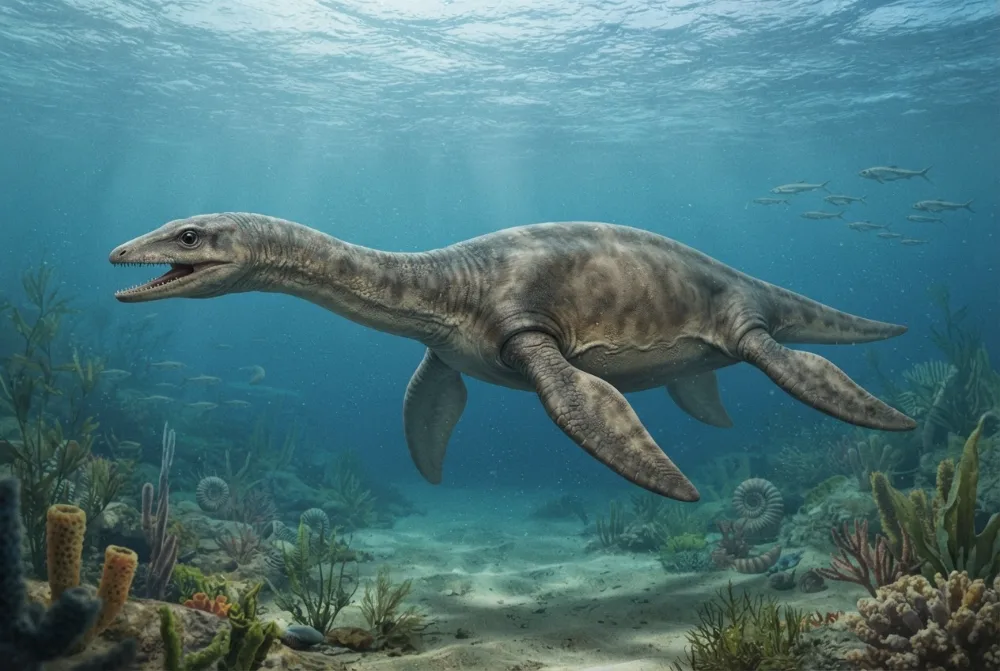
Mauriciosaurus was a short-necked plesiosaur that swam in the warm seas of Mexico 90 million years ago. It had a streamlined body and four flippers, and its fossil is so well preserved that scientists could see its skin and muscles!14
 Mexico
When did it live?
Mauriciosaurus: 94 to 90 million years ago
How big was it?
How long was it?
How heavy was it?

 as long as 4 house cats nose to tail🍌as long as 11 bananas end to end🍉as heavy as 16 watermelons🧸as heavy as 4 kindergarten kids🎒as heavy as 2.5 school kids🏊could swim the length of a big swimming pool (50 m) in 8.2 seconds
How big was Mauriciosaurus compared to YOU?
Just maths in your browser. Nothing is saved or sent anywhere.
How fast was it?


Fun facts
Mauriciosaurus is the first complete polycotylid plesiosaur ever found in Mexico.1
Its fossil preserves soft tissues like skin, muscles, and even scale-like structures, which is extremely rare for plesiosaurs.1
The body shape from the preserved soft tissues suggests it swam at speeds similar to modern leatherback turtles.1
It lived during the Early Turonian stage of the Late Cretaceous, about 93.9 to 89.8 million years ago.4
The fossil was discovered in 2011 by workmen in a limestone quarry near Vallecillo, Mexico.1
Mauriciosaurus had a flipper span of 1.15 meters (3.8 feet), making it a relatively small plesiosaur.2
Most asked questions about Mauriciosaurus
?How big was Mauriciosaurus?
About 1.9 to 2.1 metres long, with a flipper span of 1.15 metres. It was a relatively small plesiosaur.31
?What did Mauriciosaurus eat?
Scientists don't know for sure, but as a polycotylid plesiosaur it likely ate fish and other small marine animals.3
?Could Mauriciosaurus swim fast?
Yes. Its body shape and soft tissues suggest it swam at speeds similar to modern leatherback turtles, making it a fast swimmer.31
?Is Mauriciosaurus a dinosaur?
No. Mauriciosaurus is a plesiosaur, a marine reptile that lived in the sea, not a dinosaur.3
For dino experts
- Scientific name
- Mauriciosaurus
- Named by
- Frey et al. 20174
- Group
- Plesiosaurs
- Family / clade
- Polycotylidae4
- Classification
- Plesiosauria > Sauropterygia4
- Age of the rocks
- 94 to 90 million years (Turonian)4
- Rock formations
- Agua Nueva4
- Countries
- Mexico4
- Fossil records
- 1 in the Paleobiology Database4
- Discovery
- Mauriciosaurus was named in 2017 by Frey and colleagues based on a nearly complete skeleton found in 2011 by quarry workers in Vallecillo, Mexico. The species name fernandezi honors Mauricio Fernández, a Mexican paleontology enthusiast.1
- Still debated
- Scientists are still debating exactly how Mauriciosaurus used its flippers to swim, and whether its skin patterns were for camouflage or display.1
Where the facts come from
- 6901-(5)Frey (boletinsgm.igeolcu.unam.mx)
- A new polycotylid plesiosaur with extensive soft tissue preservation from the early Late Cretaceous of northeast Mexico (redalyc.org)
- Mauriciosaurus (en.wikipedia.org)
- Mauriciosaurus in The Paleobiology Database (CC BY 4.0): age, places, rock formations, classification.
Every fact on this page has a number that points to its source. If we got something wrong, sorry, we are dino fans, not a science journal. Tell us at hello@dinowiki.app and we will fix it.
 Rex is hungry! Dino Wiki is a dad's project for his dino-loving son, free with no ads and no cookies. Grown-ups can feed Rex a snack to help keep it online.Feed Rex
 Elasmosaurus
 Pliosaurus
 Plesiosaurus
 Cimoliasaurus
 Colymbosaurus
 Trinacromerum
 Tyrannosaurus
 Triceratops
 Velociraptor
 Spinosaurus
 Ankylosaurus
 Parasaurolophus