
Megacephalosaurus
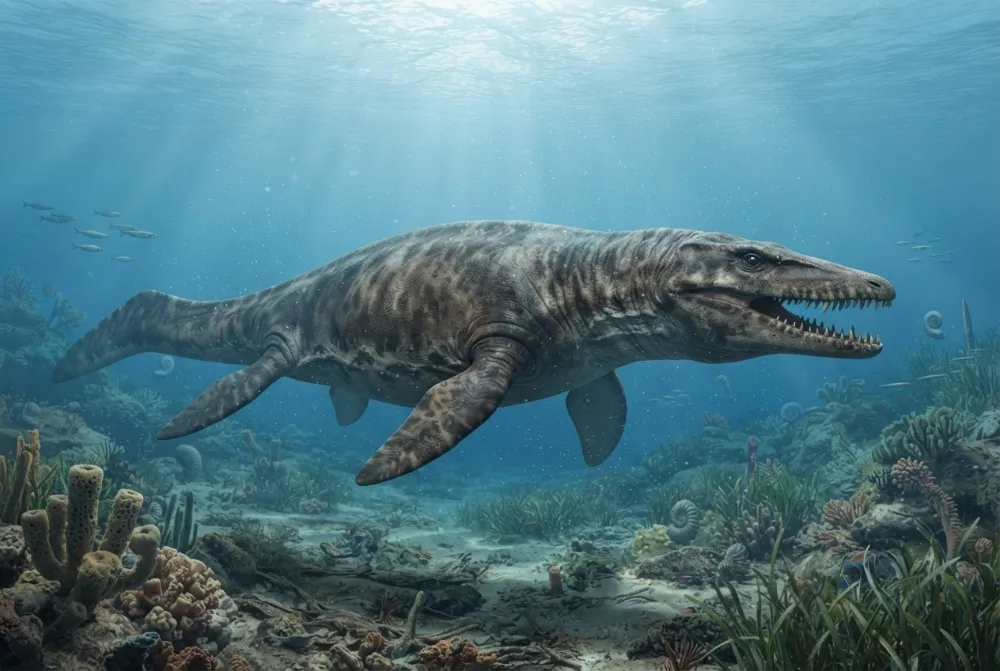
Megacephalosaurus was a huge, short-necked plesiosaur that swam in the ancient sea that split North America in two. It had a massive head, the biggest of any plesiosaur found on the continent, and used its long snout to catch smaller prey.1
When did it live?
How big was it?
How long was it?
How big was Megacephalosaurus compared to YOU?
Just maths in your browser. Nothing is saved or sent anywhere.
Fun facts
Megacephalosaurus was one of the last pliosaurs, living about 94 to 93 million years ago during the Turonian stage of the Late Cretaceous.1
Its skull was up to 1.75 meters (5.7 feet) long, making it the largest skull of any plesiosaur known from North America.1
The teeth had long, thin ridges called apicobasal ridges that helped grip and puncture slippery prey.1
It shared its ocean home with sharks like Cretoxyrhina and Squalicorax, as well as other marine reptiles like mosasaurs and sea turtles.1
The first fossils were found in 1950 and were originally thought to belong to a different pliosaur called Brachauchenius lucasi.1
It was not until 2013 that scientists realized the fossils were from a new, distinct animal and named it Megacephalosaurus.1
Most asked questions about Megacephalosaurus
?How big was Megacephalosaurus?
It was one of the largest marine reptiles of its time, estimated to be 6 to 9 meters (20 to 30 ft) long. Its skull alone could reach 1.75 meters (5.7 ft) in length.1
?What did Megacephalosaurus eat?
It likely ate smaller prey, because it had a long snout and teeth that were all about the same size. Its teeth had ridges that helped grip and puncture slippery animals.12
?When did Megacephalosaurus live?
It lived about 94 to 93 million years ago, during the Turonian stage of the Late Cretaceous. It was among the last of the pliosaurs.1
?Is Megacephalosaurus a dinosaur?
No, it is not a dinosaur. It is a plesiosaur, a type of marine reptile that lived in the ocean at the same time as dinosaurs.1

Ask Rex about Megacephalosaurus
Rex only answers questions about this page. 3 questions a day.
Rex is an AI and can make mistakes. He runs on servers in the EU and questions are never saved. Never type your name or other personal things.
For dino experts
- Scientific name
- Megacephalosaurus
- Named by
- Schumacher et al. 20133
- Group
- Plesiosaurs
- Family / clade
- Pliosauridae3
- Classification
- Plesiosauria > Pliosauridae > Sauropterygia3
- Age of the rocks
- 94 to 90 million years (Turonian)3
- Rock formations
- Carlile Shale, Greenhorn Limestone3
- Countries
- USA3
- Fossil records
- 2 in the Paleobiology Database3
- Discovery
- The first fossils were discovered in 1950 by George F. Sternberg in Kansas. They were later studied by Bruce Schumacher, Kenneth Carpenter, and Mike Everhart, who named the new species Megacephalosaurus eulerti in 2013.1
- Still debated
- Scientists are still debating how the last brachauchenine pliosaurs, including Megacephalosaurus, are related to each other and what their teeth tell us about their evolution.2
Where the facts come from
- Megacephalosaurus (en.wikipedia.org)
- Morphological and phylogenetic aspects of the dentition of Megacephalosaurus eulerti , a pliosaurid from the Turonian of Kansas, USA, with remarks on the cranial anatomy of the taxon (cambridge.org)
- Megacephalosaurus in The Paleobiology Database (CC BY 4.0): age, places, rock formations, classification.
Every fact on this page has a number that points to its source. If we got something wrong, sorry, we are dino fans, not a science journal. Tell us at [email protected] and we will fix it.
 Rex is hungry! Dino Wiki is a dad's project for his dino-loving son, free with no ads. Grown-ups can feed Rex a snack to help keep it online.Feed Rex
 Elasmosaurus
 Pliosaurus
 Plesiosaurus
 Cimoliasaurus
 Colymbosaurus
 Trinacromerum
 Tyrannosaurus
 Triceratops
 Velociraptor
 Spinosaurus
 Ankylosaurus
 Parasaurolophus