
Morenosaurus
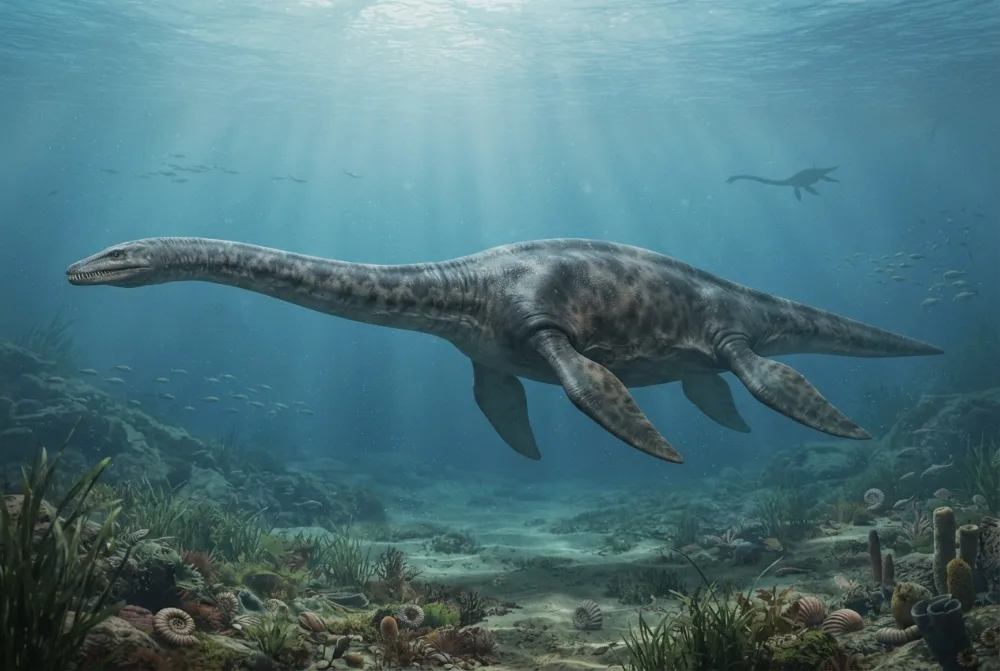
Morenosaurus was a huge marine reptile that swam in the seas near California about 70 million years ago. It had a very long neck and flippers like paddles, and it was not a dinosaur!1
When did it live?
Fun facts
The skeleton of Morenosaurus was fairly complete, but it was missing the head and parts of the neck and paddles.1
The preserved part of the trunk and tail is 3.63 metres (11.9 feet) long.1
Morenosaurus lived during the Maastrichtian age, about 72 to 66 million years ago.3
The type specimen is stored at the California Institute of Technology, but the mounted skeleton is now in the Natural History Museum of Los Angeles County.1
Morenosaurus belongs to a group called elasmosaurids, which were plesiosaurs with very long necks.1

Ask Rex about Morenosaurus
Rex only answers questions about this page. 3 questions a day.
Rex is an AI and can make mistakes. He runs on servers in the EU and questions are never saved. Never type your name or other personal things.
Myth buster
Myth: Some people think all marine reptiles from the dinosaur age were dinosaurs.
Truth: Morenosaurus was a plesiosaur, a marine reptile, not a dinosaur. Dinosaurs lived on land.1
For dino experts
- Scientific name
- Morenosaurus
- Named by
- Welles 19433
- Group
- Plesiosaurs
- Family / clade
- Elasmosauridae3
- Classification
- Plesiosauria > Elasmosauridae > Sauropterygia3
- Age of the rocks
- 72 to 66 million years (Maastrichtian)3
- Rock formations
- Moreno3
- Countries
- USA3
- Fossil records
- 2 in the Paleobiology Database3
- Discovery
- The skeleton was found by Robert Wallace and Arthur Drescher in 1939 in the Panoche Hills, California. Samuel Welles named it Morenosaurus stocki in 1943, honoring Dr. Chester Stock.12
- Still debated
- Scientists are not sure about the total length of Morenosaurus because the head and neck are missing from the fossil.1
Where the facts come from
- Morenosaurus (en.wikipedia.org)
- Dinosaur Institute Collections Details | NHM (collections.nhm.org)
- Morenosaurus in The Paleobiology Database (CC BY 4.0): age, places, rock formations, classification.
Every fact on this page has a number that points to its source. If we got something wrong, sorry, we are dino fans, not a science journal. Tell us at [email protected] and we will fix it.
 Rex is hungry! Dino Wiki is a dad's project for his dino-loving son, free with no ads. Grown-ups can feed Rex a snack to help keep it online.Feed Rex
 Elasmosaurus
 Pliosaurus
 Plesiosaurus
 Cimoliasaurus
 Colymbosaurus
 Trinacromerum
 Tyrannosaurus
 Triceratops
 Velociraptor
 Spinosaurus
 Ankylosaurus
 Parasaurolophus