
Dino card No. 1229 of 2,027
Nakonanectes
Say it: nah-KOH-nan-EK-teez
Name means: “Nakona swimmer”1
Ate: MeatPlesiosaursLate CretaceousNot technically a dinosaur
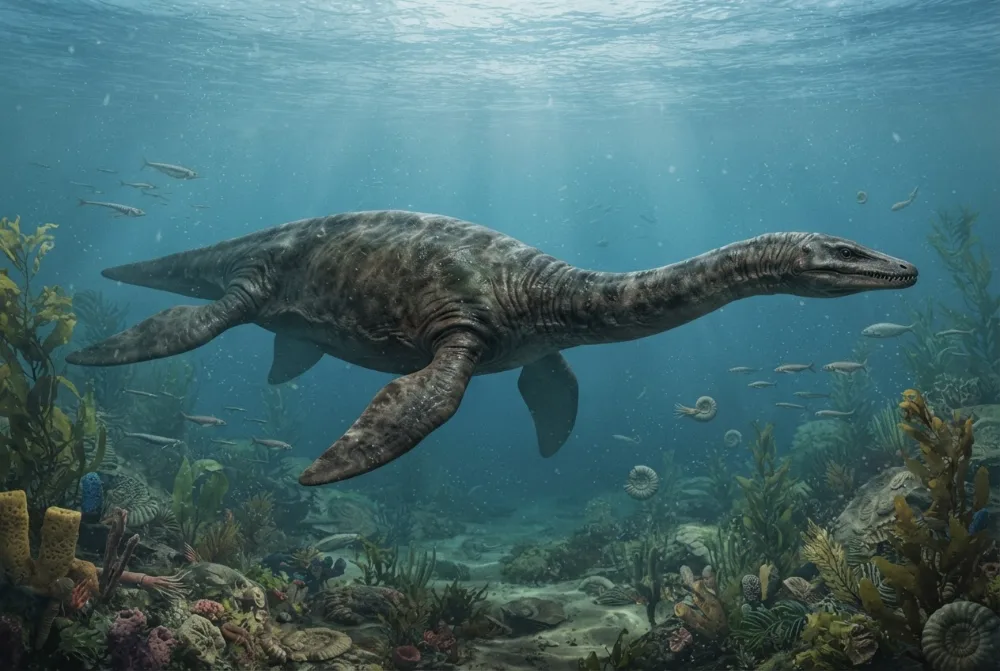
Nakonanectes was a plesiosaur, a marine reptile that lived in the sea, not a dinosaur. It had a shorter neck than most of its relatives, making it a special kind of elasmosaurid.12
Fun fact: this sea reptile swam while dinosaurs walked on land. Everyone calls them dinos, but they were a different branch of reptiles.
When did it live?
Triassic
Jurassic
Cretaceous
252 million years ago20114566, the asteroid
How big was it?
🚲as long as 3 bicycles in a row🍌as long as 31 bananas end to end
How big was Nakonanectes compared to YOU?
Just maths in your browser. Nothing is saved or sent anywhere.
cool stuff
Fun facts

Ask Rex about Nakonanectes
Rex only answers questions about this page. 3 questions a day.
Rex is an AI and can make mistakes. He runs on servers in the EU and questions are never saved. Never type your name or other personal things.
For dino experts
- Scientific name
- Nakonanectes
- Named by
- Serratos et al. 20174
- Group
- Plesiosaurs
- Family / clade
- Elasmosauridae4
- Classification
- Plesiosauria > Elasmosauridae > Sauropterygia4
- Age of the rocks
- 72 to 66 million years (Maastrichtian)4
- Rock formations
- Bearpaw Shale4
- Countries
- USA4
- Fossil records
- 1 in the Paleobiology Database4
- Discovery
- Nakonanectes was named in 2017 by Danielle Serratos, Patrick Druckenmiller, and Roger Benson. The fossil was found in 2010 by hunter David Bradt in the Bearpaw Shale of Montana, USA.13
- Still debated
- Scientists are still debating whether Nakonanectes belongs to the Styxosaurinae or Elasmosaurinae group.3
Where the facts come from
- Nakonanectes (en.wikipedia.org)
- A New Elasmosaurid (Sauropterygia, Plesiosauria) from the Bearpaw Shale (Late Cretaceous, Maastrichtian) of Montana Demonstrates Multiple Evolutionary Reductions of Neck Length Within Elasmosauridae (bioone.org)
- paleobiodb.org (paleobiodb.org)
- Nakonanectes in The Paleobiology Database (CC BY 4.0): age, places, rock formations, classification.
Every fact on this page has a number that points to its source. If we got something wrong, sorry, we are dino fans, not a science journal. Tell us at [email protected] and we will fix it.
Rex is hungry! Dino Wiki is a dad's project for his dino-loving son, free with no ads. Grown-ups can feed Rex a snack to help keep it online.Feed Rex Elasmosaurus
 Pliosaurus
 Plesiosaurus
 Cimoliasaurus
 Colymbosaurus
 Trinacromerum
 Triceratops
 Velociraptor
 Spinosaurus
 Ankylosaurus
 Parasaurolophus