
Picrocleidus
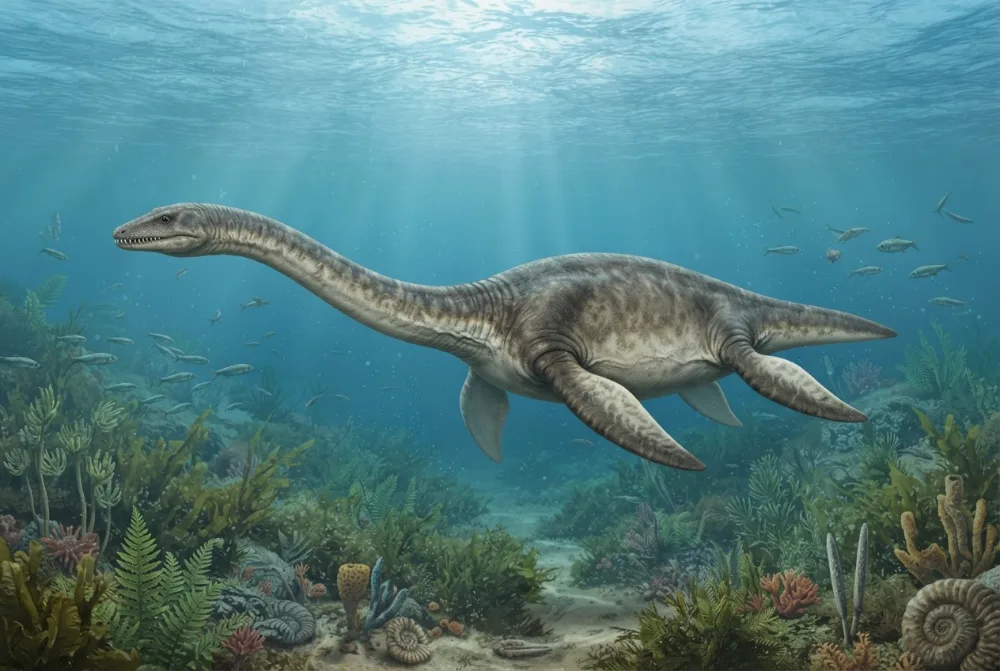
Picrocleidus was a plesiosaur, a long-necked marine reptile that swam in the Jurassic seas. It had a small head, a very long neck, and four flippers to paddle through the water. Picrocleidus was a meat-eater that hunted fish and other sea creatures.12
When did it live?
Fun facts
Picrocleidus lived about 165 to 161 million years ago, during the Middle Jurassic period.2
The first Picrocleidus fossil was found in the Oxford Clay Formation in Peterborough, England.1
Picrocleidus was originally thought to be a species of another plesiosaur called Muraenosaurus, but scientists later gave it its own name.1
Five Picrocleidus specimens have been found, including one with a complete tail and another that was a young individual.1
The name Picrocleidus comes from Greek words meaning 'sharp key', because of its sharp, key-shaped collarbones.1

Ask Rex about Picrocleidus
Rex only answers questions about this page. 3 questions a day.
Rex is an AI and can make mistakes. He runs on servers in the EU and questions are never saved. Never type your name or other personal things.
For dino experts
- Scientific name
- Picrocleidus
- Named by
- Andrews 19092
- Group
- Plesiosaurs
- Family / clade
- Cryptoclididae2
- Classification
- Plesiosauria > Sauropterygia2
- Age of the rocks
- 165 to 162 million years (Callovian)2
- Rock formations
- Oxford Clay2
- Countries
- United Kingdom2
- Fossil records
- 1 in the Paleobiology Database2
- Discovery
- The first Picrocleidus fossil was discovered in the Oxford Clay Formation in Peterborough, England, and was acquired by Alfred Nicholson Leeds. It was first named Muraenosaurus beloclis by Seeley in 1892, but Charles William Andrews gave it its own genus name Picrocleidus in 1910.1
- Still debated
- Scientists are not sure if Picrocleidus is really a separate genus from Muraenosaurus, or if they are the same animal.1
Where the facts come from
- Picrocleidus (en.wikipedia.org)
- Picrocleidus in The Paleobiology Database (CC BY 4.0): age, places, rock formations, classification.
Every fact on this page has a number that points to its source. If we got something wrong, sorry, we are dino fans, not a science journal. Tell us at [email protected] and we will fix it.
 Rex is hungry! Dino Wiki is a dad's project for his dino-loving son, free with no ads. Grown-ups can feed Rex a snack to help keep it online.Feed Rex
 Elasmosaurus
 Pliosaurus
 Plesiosaurus
 Cimoliasaurus
 Colymbosaurus
 Trinacromerum
 Ichthyosaurus
 Khudiakovia
 Ophthalmosaurus
 Pterodactylus
 Rhamphocephalus
 Gongbusaurus