
Scalamagnus
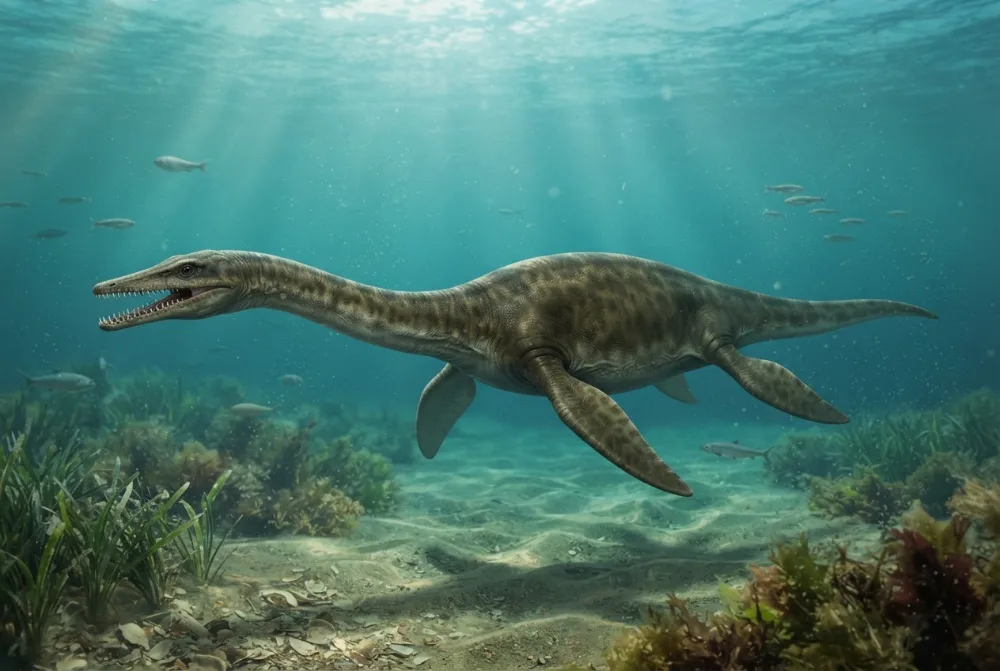
Scalamagnus was a small, fast-swimming marine reptile that lived in the warm, shallow sea that once covered North America. It had a long snout full of sharp teeth and used its four flippers to zoom through the water after fish and squid.12
When did it live?
How big was it?
How long was it?
How big was Scalamagnus compared to YOU?
Just maths in your browser. Nothing is saved or sent anywhere.
Fun facts
Scalamagnus was originally thought to be a species of Dolichorhynchops, but scientists later gave it its own name in 2023.1
One Scalamagnus skeleton was found with 289 stomach stones (gastroliths), which is very unusual for this group of plesiosaurs.1
The stomach stones weighed about 518 grams in total, and most were smaller than 2 grams.1
It lived about 93 to 91 million years ago, during the early Turonian stage of the Late Cretaceous.1
Scalamagnus was a polycotylid plesiosaur, a group known for having short necks and large heads, unlike the long-necked plesiosaurs.1
The name Scalamagnus honors the Grand Staircase-Escalante National Monument in Utah, where its fossils were dug up.1

Ask Rex about Scalamagnus
Rex only answers questions about this page. 3 questions a day.
Rex is an AI and can make mistakes. He runs on servers in the EU and questions are never saved. Never type your name or other personal things.
For dino experts
- Scientific name
- Scalamagnus
- Named by
- Clark et al. 20242
- Group
- Plesiosaurs
- Family / clade
- Polycotylidae2
- Classification
- Plesiosauria > Sauropterygia2
- Age of the rocks
- 94 to 90 million years (Turonian)2
- Rock formations
- Tropic Shale2
- Countries
- USA2
- Fossil records
- 2 in the Paleobiology Database2
- Discovery
- The first fossils were found between 2003 and 2005 by the Museum of Northern Arizona in the Tropic Shale of Utah. It was named Scalamagnus tropicensis in 2023 by Robert Clark, Robin O'Keefe, and Sara Slack.12
- Still debated
- Scientists are not sure why Scalamagnus had so many stomach stones, since most other polycotylids did not have them.1
Where the facts come from
- Scalamagnus (en.wikipedia.org)
- Scalamagnus in The Paleobiology Database (CC BY 4.0): age, places, rock formations, classification.
Every fact on this page has a number that points to its source. If we got something wrong, sorry, we are dino fans, not a science journal. Tell us at [email protected] and we will fix it.
 Rex is hungry! Dino Wiki is a dad's project for his dino-loving son, free with no ads. Grown-ups can feed Rex a snack to help keep it online.Feed Rex
 Elasmosaurus
 Pliosaurus
 Plesiosaurus
 Cimoliasaurus
 Colymbosaurus
 Trinacromerum
 Tyrannosaurus
 Triceratops
 Velociraptor
 Spinosaurus
 Ankylosaurus
 Parasaurolophus