When did it live?

How big was it?
How long was it?
How tall was it?
estimate
How heavy was it?
 as long as 5 dogs nose to tail🍌as long as 26 bananas end to end🍉as heavy as 60 watermelons🧸as heavy as 16 kindergarten kids🎒as heavy as 9 school kids🏃could run 100 metres in 8.8 seconds (the fastest human needs 9.6)
How big was Talenkauen compared to YOU?
Just maths in your browser. Nothing is saved or sent anywhere.
How fast was it?


Fun facts
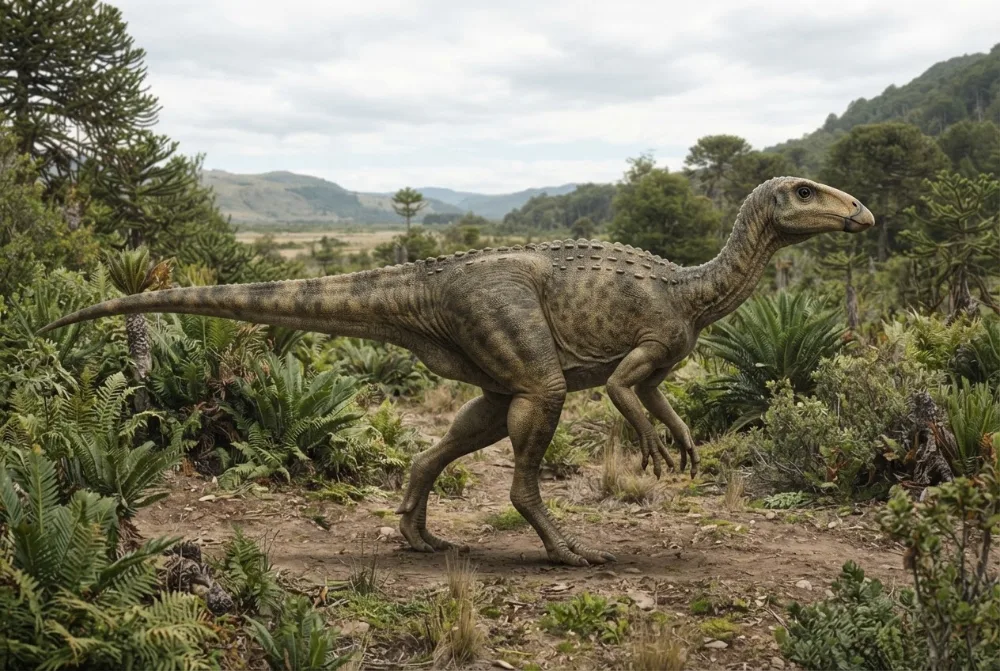
Talenkauen had smooth, oval plates along its ribcage. These plates were very thin, only about 3 millimeters thick, and may have helped with breathing, like similar structures in birds.1
Unlike many other plant-eating dinosaurs, Talenkauen still had teeth in the front of its beak and a first toe. More advanced relatives lost these features.1
A tiny baby Talenkauen was found with an adult. The baby had already hatched and eaten food, because its teeth showed wear. This is one of the few baby ornithopod fossils found in the southern hemisphere.1
Talenkauen lived alongside giant dinosaurs like Dreadnoughtus and Puertasaurus, which were huge long-necked plant-eaters, and the predator Orkoraptor.1
The plates on Talenkauen's ribs were too thin and small to be useful for defense, so scientists think they had another job, like helping the dinosaur breathe.1
Most asked questions about Talenkauen
?How big was Talenkauen?
About 4 meters (13 feet) long, maybe up to 4.7 meters (15 feet) and 300 kilograms (660 pounds).1
?What did Talenkauen eat?
It ate plants, using its beak and teeth to chew leaves and other vegetation.1
?Did Talenkauen have feathers?
No one knows for sure. No fossils of feathers have been found with Talenkauen, and it is not closely related to feathered dinosaurs.1
?When did Talenkauen live?
It lived during the Late Cretaceous period, about 72 to 66 million years ago.1

Ask Rex about Talenkauen
Rex only answers questions about this page. 10 questions a month.
Rex is an AI and can make mistakes. He runs on servers in the EU and questions are never saved. Never type your name or other personal things.
Myth buster
Myth: Some people think Talenkauen's rib plates were armor for protection.
Truth: Scientists think the plates were more like uncinate processes, which help with breathing, not armor.1
For dino experts
- Scientific name
- Talenkauen
- Named by
- Novas et al. 20042
- Group
- Beaked plant-eaters
- Family / clade
- Elasmaria2
- Classification
- Ornithischia > Ornithopoda > Iguanodontia2
- Age of the rocks
- 84 to 72 million years (Campanian)2
- Rock formations
- Cerro Fortaleza2
- Countries
- Argentina2
- Fossil records
- 2 in the Paleobiology Database2
- Discovery
- Talenkauen was found in February 2000 on Los Hornos Hill near Viedma Lake in Argentina. It was named and described by Fernando Novas and colleagues in 2004.1
- Still debated
- Scientists debate whether the rib plates of Talenkauen are related to the uncinate processes of birds and other animals, or if they are a different feature.1
Where the facts come from
- Talenkauen (en.wikipedia.org)
- Talenkauen in The Paleobiology Database (CC BY 4.0): age, places, rock formations, classification.
Every fact on this page has a number that points to its source. If we got something wrong, sorry, we are dino fans, not a science journal. Tell us at [email protected] and we will fix it.
 Rex is hungry! Dino Wiki is a dad's project for his dino-loving son, free with no ads. Grown-ups can feed Rex a snack to help keep it online.Feed Rex
 Iguanodon
 Tenontosaurus
 Thescelosaurus
 Zalmoxes
 Camptosaurus
 Rhabdodon
 Tyrannosaurus
 Triceratops
 Velociraptor
 Spinosaurus
 Ankylosaurus
 Parasaurolophus