
Tricleidus
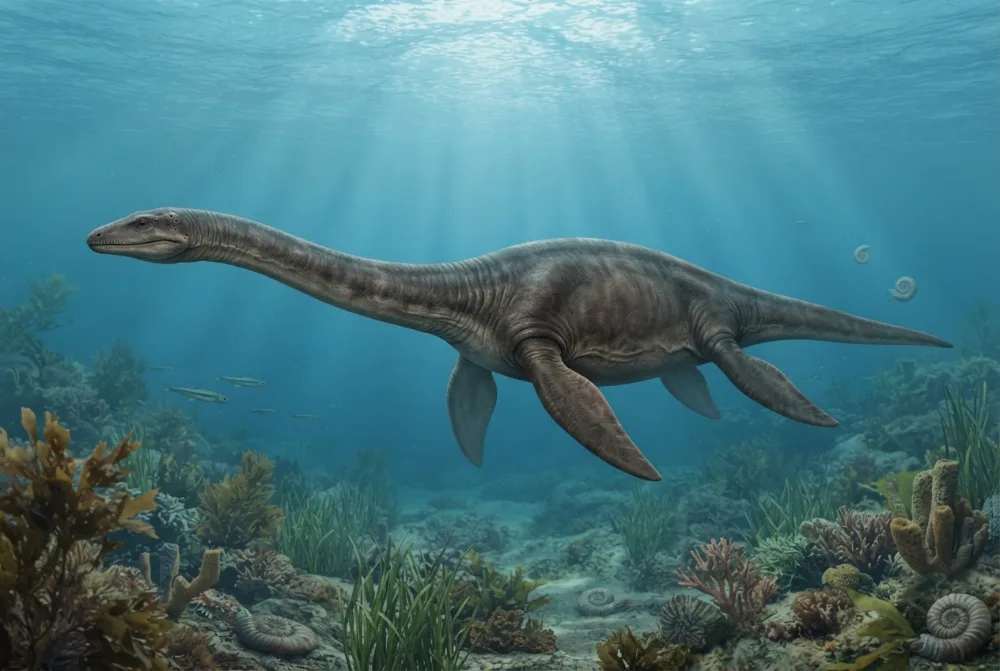
Tricleidus was a plesiosaur, a marine reptile that swam in the seas during the Jurassic Period. It had a small head, a long neck, and flippers to paddle through the water. It was not a dinosaur, but a distant cousin that lived in the ocean.13
When did it live?
Fun facts
Tricleidus is known from only one skeleton, found in the Oxford Clay of England.1
The first fossil was a shoulder girdle, which is part of the skeleton that supports the flippers.2
It lived about 165 to 161 million years ago, during the Callovian age of the Jurassic.2
One species that was once called Tricleidus svalbardensis was moved to another genus, Colymbosaurus, in 2012.1

Ask Rex about Tricleidus
Rex only answers questions about this page. 3 questions a day.
Rex is an AI and can make mistakes. He runs on servers in the EU and questions are never saved. Never type your name or other personal things.
Myth buster
Myth: Some people think Tricleidus was a dinosaur because it lived long ago and is often shown in dinosaur books.
Truth: Tricleidus was a plesiosaur, a marine reptile, not a dinosaur. Dinosaurs lived on land and had different body features.1
For dino experts
- Scientific name
- Tricleidus
- Named by
- Andrews 19093
- Group
- Plesiosaurs
- Family / clade
- Cryptoclididae3
- Classification
- Plesiosauria > Sauropterygia3
- Age of the rocks
- 184 to 155 million years (Toarcian / Oxfordian)3
- Rock formations
- Oxford Clay3
- Countries
- United Kingdom, Norway3
- Fossil records
- 3 in the Paleobiology Database3
- Discovery
- Tricleidus was named by C. W. Andrews in 1909, based on a skeleton found in the Oxford Clay of Peterborough, England. The type species is Tricleidus seeleyi.13
- Still debated
- Scientists are still debating how Tricleidus is related to other plesiosaurs, and some fossils from Norway were once assigned to it but later moved to another genus.1
Where the facts come from
- Tricleidus (en.wikipedia.org)
- PBDB Taxon (paleobiodb.org)
- Tricleidus in The Paleobiology Database (CC BY 4.0): age, places, rock formations, classification.
Every fact on this page has a number that points to its source. If we got something wrong, sorry, we are dino fans, not a science journal. Tell us at [email protected] and we will fix it.
 Rex is hungry! Dino Wiki is a dad's project for his dino-loving son, free with no ads. Grown-ups can feed Rex a snack to help keep it online.Feed Rex
 Elasmosaurus
 Pliosaurus
 Plesiosaurus
 Cimoliasaurus
 Colymbosaurus
 Trinacromerum
 Ichthyosaurus
 Khudiakovia
 Ophthalmosaurus
 Pterodactylus
 Rhamphocephalus
 Gongbusaurus