
Wapuskanectes
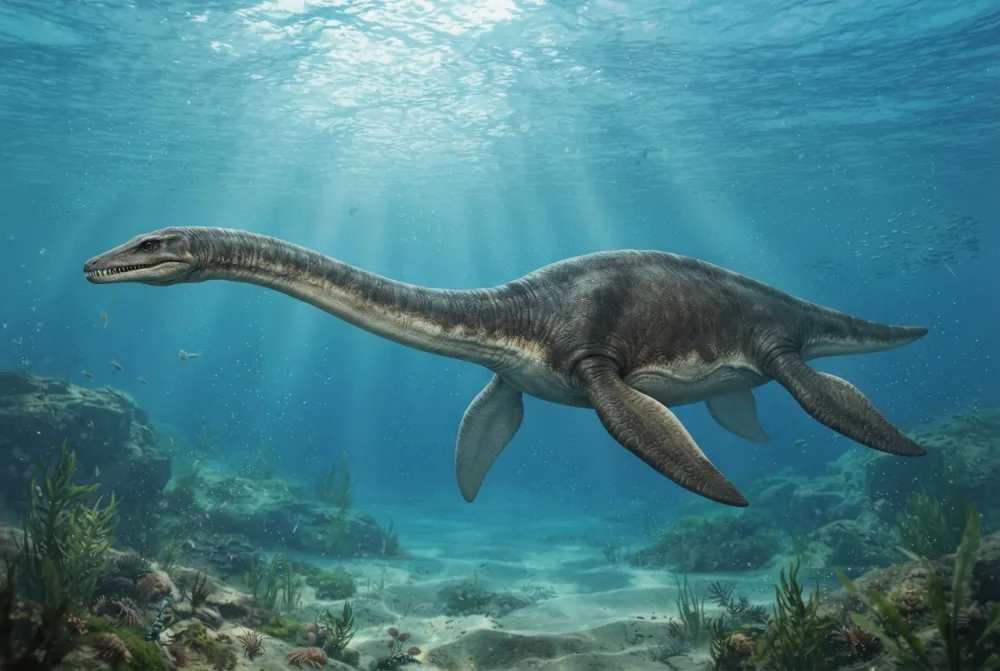
Wapuskanectes was an ancient marine reptile that swam in the seas of Alberta, Canada, about 112 million years ago. It was an early elasmosaur, a type of plesiosaur with a very long neck. This creature was a powerful swimmer and a meat-eater.1
When did it live?
How fast was it?
Fun facts
Wapuskanectes is the oldest known elasmosaur from North America, living about 112 million years ago.1
Its name comes from the Cree word 'Wapuska', meaning a body of water with whitecaps, and the Greek word 'nectes', meaning swimmer.1
The species name, betsynichollsae, honors Dr. Elizabeth 'Betsy' Nicholls, a famous curator of marine reptiles.1
Some Wapuskanectes fossils were found with gastroliths, or stomach stones, which may have helped them digest food.1
The gastroliths were mostly black, polished chert pebbles, and the largest one weighed 14.5 grams.1
One fossil, TMP 2012.50.1, was discovered when a grader plowed through its neck, destroying the skull and most of the neck.1

Ask Rex about Wapuskanectes
Rex only answers questions about this page. 10 questions a month.
Rex is an AI and can make mistakes. He runs on servers in the EU and questions are never saved. Never type your name or other personal things.
For dino experts
- Scientific name
- Wapuskanectes
- Named by
- Druckenmiller and Russell 20062
- Group
- Plesiosaurs
- Family / clade
- Elasmosauridae2
- Classification
- Plesiosauria > Elasmosauridae > Sauropterygia2
- Age of the rocks
- 113 to 110 million years (Albian)2
- Rock formations
- Clearwater2
- Countries
- Canada2
- Fossil records
- 1 in the Paleobiology Database2
- Discovery
- Wapuskanectes was named by Patrick S. Druckenmiller and Anthony P. Russell in 2006. The first fossil was found in an open-pit oilsand mine near Fort McMurray, Alberta, Canada.1
- Still debated
- Scientists are still debating exactly how Wapuskanectes used its gastroliths, whether for grinding food or for ballast.1
Where the facts come from
- Wapuskanectes (en.wikipedia.org)
- Wapuskanectes in The Paleobiology Database (CC BY 4.0): age, places, rock formations, classification.
Every fact on this page has a number that points to its source. If we got something wrong, sorry, we are dino fans, not a science journal. Tell us at [email protected] and we will fix it.
 Rex is hungry! Dino Wiki is a dad's project for his dino-loving son, free with no ads. Grown-ups can feed Rex a snack to help keep it online.Feed Rex
 Elasmosaurus
 Pliosaurus
 Plesiosaurus
 Cimoliasaurus
 Colymbosaurus
 Trinacromerum
 Stegosaurus
 Iguanodon
 Archaeopteryx
 Giganotosaurus
 Microraptor
 Deinonychus