 Ati daayinoo kami? Qormaata
 Lola daayinoo
 Dorgommii daayinoo
 Taphoota daayinoo xixiqqoo
 Albamii istiikarii
 Tarreewwan TOP daayinoo
 Na dinqisiisi!
Caupedactylus
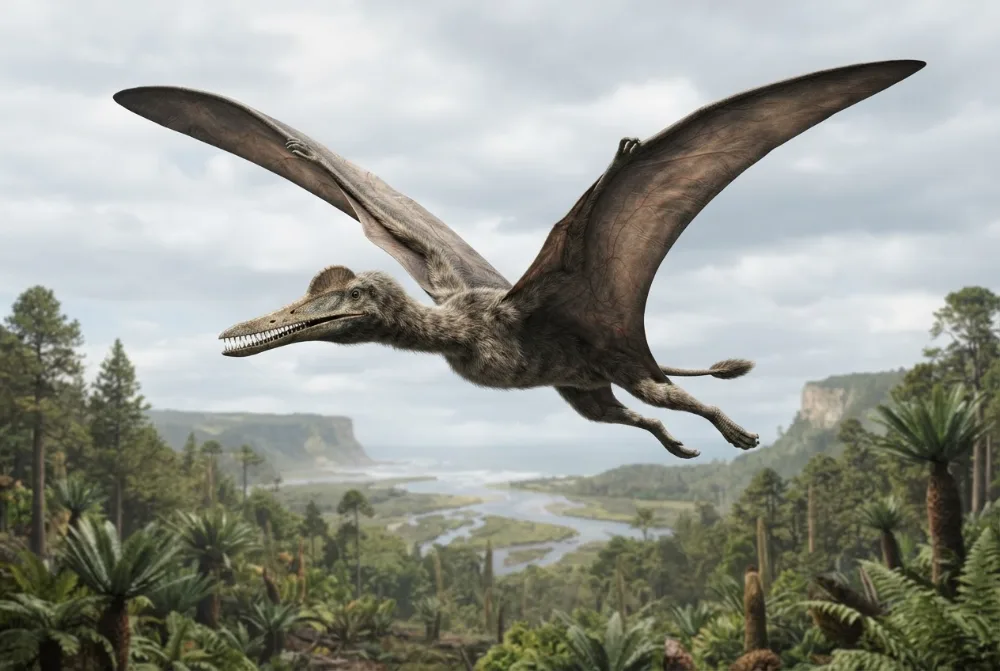
Caupedactylus was a flying reptile with a big, thin crest on its head. It had no teeth and used its beak to eat fruit. It lived about 110 million years ago in what is now Brazil.13
Yoom jiraate?
Hammam guddaa ture?
Baalleen isaa hammam bal'aa turan?
 baallee akka saayikilii 2 tarreen bal'aa⚽dirree kubbaa miilaa guutuu sekondii 6.5 keessatti balali'ee ce'uu danda'a
SI wajjin yoo wal bira qabamu, Caupedactylus hammam guddaa ture?
Herrega qofa barbaadduu kee keessatti. Wanti tokkollee hin olkaa'amu, eessayyuu hin ergamu.
Hammam saffisaa ture?


Odeeffannoowwan bashannansiisoo
Caupedactylus had a wingspan of about 3.3 metres (11 feet), making it the largest known tapejarine pterosaur.1
Its skull was about 46 centimetres long and had a large, rounded crest that was only half a millimetre thick at the top.1
The tip of its snout curved downward, and its upper jaw had a slightly concave lower edge.1
The crest on its snout had grooves that may have held blood vessels, possibly helping with temperature control.2
Its lower jaw had a thick, slightly convex surface at the rear, and when closed it fit tightly against the upper jaw with no gap.1
The holotype specimen (MN 4726-V) is an adult, which is rare for pterosaurs from this formation.1
Gaaffiiwwan waa'ee Caupedactylus baay'ee gaafataman
?What did Caupedactylus eat?
It ate fruit. Its beak had no teeth, and the Paleobiology Database lists it as a volant frugivore, meaning a flying fruit-eater.3
?How big was Caupedactylus?
Its wingspan was about 3.3 metres, making it the largest known tapejarine pterosaur. Its skull was about 46 centimetres long.1
?When did Caupedactylus live?
It lived about 110 million years ago, during the Early Cretaceous period (Albian stage).1
?Where was Caupedactylus found?
Its fossils were found in the Romualdo Formation of the Araripe Basin in northeastern Brazil.1
Ogeeyyii daayinootiif
- Maqaa saayinsii
- Caupedactylus
- Kan maqaa baase
- Kellner 20133
- Garee
- Harkifattoota balali'an
- Maatii / kilaadii
- Tapejaridae3
- Ramaddii
- Pterosauria > Pterodactyloidea3
- Umurii dhagaawwanii
- waggaa miliyoona 120 hanga 113 (Aptian)3
- Caasaawwan dhagaa
- Crato3
- Biyyoota
- Biraazil3
- Galmee fosilii
- 1 The Paleobiology Database keessa3
- Argannoo
- Caupedactylus was named and described by Alexander Kellner in 2013 based on a partial skeleton found in the Romualdo Formation of Brazil.13
- Ammallee falmisiisaa
- Scientists are still debating whether the bones in the front of the palate are part of the palatine bones or the maxillae.1
Odeeffannoon eessaa dhufa
- Caupedactylus (en.wikipedia.org)
- A new unusual tapejarid (Pterosauria, Pterodactyloidea) from the Early Cretaceous Romualdo Formation, Araripe Basin, Brazil (cambridge.org)
- Caupedactylus in The Paleobiology Database (CC BY 4.0): umurii, bakkeewwan, caasaawwan dhagaa, ramaddii.
Odeeffannoon fuula kana irra jiru hundi lakkoofsa madda isaa agarsiisu qaba. Yoo waa dogoggorre, dhiifama, nuti jaallattoota daayinoo malee joornaalii saayinsii miti. [email protected] irratti nutti himi, nus ni sirreessina.
 Rex beela'eera! Dino Wiki pirojektii abbaa tokkoo kan ilma isaa daayinoo jaallatuuf hojjetame, bilisa, beeksisa malee fi hordoftuu malee. Ga'eessonni akka inni interneetii irra turuuf Rexiif nyaata xiqqoo kennuu danda'u.Rex soori
 Pteranodon
 Quetzalcoatlus
 Dorygnathus
 Rhamphorhynchus
 Anhanguera
 Pterodactylus
 Stegosaurus
 Iguanodon
 Archaeopteryx
 Giganotosaurus
 Microraptor
 Deinonychus