 Ati daayinoo kami? Qormaata
 Lola daayinoo
 Dorgommii daayinoo
 Taphoota daayinoo xixiqqoo
 Albamii istiikarii
 Tarreewwan TOP daayinoo
 Na dinqisiisi!
Istiodactylus
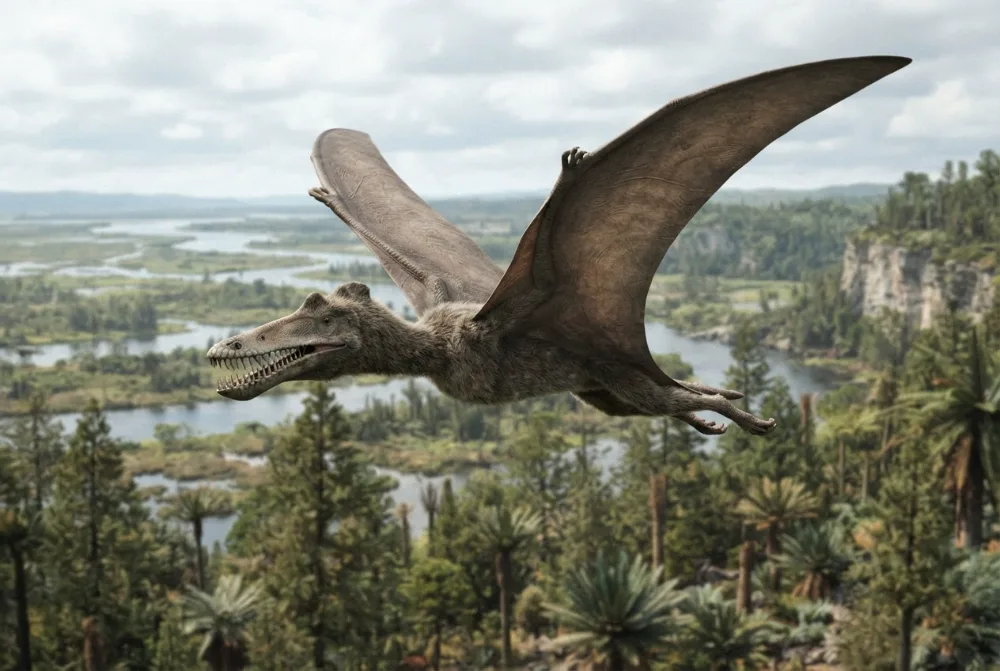
Istiodactylus was a flying reptile with a wide, blunt snout full of sharp, interlocking teeth. It lived about 120 million years ago and probably used its teeth like a cookie cutter to slice meat from big dead animals.12
Yoom jiraate?
Hammam guddaa ture?
Baalleen isaa hammam bal'aa turan?
 baallee akka saayikilii 3 tarreen bal'aa⚽dirree kubbaa miilaa guutuu sekondii 5.5 keessatti balali'ee ce'uu danda'a
SI wajjin yoo wal bira qabamu, Istiodactylus hammam guddaa ture?
Herrega qofa barbaadduu kee keessatti. Wanti tokkollee hin olkaa'amu, eessayyuu hin ergamu.
Hammam saffisaa ture?


Odeeffannoowwan bashannansiisoo
Its skull was about 45 centimetres (18 inches) long and had a semicircle of 48 closely spaced, triangular teeth that interlocked to form a razor-edged outline.1
The lower jaw had a tooth-like projection that fit into the upper teeth, helping it bite cleanly.1
Some of its back vertebrae were fused into a structure called a notarium, which helped support its large wings.1
Its hindlimbs were very short, while its forelimbs and wing-finger were huge, making it a soaring specialist.1
For much of the 20th century, it was the only pterosaur known from three-dimensionally preserved fossils, giving scientists a rare look at pterosaur anatomy.12
Its teeth were unlike the long, curved fish-grabbing teeth of other pterosaurs, so scientists think it did not catch fish but instead scavenged.2
It lived in river and coastal environments in southern England, where the climate was warm, about 20 to 25 °C (68 to 77 °F).1
Gaaffiiwwan waa'ee Istiodactylus baay'ee gaafataman
?How big was Istiodactylus?
Its wingspan was about 4.3 to 5 metres. Its skull was about 45 centimetres long.12
?What did Istiodactylus eat?
It was a scavenger. It used its sharp, interlocking teeth like a cookie cutter to slice meat from dead animals.12
?Was Istiodactylus a dinosaur?
No, it was a pterosaur, a flying reptile that lived at the same time as dinosaurs but is not a dinosaur.1
?Could Istiodactylus fly?
Yes, it was a flying reptile with large wings. It may have been a soaring specialist, gliding long distances to find food.1
Seenaa sobaa diigaa
Seenaa sobaa: Some people think Istiodactylus was a dinosaur because it lived with dinosaurs and had sharp teeth.
Dhugaa: Istiodactylus was a pterosaur, a flying reptile, not a dinosaur. Pterosaurs are a separate group of reptiles.1
Ogeeyyii daayinootiif
- Maqaa saayinsii
- Istiodactylus
- Kan maqaa baase
- Howse et al. 20013
- Garee
- Harkifattoota balali'an
- Maatii / kilaadii
- Ornithocheiroidea3
- Ramaddii
- Pterosauria > Pterodactyloidea3
- Umurii dhagaawwanii
- waggaa miliyoona 126 hanga 120 (Barremian / Aptian)3
- Caasaawwan dhagaa
- Wessex, Vectis, Yixian3
- Biyyoota
- Biriteen, Chaayinaa3
- Galmee fosilii
- 6 The Paleobiology Database keessa3
- Argannoo
- The first fossil was found on the Isle of Wight in 1887, and in 1901 it was named Ornithodesmus latidens. In 2001, scientists moved it to its own genus, Istiodactylus.1
- Ammallee falmisiisaa
- Scientists debate whether the Chinese species Istiodactylus sinensis really belongs to this genus or to a different one, and whether it is the same as another pterosaur called Longchengpterus.1
Odeeffannoon eessaa dhufa
- Istiodactylus (en.wikipedia.org)
- New Insights into the Skull of Istiodactylus latidens (Ornithocheiroidea, Pterodactyloidea) | PLOS One (journals.plos.org)
- Istiodactylus in The Paleobiology Database (CC BY 4.0): umurii, bakkeewwan, caasaawwan dhagaa, ramaddii.
Odeeffannoon fuula kana irra jiru hundi lakkoofsa madda isaa agarsiisu qaba. Yoo waa dogoggorre, dhiifama, nuti jaallattoota daayinoo malee joornaalii saayinsii miti. [email protected] irratti nutti himi, nus ni sirreessina.
 Rex beela'eera! Dino Wiki pirojektii abbaa tokkoo kan ilma isaa daayinoo jaallatuuf hojjetame, bilisa, beeksisa malee fi hordoftuu malee. Ga'eessonni akka inni interneetii irra turuuf Rexiif nyaata xiqqoo kennuu danda'u.Rex soori
 Pteranodon
 Quetzalcoatlus
 Dorygnathus
 Rhamphorhynchus
 Anhanguera
 Pterodactylus
 Stegosaurus
 Iguanodon
 Archaeopteryx
 Giganotosaurus
 Microraptor
 Deinonychus