 Uri dinozore iyihe? Umukino w'ibibazo
 Intambara ya dinozore
 Isiganwa rya dinozore
 Imikino mito ya dinozore
 Alubumu ya sitikeri
 Intonde za TOP za dinozore
 Ntungura!
Bergamodactylus
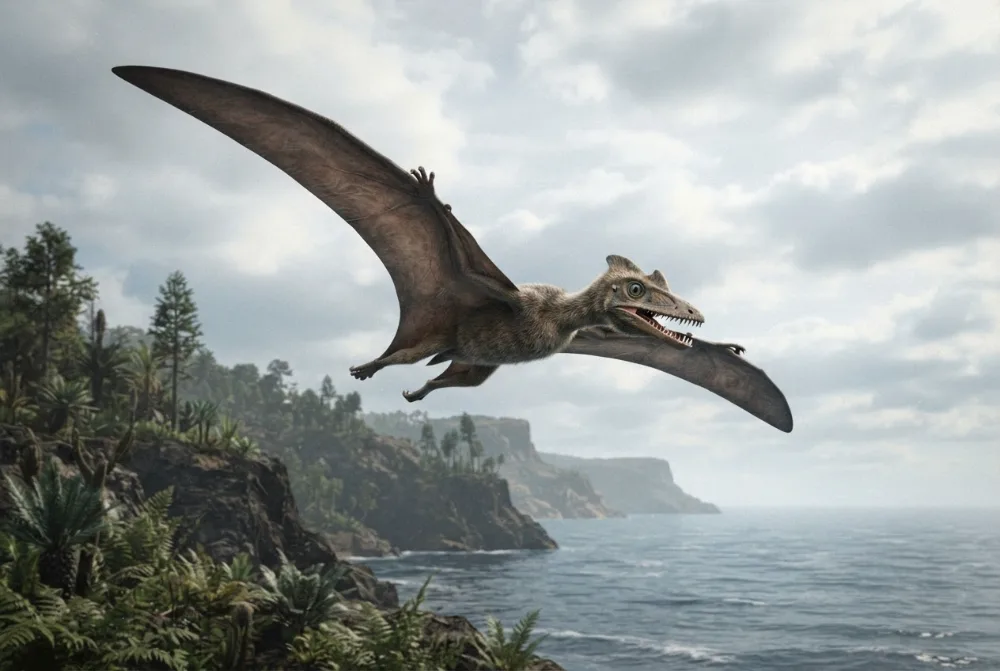
Bergamodactylus was a small flying reptile that lived in the Late Triassic, about 215 to 211 million years ago. It had a long wing finger and sharp teeth, and it soared over ancient seas in what is now Italy. It was not a dinosaur, but a pterosaur, a cousin of dinosaurs.13
Yabayeho ryari?
Yanganaga ite?
Amababa yayo yari arambuye angana iki?
Bergamodactylus yanganaga ite ugereranyije NAWE?
Ni imibare gusa ibarirwa muri mushakisha yawe. Nta kintu kibikwa cyangwa cyoherezwa ahandi.
Yihutaga ite?


Utuntu dushimishije
Bergamodactylus was named in 2015 by Alexander Kellner, but the same fossil was earlier thought to be a young Eudimorphodon or Carniadactylus.1
The only known specimen is a skeleton with parts of the skull and most of the body, but it lacks the tail.1
Its teeth were complex with multiple cusps, similar to its relative Eudimorphodon, but they show little wear, so it probably ate soft food.1
The fossil was found in the Zorzino Limestone Formation, which was a marine environment, so it likely flew over the sea.3
Some scientists think Bergamodactylus is actually the same animal as Carniadactylus, because the differences might just be due to age or individual variation.1
Ibibazo bibazwa cyane kuri Bergamodactylus
?How big was Bergamodactylus?
It was small, with a wingspan of about 70 centimetres (roughly 2.3 feet). That is about as wide as a large pizza.12
?What did Bergamodactylus eat?
It probably ate soft-bodied prey like worms and insect larvae. Its teeth show little wear, unlike the fish-eating Eudimorphodon.2
?Is Bergamodactylus a dinosaur?
No, it is a pterosaur, a flying reptile that is a cousin of dinosaurs.1
?When did Bergamodactylus live?
It lived in the Late Triassic, about 215 to 211 million years ago.1
Gusenya ibinyoma
Ibivugwa: Bergamodactylus was a dinosaur.
Ukuri: It was a pterosaur, a flying reptile that is a close cousin of dinosaurs, but not a dinosaur itself.1
Ku bazobereye muri dinozore
- Izina rya siyansi
- Bergamodactylus
- Yiswe na
- Kellner 20153
- Itsinda
- Ibikururanda biguruka
- Umuryango / ishami
- Campylognathoididae3
- Ishyirwa mu byiciro
- Pterosauria3
- Imyaka y'amabuye
- imyaka miliyoni 215 kugeza 211 (Norian)3
- Inzego z'amabuye
- Zorzino Limestone3
- Ibihugu
- Ubutaliyani3
- Ibisigazwa byanditswe
- 1 muri The Paleobiology Database3
- Ivumburwa
- The fossil was first described in 1978 by Rupert Wild, who thought it was a young Eudimorphodon. In 2015, Alexander Kellner named it Bergamodactylus wildi, honoring Wild.1
- Biracyagibwaho impaka
- Scientists still debate whether Bergamodactylus is a separate species or just a young Carniadactylus, because the differences might be due to growth stage.1
Aho amakuru yakuwe
- Carniadactylus (en.wikipedia.org)
- Carniadactylus (Wikipedia) (Wikipedia)
- Bergamodactylus in The Paleobiology Database (CC BY 4.0): imyaka, ahantu, inzego z'amabuye, ishyirwa mu byiciro.
Buri kintu kiri kuri uru rupapuro gifite nimero yerekana aho cyakuwe. Niba hari icyo twibeshye, tubabarire, turi abakunzi ba dinozore, ntituri ikinyamakuru cya siyansi. Tubwire kuri [email protected] tuzagikosora.
 Rex arashonje! Dino Wiki ni umushinga wa papa umwe yakoreye umuhungu we ukunda dinozore, ni ubuntu, nta matangazo kandi nta bigukurikirana. Abantu bakuru bashobora guha Rex akantu ko kurya kugira ngo Dino Wiki ikomeze kuboneka kuri interineti.Gaburira Rex
 Pteranodon
 Quetzalcoatlus
 Dorygnathus
 Rhamphorhynchus
 Anhanguera
 Pterodactylus
 Nothosaurus
 Massospondylus
 Plateosaurus
 Coelophysis
 Podokesaurus
 Simosaurus