 Uri dinozore iyihe? Umukino w'ibibazo
 Intambara ya dinozore
 Isiganwa rya dinozore
 Imikino mito ya dinozore
 Alubumu ya sitikeri
 Intonde za TOP za dinozore
 Ntungura!
Caelestiventus
Caelestiventus was a flying reptile that lived in a hot desert during the Late Triassic, about 205 million years ago. It was one of the biggest pterosaurs of its time, with a wingspan over 1.5 meters (5 feet). Unlike most early pterosaurs, which are found in marine rocks, this one lived among sand dunes.21
Yabayeho ryari?
Yanganaga ite?
Amababa yayo yari arambuye angana iki?
 ndende nk'injangwe 3 zo mu rugo zikurikiranye⚽yashoboraga kuguruka ikambuka ikibuga cyose cy'umupira w'amaguru mu masegonda 7,3
Caelestiventus yanganaga ite ugereranyije NAWE?
Ni imibare gusa ibarirwa muri mushakisha yawe. Nta kintu kibikwa cyangwa cyoherezwa ahandi.
Yihutaga ite?


Utuntu dushimishije
Caelestiventus is the only known desert-dwelling non-pterodactyloid pterosaur, and it is 65 million years older than any other desert pterosaur.21
Its skull was 17.8 centimeters (7 inches) long, and most of the skull bones were preserved in three dimensions, not squashed flat like most Triassic pterosaur fossils.1
The lower jaw of Caelestiventus was hollow and air-filled, with large openings that may have helped reduce weight for flight.1
It had three different kinds of teeth: long fang-like spikes at the front, large leaf-shaped blades, and tiny blades further back.1
The only known fossil includes most of the skull and the last finger bone of the wing, which supported the wingtip.1
Caelestiventus is closely related to Dimorphodon, a pterosaur from the Early Jurassic of Britain.21
The quarry where it was found also contained bones of crocodile-like reptiles, lizards, and small meat-eating dinosaurs.1
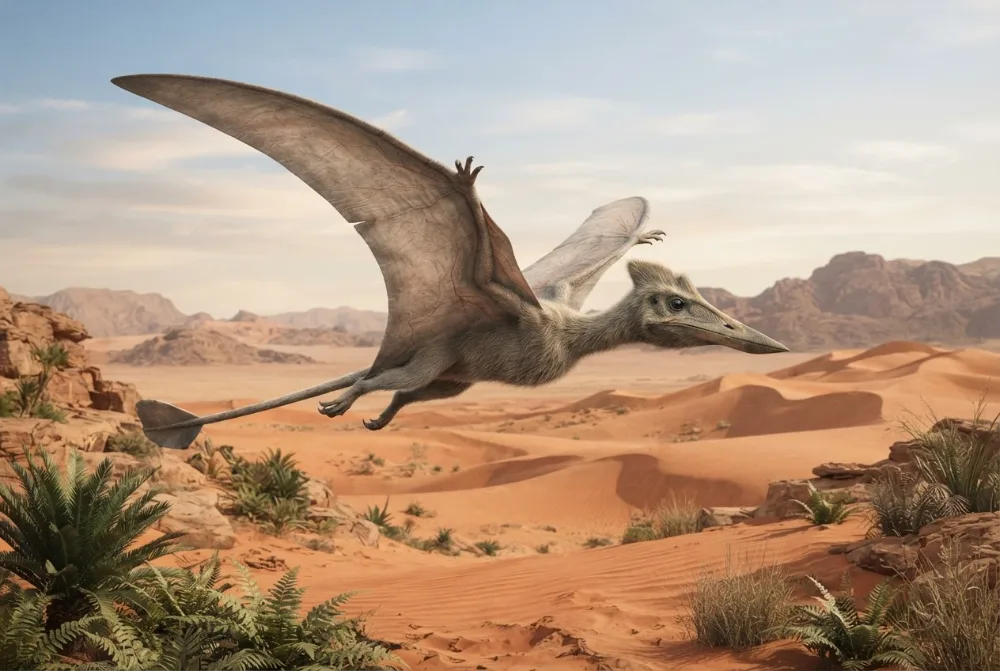
Ibibazo bibazwa cyane kuri Caelestiventus
?Was Caelestiventus a dinosaur?
No, Caelestiventus was a pterosaur, a flying reptile, not a dinosaur.13
?How big was Caelestiventus?
It had a wingspan of at least 1.5 meters (4.9 feet) and a skull 17.8 centimeters (7 inches) long. It was one of the largest Triassic pterosaurs, and the only known specimen was not fully grown.1
?What did Caelestiventus eat?
Scientists are not sure, but its three kinds of teeth (fang-like spikes, leaf-shaped blades, and tiny blades) suggest it ate different foods, possibly insects or small animals.1
?Did Caelestiventus have feathers?
No, it did not have feathers. Like most pterosaurs, it was covered in small hair-like structures called pycnofibers.3
?When did Caelestiventus live?
It lived during the Late Triassic Period, about 205 million years ago.1
?Where was Caelestiventus found?
It was discovered in the Saints & Sinners Quarry in northeastern Utah, USA, in fossilized sand dunes.1
Ku bazobereye muri dinozore
- Izina rya siyansi
- Caelestiventus
- Yiswe na
- Britt et al. 20184
- Itsinda
- Ibikururanda biguruka
- Umuryango / ishami
- Dimorphodontidae4
- Ishyirwa mu byiciro
- Pterosauria4
- Imyaka y'amabuye
- imyaka miliyoni 237 kugeza 175 (Carnian / Toarcian)4
- Inzego z'amabuye
- Nugget Sandstone4
- Ibihugu
- Amerika4
- Ibisigazwa byanditswe
- 1 muri The Paleobiology Database4
- Ivumburwa
- The fossil was discovered in 2007 by Dan Chure and George Engelmann in the Nugget Sandstone of Utah. It was named in 2018 by Britt and colleagues, honoring Robin Hansen, a geologist who helped with the excavation.14
- Biracyagibwaho impaka
- Scientists are not sure if the hollow spaces in its skull and jaw were used for storing food, for making sounds, or for display.1
Aho amakuru yakuwe
- Caelestiventus (en.wikipedia.org)
- Caelestiventus hanseni gen. et sp. nov. extends the desert-dwelling pterosaur record back 65 million years | Nature Ecology & Evolution (nature.com)
- Caelestiventus hanseni - BYU Geology (geology.byu.edu)
- Caelestiventus in The Paleobiology Database (CC BY 4.0): imyaka, ahantu, inzego z'amabuye, ishyirwa mu byiciro.
Buri kintu kiri kuri uru rupapuro gifite nimero yerekana aho cyakuwe. Niba hari icyo twibeshye, tubabarire, turi abakunzi ba dinozore, ntituri ikinyamakuru cya siyansi. Tubwire kuri [email protected] tuzagikosora.
 Rex arashonje! Dino Wiki ni umushinga wa papa umwe yakoreye umuhungu we ukunda dinozore, ni ubuntu, nta matangazo kandi nta bigukurikirana. Abantu bakuru bashobora guha Rex akantu ko kurya kugira ngo Dino Wiki ikomeze kuboneka kuri interineti.Gaburira Rex
 Pteranodon
 Quetzalcoatlus
 Dorygnathus
 Rhamphorhynchus
 Anhanguera
 Pterodactylus
 Nothosaurus
 Massospondylus
 Plateosaurus
 Coelophysis
 Podokesaurus
 Simosaurus