 Uri dinozore iyihe? Umukino w'ibibazo
 Intambara ya dinozore
 Isiganwa rya dinozore
 Imikino mito ya dinozore
 Alubumu ya sitikeri
 Intonde za TOP za dinozore
 Ntungura!
Rhamphinion
Rhamphinion was an early flying reptile that soared over what is now Arizona during the Early Jurassic. It was one of the first pterosaurs ever found in the Americas, but we only know it from a few pieces of its skull.12
Yabayeho ryari?
Yihutaga ite?


Utuntu dushimishije
Rhamphinion lived about 196 to 183 million years ago, during the Early Jurassic.1
The only known fossils are three pieces of skull: an occipital bone, part of a left jugal (cheek bone), and two teeth with a possible jaw fragment.12
Its name comes from Greek words meaning 'beak nape', because the fossils come from the back of the skull.1
When it was discovered in 1978, Rhamphinion was the oldest pterosaur known from the Western Hemisphere.1
The fossils were found by an expedition led by Farish A. Jenkins Jr., and the species name jenkinsi honors him.1
A nearly complete wing bone (fourth metacarpal) found nearby might belong to Rhamphinion, but scientists are not sure.1
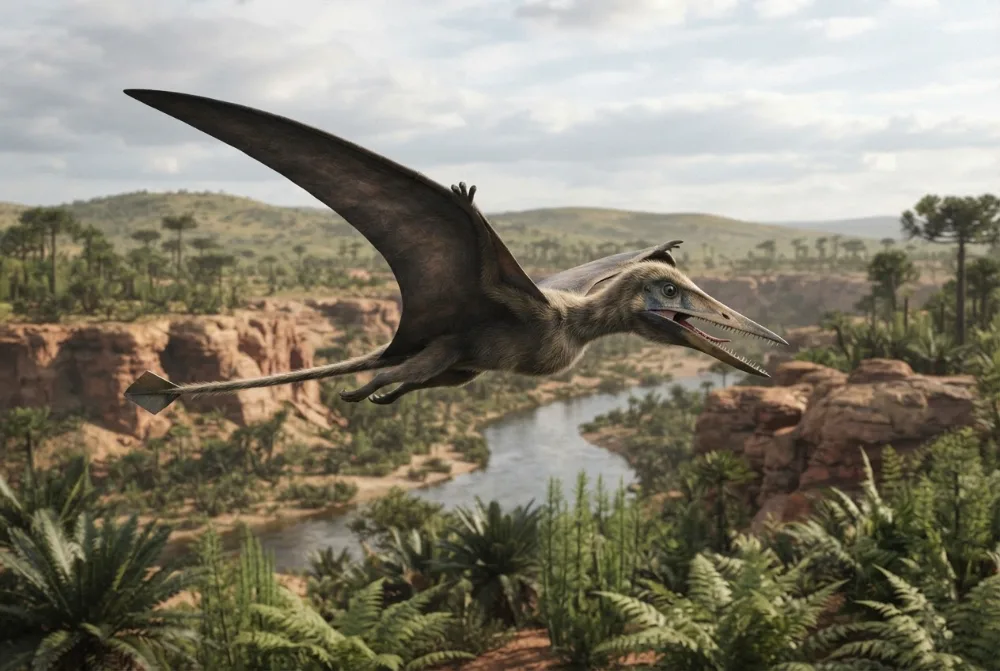
Ibibazo bibazwa cyane kuri Rhamphinion
?Is Rhamphinion a dinosaur?
No, Rhamphinion is a pterosaur, a flying reptile that is not a dinosaur.1
?How big was Rhamphinion?
Nobody knows for sure because only a few skull pieces have been found, but it was a small pterosaur.1
?What did Rhamphinion eat?
Scientists are not certain, but as a basal pterosaur it likely ate small animals like insects or fish.1
?When did Rhamphinion live?
Rhamphinion lived during the Early Jurassic, about 196 to 183 million years ago.1
Ku bazobereye muri dinozore
- Izina rya siyansi
- Rhamphinion
- Yiswe na
- Padian 19843
- Itsinda
- Ibikururanda biguruka
- Umuryango / ishami
- Rhamphorhynchoidea3
- Ishyirwa mu byiciro
- Pterosauria3
- Imyaka y'amabuye
- imyaka miliyoni 200 kugeza 184 (Sinemurian / Pliensbachian)3
- Inzego z'amabuye
- Kayenta3
- Ibihugu
- Amerika3
- Ibisigazwa byanditswe
- 1 muri The Paleobiology Database3
- Ivumburwa
- Rhamphinion was named in 1984 by Kevin Padian based on skull fragments collected in 1978 from the Kayenta Formation of Arizona. The fossils were found by an expedition from Harvard's Museum of Comparative Zoology and the Museum of Northern Arizona.12
- Biracyagibwaho impaka
- Scientists are not sure exactly where Rhamphinion fits in the pterosaur family tree because the fossils are so fragmentary. It might be related to Dimorphodon, but its classification remains uncertain.1
Aho amakuru yakuwe
- Rhamphinion (en.wikipedia.org)
- Pterosaur remains from the Kayenta Formation (?Early Jurassic) of Arizona | The Palaeontological Association (palass.org)
- Rhamphinion in The Paleobiology Database (CC BY 4.0): imyaka, ahantu, inzego z'amabuye, ishyirwa mu byiciro.
Buri kintu kiri kuri uru rupapuro gifite nimero yerekana aho cyakuwe. Niba hari icyo twibeshye, tubabarire, turi abakunzi ba dinozore, ntituri ikinyamakuru cya siyansi. Tubwire kuri [email protected] tuzagikosora.
 Rex arashonje! Dino Wiki ni umushinga wa papa umwe yakoreye umuhungu we ukunda dinozore, ni ubuntu, nta matangazo kandi nta bigukurikirana. Abantu bakuru bashobora guha Rex akantu ko kurya kugira ngo Dino Wiki ikomeze kuboneka kuri interineti.Gaburira Rex
 Pteranodon
 Quetzalcoatlus
 Dorygnathus
 Rhamphorhynchus
 Anhanguera
 Pterodactylus
 Dilophosaurus
 Stenopterygius
 Lufengosaurus
 Scutellosaurus
 Yunnanosaurus
 Sinosaurus