 Uri dinozore iyihe? Umukino w'ibibazo
 Intambara ya dinozore
 Isiganwa rya dinozore
 Imikino mito ya dinozore
 Alubumu ya sitikeri
 Intonde za TOP za dinozore
 Ntungura!
Sacisaurus
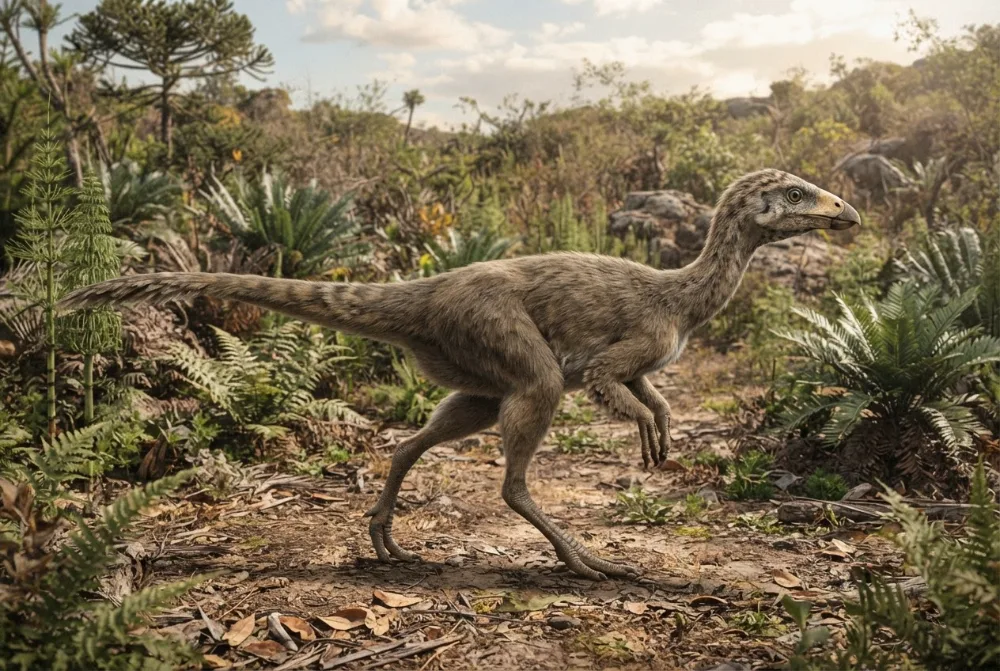
Sacisaurus was a small, fast plant-eater that lived in Brazil about 225 million years ago. It had a beak-like jaw and leaf-shaped teeth for munching on tough plants. This dinosaur got its name because scientists found 35 right thigh bones but only one left one, just like the one-legged Saci from Brazilian stories.1
Yabayeho ryari?
Yanganaga ite?
Yari ndende ite?
Ubutumburuke bwayo bwanganaga iki?
 ndende nk'injangwe 2 zo mu rugo zikurikiranye🍌ndende nk'imineke 6 ikurikiranye🪑nto ku buryo yanyura munsi y'intebe🏃yashoboraga kwiruka metero 100 mu masegonda 13 (umuntu wihuta kurusha abandi akenera 9,6)
Sacisaurus yanganaga ite ugereranyije NAWE?
Ni imibare gusa ibarirwa muri mushakisha yawe. Nta kintu kibikwa cyangwa cyoherezwa ahandi.
Yihutaga ite?


Utuntu dushimishije
Sacisaurus was a small dinosaur, only about 1.1 metres (3.6 feet) long and 35 centimetres (1.15 feet) tall at the hips.1
Its biggest teeth were just 3 millimetres (0.12 inches) long, perfect for nibbling plants.1
Sacisaurus had long, strong legs that made it a fast runner, able to dart away from predators.1
The tip of its lower jaw had a beak-like bone that looks like the predentary bone found in ornithischian dinosaurs.1
Scientists found 35 right thigh bones but only one left thigh bone, which is why they named it after the one-legged Saci.1
Sacisaurus lived during the Late Triassic period, about 225 million years ago, in what is now southern Brazil.1
Ibibazo bibazwa cyane kuri Sacisaurus
?Is Sacisaurus a dinosaur?
Scientists are not sure. It is a silesaurid dinosauriform, which means it is a close relative of dinosaurs, but it is not classified as a dinosaur.13
?What did Sacisaurus eat?
Sacisaurus was an herbivore, meaning it ate plants. It had leaf-shaped teeth with large denticles and a beak-like jaw tip to help it chew tough plants.12
?How fast could Sacisaurus run?
Nobody knows the exact speed, but its long, strong legs and elongate hindlimbs suggest it was a fast runner with good cursorial ability.12
?Why is it called Sacisaurus?
It is named after Saci, a one-legged creature from Brazilian folklore, because scientists found 35 right thigh bones but only one left thigh bone among the fossils.1
Gusenya ibinyoma
Ibivugwa: Some people think Sacisaurus was a true dinosaur.
Ukuri: Most scientists now place Sacisaurus in Silesauridae, a group of dinosaur-like reptiles that are close relatives but not true dinosaurs. A few studies suggest it might be a very early ornithischian dinosaur, but this is debated.12
Ku bazobereye muri dinozore
- Izina rya siyansi
- Sacisaurus
- Yiswe na
- Ferigolo and Langer 20073
- Itsinda
- Izirya ibimera zifite umunwa w'inyoni
- Umuryango / ishami
- Silesauridae3
- Ishyirwa mu byiciro
- Ornithischia3
- Imyaka y'amabuye
- imyaka miliyoni 227 kugeza 206 (Norian)3
- Inzego z'amabuye
- Caturrita3
- Ibihugu
- Burezili3
- Ibisigazwa byanditswe
- 1 muri The Paleobiology Database3
- Ivumburwa
- Sacisaurus was discovered in 2001 near Agudo, Brazil, by a team led by paleontologist Jorge Ferigolo. The species was officially named in 2006 in the journal Historical Biology.1
- Biracyagibwaho impaka
- Scientists still debate whether Sacisaurus was a non-dinosaur dinosauromorph or one of the earliest ornithischian dinosaurs.12
Aho amakuru yakuwe
- Sacisaurus (en.wikipedia.org)
- Brazil): anatomy and affinities agudoensis (Caturrita Formation; Rio Grande do Sul, (paleolab.com.br)
- Sacisaurus in The Paleobiology Database (CC BY 4.0): imyaka, ahantu, inzego z'amabuye, ishyirwa mu byiciro.
Buri kintu kiri kuri uru rupapuro gifite nimero yerekana aho cyakuwe. Niba hari icyo twibeshye, tubabarire, turi abakunzi ba dinozore, ntituri ikinyamakuru cya siyansi. Tubwire kuri [email protected] tuzagikosora.
 Rex arashonje! Dino Wiki ni umushinga wa papa umwe yakoreye umuhungu we ukunda dinozore, ni ubuntu, nta matangazo kandi nta bigukurikirana. Abantu bakuru bashobora guha Rex akantu ko kurya kugira ngo Dino Wiki ikomeze kuboneka kuri interineti.Gaburira Rex
 Iguanodon
 Tenontosaurus
 Thescelosaurus
 Zalmoxes
 Camptosaurus
 Rhabdodon
 Nothosaurus
 Massospondylus
 Plateosaurus
 Coelophysis
 Podokesaurus
 Simosaurus