 Uri dinozore iyihe? Umukino w'ibibazo
 Intambara ya dinozore
 Isiganwa rya dinozore
 Imikino mito ya dinozore
 Alubumu ya sitikeri
 Intonde za TOP za dinozore
 Ntungura!
Syntarsus
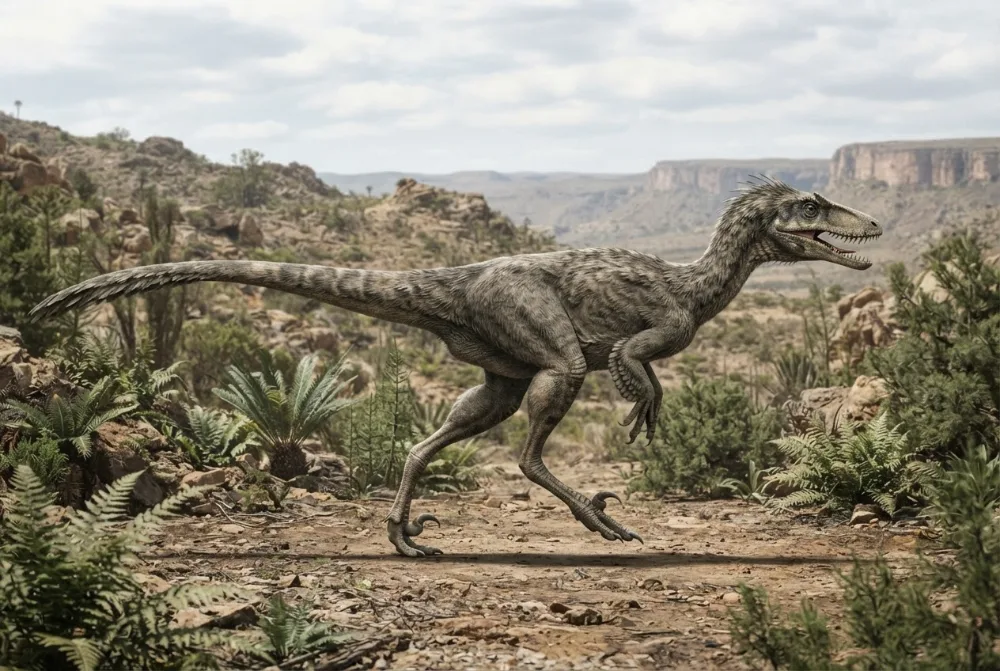
Syntarsus was a fast, meat-eating dinosaur that lived about 200 million years ago. It was a relative of Coelophysis and used its sharp teeth and long legs to chase down small prey. Some fossils show that it might have lived in groups.2
Yabayeho ryari?
Yanganaga ite?
Yari ndende ite?
Ubutumburuke bwayo bwanganaga iki?
Yari iremereye ite?

 ndende nk'imbwa 3 zikurikiranye🍌ndende nk'imineke 17 ikurikiranye🍉iremereye nk'imbuto 6 za watermelon🏃yashoboraga kwiruka metero 100 mu masegonda 8,6 (umuntu wihuta kurusha abandi akenera 9,6)
Syntarsus yanganaga ite ugereranyije NAWE?
Ni imibare gusa ibarirwa muri mushakisha yawe. Nta kintu kibikwa cyangwa cyoherezwa ahandi.
Yihutaga ite?


Utuntu dushimishije
Syntarsus had a long, slim body and a tail that helped it keep balance while running fast.2
Fossils of Syntarsus have been found in Arizona in the Kayenta Formation and in South Africa in the Elliot Formation.22
The species Syntarsus kayentakatae was named by Timothy Rowe in 1989 from a partial skeleton found in Arizona.21
Syntarsus lived during the Early Jurassic, about 199 to 183 million years ago, in what is now the southwestern United States and southern Africa.2
Scientists think Syntarsus was a fast and agile hunter, using its long legs to chase after lizards and small dinosaurs.2
The name Syntarsus was first used by Michael Raath in 1969 for fossils found in Rhodesia (now Zimbabwe).2
Ku bazobereye muri dinozore
- Izina rya siyansi
- Syntarsus
- Yiswe na
- Raath 19692
- Itsinda
- Dinozore zirya inyama
- Umuryango / ishami
- Coelophysoidea2
- Ishyirwa mu byiciro
- Theropoda > Coelophysoidea2
- Imyaka y'amabuye
- imyaka miliyoni 206 kugeza 184 (Rhaetian / Pliensbachian)2
- Inzego z'amabuye
- Kayenta, Elliot, Moenave2
- Ibihugu
- Amerika, Afurika y'Epfo2
- Ibisigazwa byanditswe
- 11 muri The Paleobiology Database2
- Ivumburwa
- The first Syntarsus fossils were found in the Forest Sandstone of Rhodesia (now Zimbabwe) and named by Michael Raath in 1969. Another species, Syntarsus kayentakatae, was named by Timothy Rowe in 1989 from the Kayenta Formation in Arizona.221
- Biracyagibwaho impaka
- Scientists still debate whether Syntarsus should be called a separate genus or classified as a type of Coelophysis. Some researchers suggest the name Megapnosaurus instead.22
Aho amakuru yakuwe
- : Rowe 1989 | Publication Details | MCZbase (mczbase.mcz.harvard.edu)
- Syntarsus in The Paleobiology Database (CC BY 4.0): imyaka, ahantu, inzego z'amabuye, ishyirwa mu byiciro.
Buri kintu kiri kuri uru rupapuro gifite nimero yerekana aho cyakuwe. Niba hari icyo twibeshye, tubabarire, turi abakunzi ba dinozore, ntituri ikinyamakuru cya siyansi. Tubwire kuri [email protected] tuzagikosora.
 Rex arashonje! Dino Wiki ni umushinga wa papa umwe yakoreye umuhungu we ukunda dinozore, ni ubuntu, nta matangazo kandi nta bigukurikirana. Abantu bakuru bashobora guha Rex akantu ko kurya kugira ngo Dino Wiki ikomeze kuboneka kuri interineti.Gaburira Rex
 Allosaurus
 Carnotaurus
 Dilophosaurus
 Giganotosaurus
 Compsognathus
 Paronychodon
 Stenopterygius
 Dorygnathus
 Lufengosaurus
 Scutellosaurus
 Yunnanosaurus
 Temnodontosaurus