 Kwisi: O dinosaure efe?
 Ntwa ya didinosaure
 Peiso ya didinosaure
 Dipapadi tse nyane tsa didinosaure
 Albamo ya ditikara
 Manane a TOP a didinosaure
 Nkgethele!
Rhamphinion
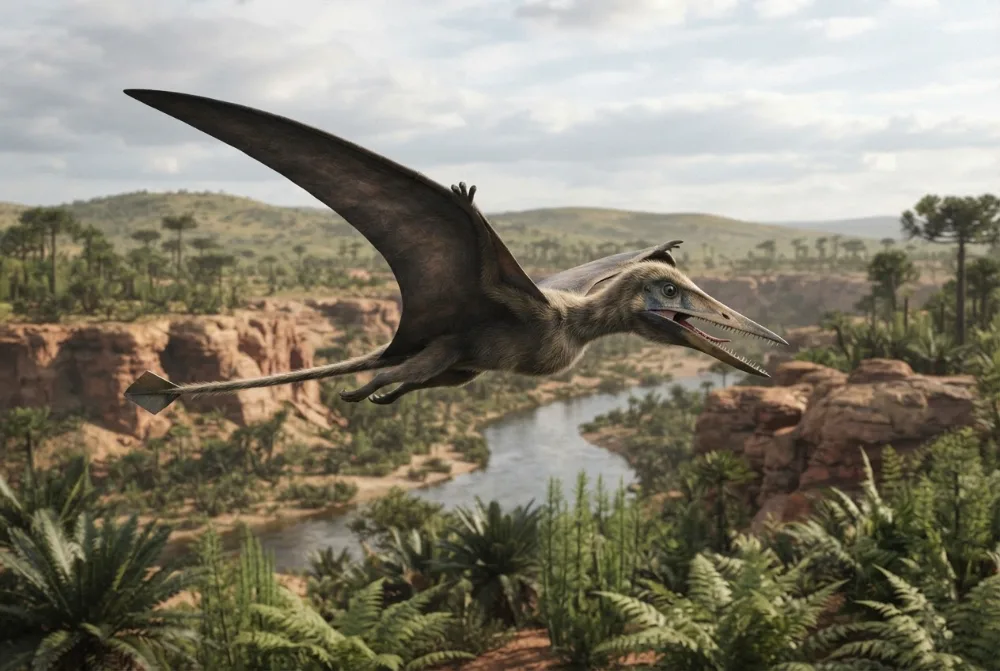
Rhamphinion was an early flying reptile that soared over what is now Arizona during the Early Jurassic. It was one of the first pterosaurs ever found in the Americas, but we only know it from a few pieces of its skull.12
E phetse neng?
E ne e le lebelo hakae?


Dintlha tse monate
Rhamphinion lived about 196 to 183 million years ago, during the Early Jurassic.1
The only known fossils are three pieces of skull: an occipital bone, part of a left jugal (cheek bone), and two teeth with a possible jaw fragment.12
Its name comes from Greek words meaning 'beak nape', because the fossils come from the back of the skull.1
When it was discovered in 1978, Rhamphinion was the oldest pterosaur known from the Western Hemisphere.1
The fossils were found by an expedition led by Farish A. Jenkins Jr., and the species name jenkinsi honors him.1
A nearly complete wing bone (fourth metacarpal) found nearby might belong to Rhamphinion, but scientists are not sure.1
Dipotso tse botswang haholo ka Rhamphinion
?Is Rhamphinion a dinosaur?
No, Rhamphinion is a pterosaur, a flying reptile that is not a dinosaur.1
?How big was Rhamphinion?
Nobody knows for sure because only a few skull pieces have been found, but it was a small pterosaur.1
?What did Rhamphinion eat?
Scientists are not certain, but as a basal pterosaur it likely ate small animals like insects or fish.1
?When did Rhamphinion live?
Rhamphinion lived during the Early Jurassic, about 196 to 183 million years ago.1
Bakeng sa ditsebi tsa didinosaure
- Lebitso la saense
- Rhamphinion
- E rehilwe ke
- Padian 19843
- Sehlopha
- Dihahabi tse fofang
- Lelapa / leloko
- Rhamphorhynchoidea3
- Tlhophiso
- Pterosauria3
- Dilemo tsa mafika
- dilemo tse dimilione tse 200 ho isa ho 184 (Sinemurian / Pliensbachian)3
- Dibopeho tsa mafika
- Kayenta3
- Dinaha
- Amerika3
- Direkoto tsa difosili
- 1 ho The Paleobiology Database3
- Ho sibollwa
- Rhamphinion was named in 1984 by Kevin Padian based on skull fragments collected in 1978 from the Kayenta Formation of Arizona. The fossils were found by an expedition from Harvard's Museum of Comparative Zoology and the Museum of Northern Arizona.12
- E sa ntse e phehwa kgang
- Scientists are not sure exactly where Rhamphinion fits in the pterosaur family tree because the fossils are so fragmentary. It might be related to Dimorphodon, but its classification remains uncertain.1
Moo dintlha di tswang teng
- Rhamphinion (en.wikipedia.org)
- Pterosaur remains from the Kayenta Formation (?Early Jurassic) of Arizona | The Palaeontological Association (palass.org)
- Rhamphinion in The Paleobiology Database (CC BY 4.0): dilemo, dibaka, dibopeho tsa mafika, tlhophiso.
Ntlha e nngwe le e nngwe leqepheng lena e na le nomoro e supang mohlodi wa yona. Haeba re fositse ho hong, re kopa tshwarelo, re balatedi ba didinosaure, ha re koranta ya saense. Re bolelle ho [email protected] mme re tla e lokisa.
 Rex o lapile! Dino Wiki ke projeke ya ntate bakeng sa mora wa hae ya ratang didinosaure, ke mahala, ha ho dipapatso, ha ho disebedi. Batho ba baholo ba ka fepa Rex seneke ho thusa hore e dule e le inthaneteng.Fepa Rex
 Pteranodon
 Quetzalcoatlus
 Dorygnathus
 Rhamphorhynchus
 Anhanguera
 Pterodactylus
 Dilophosaurus
 Stenopterygius
 Lufengosaurus
 Scutellosaurus
 Yunnanosaurus
 Sinosaurus