 Ban dino nga? Kiis
 Xeexu dino
 Rawante dino
 Fo yu ndaw yu dino
 Albomu sitikeer
 Limu TOP yu dino
 Bett ma!
Kañ la dundoon?

Naka la réyoon?
Naka la guddoon?
Naka la kawewoon?
jortu
Naka la diisoon?
 gudd ni 3 muusu kër, bakkan ba geen🍌gudd ni 8 banaana yu ñu topp-toppalelu tollu ci diisaayu muusu kër🍌diis ni 17 banaana🏃mënoon na daw 100 meetar ci 16 segond (nit ki gën a gaaw dafay soxla 9,6)
Naka la Kulindadromeus réyoon, bu ñu ko méngalee ak YAW?
Ay kalkil rekk ci sa navigatëer. Dara du ñu denc, dara du ñu yónne fenn.
Naka la gaawoon?


Xibaar yu neex
Kulindadromeus had three types of feather-like structures on its body, including simple filaments and more complex tufts.1
It also had three types of scales, showing that this dinosaur had a mix of scales and fuzzy coverings.1
Kulindadromeus lived about 168 to 166 million years ago, during the Middle Jurassic, making it the oldest known dinosaur with feather-like structures.2
It was a small, bipedal herbivore about 1.5 meters (5 feet) long, with short forelimbs, long hind limbs, and a long tail.1
The fossils were found in a lake environment, alongside plants, insect larvae, and freshwater crustaceans.1
Scientists think that feather-like structures might have been common in all dinosaurs, not just the meat-eating ones.1
Kulindadromeus is a basal neornithischian, meaning it is an early relative of plant-eating dinosaurs like Triceratops and Parasaurolophus.1
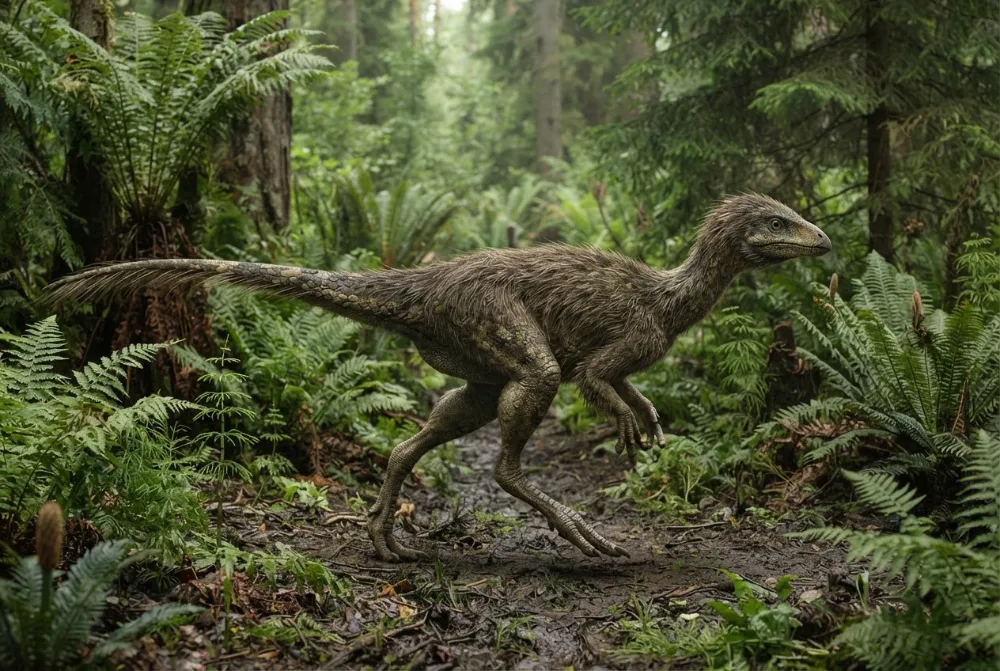
Laaj yi ñu gën a laaj ci Kulindadromeus
?What did Kulindadromeus eat?
It was a herbivore, eating plants. Its teeth were adapted for eating plants.3
?How big was Kulindadromeus?
It was about 1 to 1.5 metres long and weighed about 2 kilograms.3
?Did Kulindadromeus have feathers?
Yes, it had three types of feather-like structures on its body, including simple filaments and more complex tufts, along with scales.3
?When did Kulindadromeus live?
It lived about 168 to 166 million years ago, during the Middle Jurassic period.3
?Where was Kulindadromeus found?
Its fossils were found in Siberia, Russia, in a place called the Kulinda site.3
?Could Kulindadromeus run fast?
Yes, it was a bipedal runner with long hindlimbs and a long tail, built for speed.3
Ku tas léeb yu dul dëgg
Léeb: Only meat-eating dinosaurs like Velociraptor had feathers.
Dëgg: Kulindadromeus was a plant-eating dinosaur that also had feather-like filaments, showing that fuzzy coverings were widespread among dinosaurs.1
Ngir ñi xam dino lool
- Turu xam-xam
- Kulindadromeus
- Ku ko tudde
- Godefroit et al. 20144
- Kurél
- Dino yu lekk gàncax te am gémmiñu picc
- Njaboot / klad
- Pyrodontia4
- Klasifikasiyoŋ
- Ornithischia4
- Màggaayu doj yi
- 168 ba 165 milyoŋ at (Bathonian)4
- Formasiyoŋi doj
- Ukureyskaya4
- Réew yi
- Riisi4
- Fosil yu ñu gis
- 3 ci The Paleobiology Database4
- Gisees
- Kulindadromeus was named in 2014 by Pascal Godefroit and colleagues based on fossils found at the Kulinda locality in Siberia, Russia. The site yielded several partial skulls and hundreds of disarticulated bones.41
- Ñu ngi koy werante ba tey
- Scientists are still debating whether the feather-like structures of Kulindadromeus are true feathers or just similar-looking filaments that evolved independently.1
Fa xibaar yi jóge
- and scales (biblio.naturalsciences.be)
- The rise of feathered dinosaurs: Kulindadromeus zabaikalicus , the oldest dinosaur with ‘feather-like’ structures (pmc.ncbi.nlm.nih.gov)
- Kulindadromeus (en.wikipedia.org)
- Kulindadromeus in The Paleobiology Database (CC BY 4.0): at, béréb yi, formasiyoŋi doj, klasifikasiyoŋ.
Bépp xibaar ci xët wii am na lim bu wone fa mu jóge. Su nu juumee, baal nu, nun ñu bëgg dino lanu, du ab sërnaalu xam-xam. Wax nu ko ci [email protected] nu defar ko.
 Rex xiif na! Dino Wiki, mbiru ab baay la ngir doomam ju góor ju bëgg dinosoor, ci neen te amul kaamuñaate, amul tracker. Mag ñi mën nañu jox Rex tuuti ñam ngir dimbali ko mu des ci internet.Dundal Rex
 Iguanodon
 Tenontosaurus
 Thescelosaurus
 Zalmoxes
 Camptosaurus
 Rhabdodon
 Ichthyosaurus
 Khudiakovia
 Ophthalmosaurus
 Pterodactylus
 Peloneustes
 Rhamphocephalus