 Ban dino nga? Kiis
 Xeexu dino
 Rawante dino
 Fo yu ndaw yu dino
 Albomu sitikeer
 Limu TOP yu dino
 Bett ma!
Kañ la dundoon?

Naka la réyoon?
Naka la guddoon?
Naka la kawewoon?
jortu
 gudd ni 2,5 muusu kër, bakkan ba geen🍌gudd ni 7 banaana yu ñu topp-toppale🪑tuuti ba mën a dox ci suufu siis🏃mënoon na daw 100 meetar ci 12 segond (nit ki gën a gaaw dafay soxla 9,6)
Naka la Lycorhinus réyoon, bu ñu ko méngalee ak YAW?
Ay kalkil rekk ci sa navigatëer. Dara du ñu denc, dara du ñu yónne fenn.
Naka la gaawoon?


Xibaar yu neex
Lycorhinus was first thought to be a mammal-like reptile called a cynodont, not a dinosaur, when it was named in 1924.1
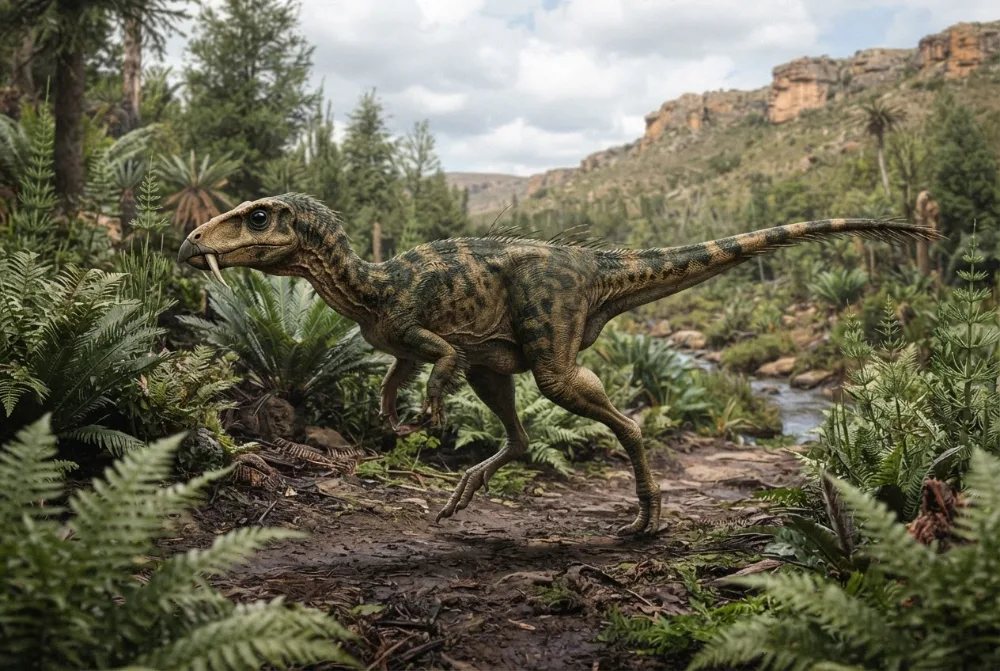
It had a beak at the front of its mouth, like a parrot, but also had long, fang-like canine teeth.1
Lycorhinus was only about 1.2 metres (4 feet) long, about the size of a large dog.1
Scientists once thought a different dinosaur called Lanasaurus was a separate species, but now they think it was the same as Lycorhinus.13
Its fossils were found in the Upper Elliot Formation, which is made of red mudstone from ancient rivers and deserts.1
Lycorhinus lived alongside the long-necked dinosaur Massospondylus and the early crocodile relative Protosuchus.1
Laaj yi ñu gën a laaj ci Lycorhinus
?What did Lycorhinus eat?
Lycorhinus was a plant-eater. Its teeth show wear from chewing tough plants, and scientists think it may have also eaten fruits, roots, and nuts, like modern peccaries do.1
?How big was Lycorhinus?
Lycorhinus was about 1.2 metres (4 feet) long, which is about the size of a large dog.12
Ku tas léeb yu dul dëgg
Léeb: Because Lycorhinus had long canine teeth, some people think it was a meat-eater.
Dëgg: Lycorhinus was actually a plant-eater. Its teeth show wear from chewing plants, and its beak helped it crop vegetation.1
Ngir ñi xam dino lool
- Turu xam-xam
- Lycorhinus
- Ku ko tudde
- Haughton 19243
- Kurél
- Dino yu lekk gàncax te am gémmiñu picc
- Njaboot / klad
- Heterodontosauridae3
- Klasifikasiyoŋ
- Ornithischia > Heterodontosauridae3
- Màggaayu doj yi
- 201 ba 184 milyoŋ at (Hettangian / Pliensbachian)3
- Formasiyoŋi doj
- Elliot, Clarens3
- Réew yi
- Afrig di Sid, Lesoto3
- Fosil yu ñu gis
- 5 ci The Paleobiology Database3
- Ñu ngi koy wooye itam
- Lanasaurus (tur yu njëkk yi, léegi ñu ngi leen jàppe ni benn rab rekk)3
- Gisees
- Lycorhinus was named in 1924 by South African paleontologist Sidney H. Haughton, based on a partial jaw found in the Upper Elliot Formation of South Africa.13
- Ñu ngi koy werante ba tey
- Scientists are not sure exactly how Lycorhinus used its long canine teeth, whether for defense, digging, or eating tough plants.1
Fa xibaar yi jóge
- Lycorhinus (en.wikipedia.org)
- Lycorhinus | Natural History Museum (nhm.ac.uk)
- Lycorhinus in The Paleobiology Database (CC BY 4.0): at, béréb yi, formasiyoŋi doj, klasifikasiyoŋ.
Bépp xibaar ci xët wii am na lim bu wone fa mu jóge. Su nu juumee, baal nu, nun ñu bëgg dino lanu, du ab sërnaalu xam-xam. Wax nu ko ci [email protected] nu defar ko.
 Rex xiif na! Dino Wiki, mbiru ab baay la ngir doomam ju góor ju bëgg dinosoor, ci neen te amul kaamuñaate, amul tracker. Mag ñi mën nañu jox Rex tuuti ñam ngir dimbali ko mu des ci internet.Dundal Rex
 Iguanodon
 Tenontosaurus
 Thescelosaurus
 Zalmoxes
 Camptosaurus
 Rhabdodon
 Dilophosaurus
 Stenopterygius
 Dorygnathus
 Lufengosaurus
 Scutellosaurus
 Yunnanosaurus