 Uyiyiphi idayinaso? Ikwizi
 Idabi leedayinaso
 Ugqatso lweedayinaso
 Imidlalo emincinci yeedayinaso
 I-albhamu yezitikha
 Iilisti ze-TOP zeedayinaso
 Ndothuse!
Yaphila nini?

Yayinkulu kangakanani?
Yayinde kangakanani?
Yayiphakame kangakanani?
uqikelelo
 inde njengezinja ezingama-4, impumlo ukuya emsileni🍌inde njengeebhanana ezingama-23 zilandelelana🏃ibinokubaleka iimitha ezili-100 ngemizuzwana engama-5.8 (oyena mntu ukhawulezayo udinga i-9,6)
Afromimus wayemkhulu kangakanani xa ethelekiswa NAWE?
Yimathematika nje kwibhrawuza yakho. Akukho nto igcinwayo okanye ithunyelwe naphi na.
Yayikhawuleza kangakanani?


Iinyani ezimnandi
Afromimus is one of the oldest ornithomimosaurs found in Africa, showing that these ostrich-like dinosaurs lived on southern continents early in their evolution.2
The only known skeleton of Afromimus includes tail bones, chevrons, and parts of the right hind leg.2
Its tail vertebrae have broad, peanut-shaped joints that helped the tail bend and flex.2
Afromimus lived about 113 to 100 million years ago, during the Albian age of the Early Cretaceous.1
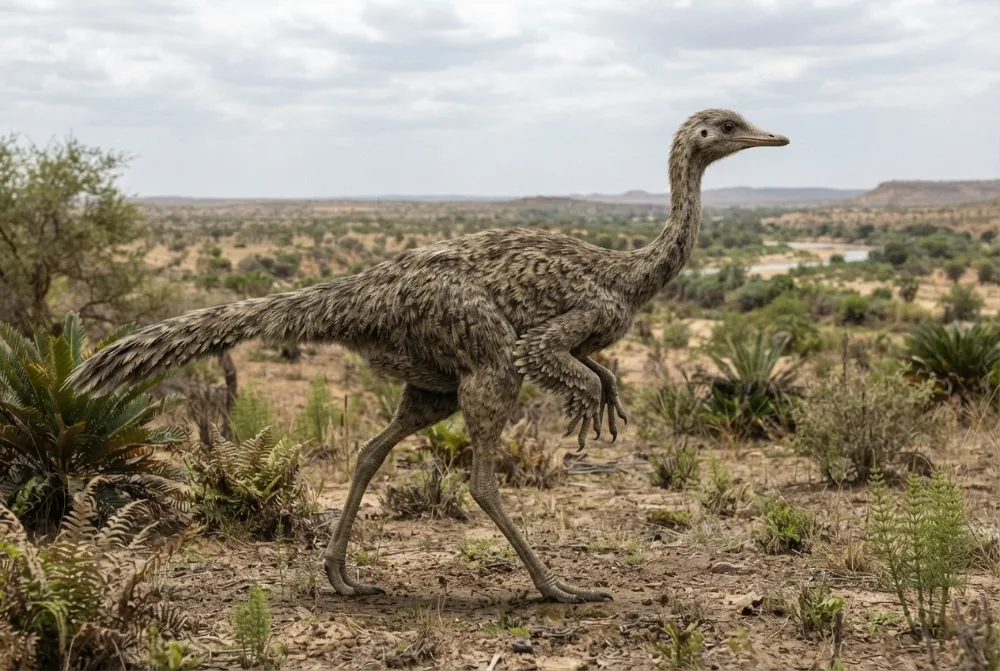
The name Afromimus means 'African mimic', because it looks like other ornithomimosaurs but comes from Africa.1
Scientists think Afromimus was a ground-dwelling dinosaur that laid eggs.1
Eyona mibuzo ibuzwa kakhulu: Afromimus
?How big was Afromimus?
About 4.14 metres long, based on its tibia length and its classification as a noasaurid. It was half the size of Gallimimus and twice the size of Shenzhousaurus.4
?What did Afromimus eat?
Scientists are not sure, but its toothless beak suggests it may have eaten plants, small animals, or eggs. No direct evidence of its diet has been found.4
?Is Afromimus a dinosaur?
Yes, Afromimus is a theropod dinosaur. It was originally thought to be an ornithomimosaur, but later studies suggest it was a ceratosaurian related to abelisauroids.4
?When did Afromimus live?
Afromimus lived during the Early Cretaceous, about 113 to 100 million years ago. That is the Albian age.4
?Could Afromimus run fast?
Probably yes. It had long legs and a light body, like modern ostriches, so it was likely a fast runner. No exact speed has been calculated.4
?Where was Afromimus found?
Its only skeleton was found in the Ténéré Desert of Niger, Africa. It was discovered in 1997 at a place called Gadoufaoua.4
Kwiingcali zeedayinaso
- Igama lenzululwazi
- Afromimus
- Inikwe igama ngu:
- Sereno 20175
- Iqela
- Iidayinaso-nciniba
- Usapho / iclade
- Ornithomimosauria5
- Ukuhlelwa
- Theropoda > Ornithomimosauria5
- Ubudala bamatye
- 113 ukuya ku-100 izigidi zeminyaka (Albian)5
- Izakhiwo zamatye
- Elrhaz5
- Amazwe
- iNiger5
- Iirekhodi zeefosili
- 1 kwi-Paleobiology Database5
- Ukufunyanwa
- Afromimus was named by paleontologist Paul Sereno in 2017, based on a fragmentary skeleton found in the El Rhaz Formation of Niger.12
- Kusaxoxwa ngayo
- Scientists are not sure exactly how big Afromimus was, because only a partial skeleton has been found.2
Apho iinyani zivela khona
- PBDB Taxon (paleobiodb.org)
- Early Cretaceous Ornithomimosaurs (Dinosauria: Coelurosauria) from Africa (exa.ai)
- Afromimus (Wikipedia) (Wikipedia)
- Afromimus - Wikipedia (en-wp.org)
- Afromimus in The Paleobiology Database (CC BY 4.0): ubudala, iindawo, izakhiwo zamatye, ukuhlelwa.
Yonke inyani ekweli phepha inenombolo ebonisa umthombo wayo. Ukuba siphosisile, uxolo, sithanda iidayinaso, asiyojenali yenzululwazi. Sixelele apha: [email protected], siya kuyilungisa.
 URex ulambile! I-Dino Wiki yiprojekthi katata ukwenzela unyana wakhe othanda iidayinaso, isimahla, ayinazintengiso, ayinazilandeli. Abantu abadala banokuphakela uRex isidlwana ukuze incede ihlale kwi-intanethi.Phakela uRex
 Gallimimus
 Ornithomimus
 Struthiomimus
 Deinocheirus
 Dromiceiomimus
 Archaeornithomimus
 Stegosaurus
 Iguanodon
 Archaeopteryx
 Giganotosaurus
 Microraptor
 Deinonychus