 Uyiyiphi idayinaso? Ikwizi
 Idabi leedayinaso
 Ugqatso lweedayinaso
 Imidlalo emincinci yeedayinaso
 I-albhamu yezitikha
 Iilisti ze-TOP zeedayinaso
 Ndothuse!
Yaphila nini?

Yayinkulu kangakanani?
Yayinde kangakanani?
Yayiphakame kangakanani?
uqikelelo
 inde njengeekati zasekhaya ezingama-3, impumlo ukuya emsileni🍌inde njengeebhanana ezingama-9 zilandelelana🏃ibinokubaleka iimitha ezili-100 ngemizuzwana engama-7.1 (oyena mntu ukhawulezayo udinga i-9,6)
Hexing wayemkhulu kangakanani xa ethelekiswa NAWE?
Yimathematika nje kwibhrawuza yakho. Akukho nto igcinwayo okanye ithunyelwe naphi na.
Yayikhawuleza kangakanani?


Iinyani ezimnandi
Hexing is one of the oldest known ornithomimosaurs, the group of ostrich-like dinosaurs.1
Its name means 'like a crane' in Chinese, and its species name means 'with slender wings'.1
The only fossil of Hexing was first found by a local farmer, who tried to make it look more valuable by adding fake parts. Scientists later removed those fake bits.1
Hexing had a very long hind leg compared to its thigh, which helped it run fast.3
Unlike later ornithomimosaurs, Hexing still had teeth in the front of its upper jaw.3
Hexing lived alongside many other amazing animals in the Jehol Biota, including early birds, mammals, and even feathered dinosaurs.3
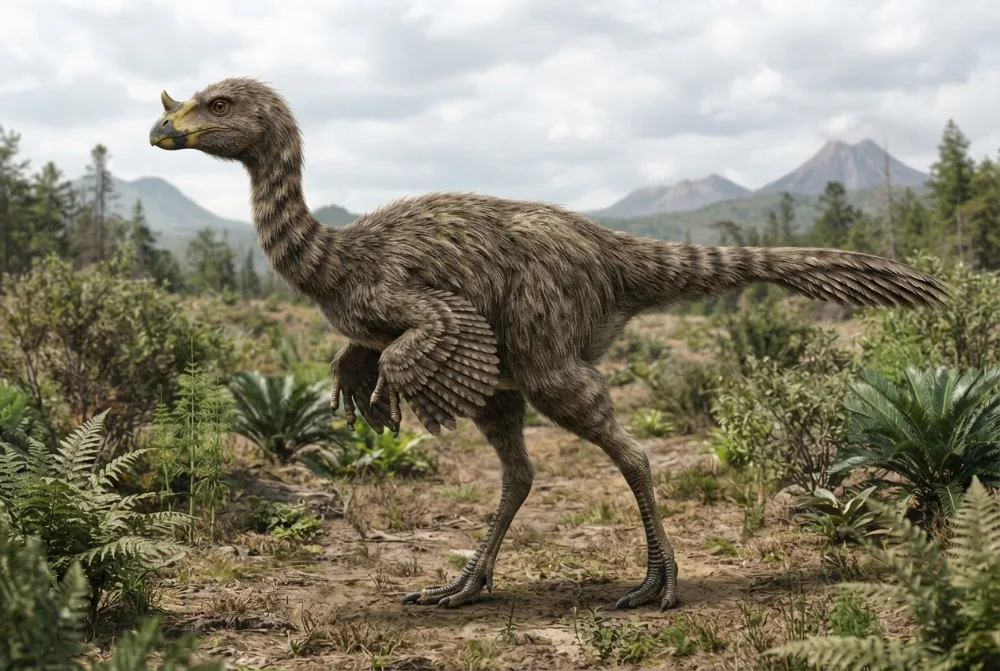
Eyona mibuzo ibuzwa kakhulu: Hexing
?How big was Hexing?
Hexing was small, but its exact length is unknown because most of its backbone is missing. Comparing its thighbone to a similar dinosaur, Shenzhousaurus, which was 1.6 metres (about 5.2 feet) long, Hexing was probably smaller.1
?Did Hexing have teeth?
Yes, Hexing had a few small conical teeth in the front of its lower jaw, but its upper jaw was toothless. This is different from later ornithomimosaurs, which had no teeth at all.1
Kwiingcali zeedayinaso
- Igama lenzululwazi
- Hexing
- Inikwe igama ngu:
- Jin et al. 20124
- Iqela
- Iidayinaso-nciniba
- Usapho / iclade
- Ornithomimosauria4
- Ukuhlelwa
- Theropoda > Ornithomimosauria4
- Ubudala bamatye
- 126 ukuya ku-120 izigidi zeminyaka (Barremian / Aptian)4
- Izakhiwo zamatye
- Yixian4
- Amazwe
- iTshayina4
- Iirekhodi zeefosili
- 1 kwi-Paleobiology Database4
- Ukufunyanwa
- Hexing was named and described in 2012 by Jin Liyong, Chen Jun, and Pascal Godefroit. The fossil was found at Xiaobeigou in Liaoning, China, in rocks that are about 128 to 139 million years old.1
- Kusaxoxwa ngayo
- Scientists are not sure whether Hexing or Shenzhousaurus was the more primitive ornithomimosaur, because the fossils of both are incomplete.3
Apho iinyani zivela khona
- Hexing (en.wikipedia.org)
- PBDB Taxon (paleobiodb.org)
- IU Press uncorrected proof. Copyrighted material. For proofing purposes only. (dinoweb.ucoz.ru)
- Hexing in The Paleobiology Database (CC BY 4.0): ubudala, iindawo, izakhiwo zamatye, ukuhlelwa.
Yonke inyani ekweli phepha inenombolo ebonisa umthombo wayo. Ukuba siphosisile, uxolo, sithanda iidayinaso, asiyojenali yenzululwazi. Sixelele apha: [email protected], siya kuyilungisa.
 URex ulambile! I-Dino Wiki yiprojekthi katata ukwenzela unyana wakhe othanda iidayinaso, isimahla, ayinazintengiso, ayinazilandeli. Abantu abadala banokuphakela uRex isidlwana ukuze incede ihlale kwi-intanethi.Phakela uRex
 Gallimimus
 Ornithomimus
 Struthiomimus
 Deinocheirus
 Dromiceiomimus
 Archaeornithomimus
 Stegosaurus
 Iguanodon
 Archaeopteryx
 Giganotosaurus
 Microraptor
 Deinonychus