 Uyiyiphi idayinaso? Ikwizi
 Idabi leedayinaso
 Ugqatso lweedayinaso
 Imidlalo emincinci yeedayinaso
 I-albhamu yezitikha
 Iilisti ze-TOP zeedayinaso
 Ndothuse!
Kinnareemimus
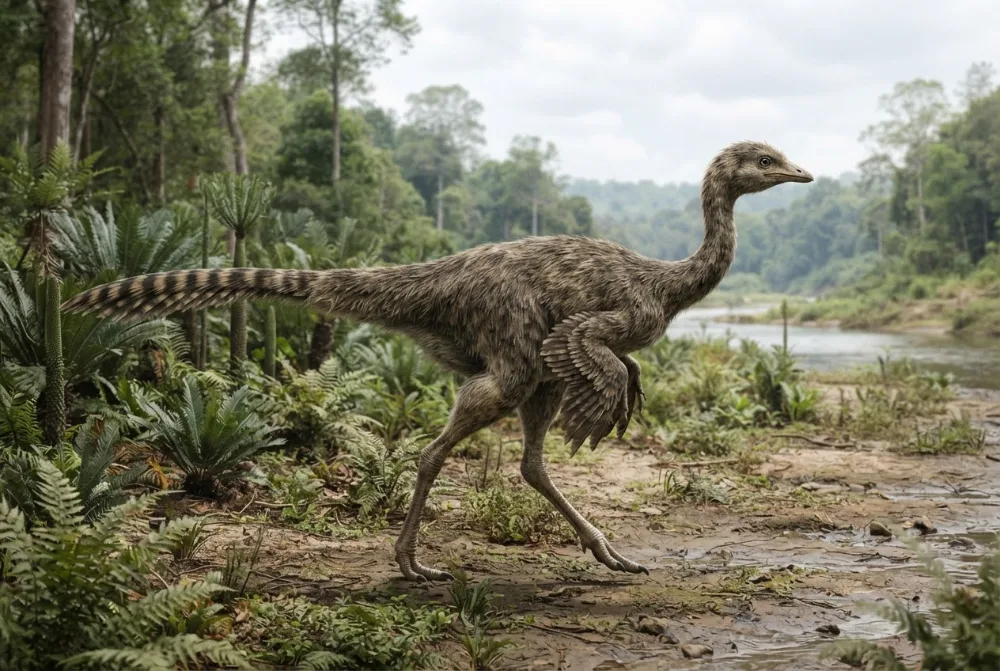
Kinnareemimus was a small, fast dinosaur that looked a bit like an ostrich. It lived in what is now Thailand during the Early Cretaceous period, about 125 million years ago. Scientists think it could run quickly on its long, bird-like legs.1
Yaphila nini?
Yayinkulu kangakanani?
Yayinde kangakanani?
Yayiphakame kangakanani?
uqikelelo
Yayinzima kangakanani?
 inde njengeekati zasekhaya ezingama-4, impumlo ukuya emsileni🍌inde njengeebhanana ezingama-10 zilandelelana🍌inzima njengeebhanana ezingama-110🏃ibinokubaleka iimitha ezili-100 ngemizuzwana engama-7.1 (oyena mntu ukhawulezayo udinga i-9,6)
Kinnareemimus wayemkhulu kangakanani xa ethelekiswa NAWE?
Yimathematika nje kwibhrawuza yakho. Akukho nto igcinwayo okanye ithunyelwe naphi na.
Yayikhawuleza kangakanani?


Iinyani ezimnandi
The name Kinnareemimus comes from a Kinnaree, a magical creature from Thai stories that has a woman's head and a bird's legs.1
Only a single foot bone, a metatarsal, was chosen as the main specimen. Other bones from the same site were also assigned to this dinosaur.1
Its foot had a special shape called semi-arctometatarsalian, where the middle toe bone gets narrow in the middle and then widens at the bottom.1
Kinnareemimus lived alongside many other dinosaurs, including the huge sauropod Phuwiangosaurus and the meat-eating Siamotyrannus.1
The fossils were found in red clay and sandstone that were once a river floodplain with lakes.1
Scientists think Kinnareemimus might have been a good runner, but not as fast as later ostrich dinosaurs like Gallimimus.1
Eyona mibuzo ibuzwa kakhulu: Kinnareemimus
?How big was Kinnareemimus?
About 1.8 metres (5.9 ft) long and possibly weighed around 13 kilograms (29 lb). Scientists are not sure because only a few foot bones have been found.1
?What did Kinnareemimus eat?
It was an ornithomimosaur, so it likely ate plants and small animals, like other ostrich dinosaurs. No direct evidence of its diet has been found.1
?Could Kinnareemimus run fast?
Probably yes, but not as fast as later ostrich dinosaurs like Gallimimus. Its leg bones suggest it was a good runner, though scientists are not certain.1
?Where was Kinnareemimus found?
In northeastern Thailand, in the Early Cretaceous Sao Khua Formation. The fossils were discovered at a site called Phu Wiang 5.1
Kwiingcali zeedayinaso
- Igama lenzululwazi
- Kinnareemimus
- Inikwe igama ngu:
- Buffetaut et al. 20093
- Iqela
- Iidayinaso-nciniba
- Usapho / iclade
- Ornithomimosauria3
- Ukuhlelwa
- Theropoda > Ornithomimosauria3
- Ubudala bamatye
- 126 ukuya ku-121 izigidi zeminyaka (Barremian)3
- Izakhiwo zamatye
- Sao Khua3
- Amazwe
- iThailand3
- Iirekhodi zeefosili
- 1 kwi-Paleobiology Database3
- Ukufunyanwa
- The first fossils were reported in 1997, but the dinosaur was officially named Kinnareemimus khonkaenensis in 2009 by Eric Buffetaut, Varavudh Suteethorn, and Haiyan Tong.1
- Kusaxoxwa ngayo
- Because only a few bones are known, scientists are not sure exactly how big Kinnareemimus was or what its whole body looked like.1
Apho iinyani zivela khona
- Kinnareemimus (en.wikipedia.org)
- PBDB Taxon (paleobiodb.org)
- Kinnareemimus in The Paleobiology Database (CC BY 4.0): ubudala, iindawo, izakhiwo zamatye, ukuhlelwa.
Yonke inyani ekweli phepha inenombolo ebonisa umthombo wayo. Ukuba siphosisile, uxolo, sithanda iidayinaso, asiyojenali yenzululwazi. Sixelele apha: [email protected], siya kuyilungisa.
 URex ulambile! I-Dino Wiki yiprojekthi katata ukwenzela unyana wakhe othanda iidayinaso, isimahla, ayinazintengiso, ayinazilandeli. Abantu abadala banokuphakela uRex isidlwana ukuze incede ihlale kwi-intanethi.Phakela uRex
 Gallimimus
 Ornithomimus
 Struthiomimus
 Deinocheirus
 Dromiceiomimus
 Archaeornithomimus
 Stegosaurus
 Iguanodon
 Archaeopteryx
 Giganotosaurus
 Microraptor
 Deinonychus