 Uyiyiphi idayinaso? Ikwizi
 Idabi leedayinaso
 Ugqatso lweedayinaso
 Imidlalo emincinci yeedayinaso
 I-albhamu yezitikha
 Iilisti ze-TOP zeedayinaso
 Ndothuse!
Nqwebasaurus
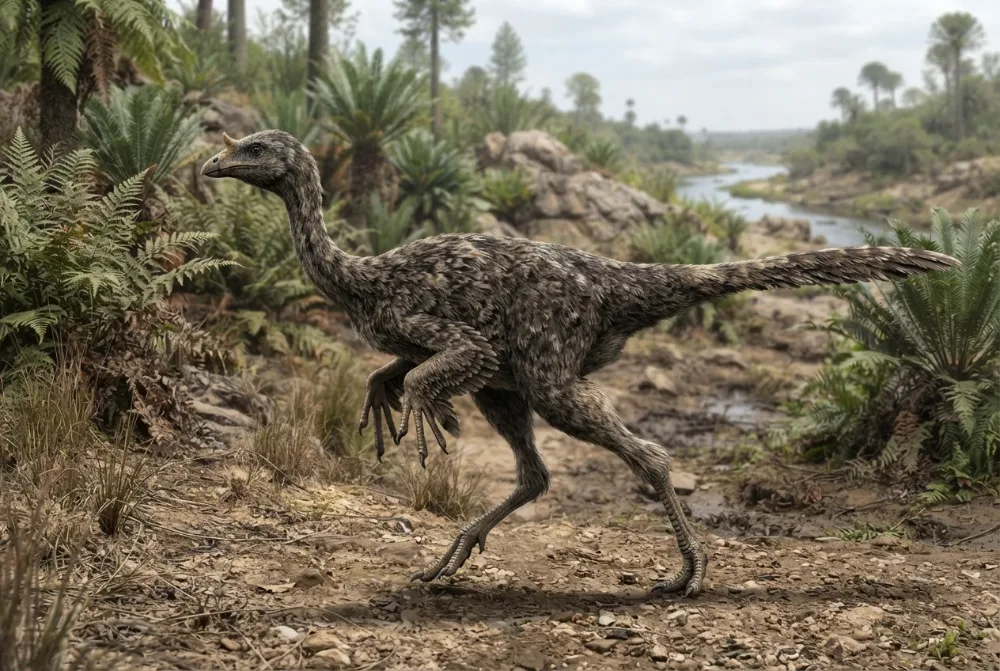
Nqwebasaurus was a small, fast-running dinosaur that lived in what is now South Africa. It had a long, three-fingered hand with a thumb that could partly grip things, and it swallowed stones to help grind up its food.12
Yaphila nini?
Yayinkulu kangakanani?
Yayinde kangakanani?
Yayiphakame kangakanani?
Yayinzima kangakanani?
 inde njengeekati zasekhaya ezingama-2, impumlo ukuya emsileni🍌inde njengeebhanana ezingama-6 zilandelelana🪶ilula kunekati yasekhaya🍌inzima njengeebhanana ezingama-8🪑incinci ngokwaneleyo ukuba ihambe phantsi kwesitulo🏃ibinokubaleka iimitha ezili-100 ngemizuzwana engama-13 (oyena mntu ukhawulezayo udinga i-9,6)
Nqwebasaurus wayemkhulu kangakanani xa ethelekiswa NAWE?
Yimathematika nje kwibhrawuza yakho. Akukho nto igcinwayo okanye ithunyelwe naphi na.
Yayikhawuleza kangakanani?


Iinyani ezimnandi
Nqwebasaurus is the oldest coelurosaur dinosaur ever found in Africa, pushing the record back about 50 million years.2
Its hands had three fingers, and the first finger (like a thumb) was partly opposable, meaning it could grasp things a little bit.1
The claws on its first and second fingers were curved, but the third claw was straight, which is unusual for a theropod dinosaur.1
Scientists found gastroliths (stomach stones) in its belly, which it used to help grind up tough plant food, just like some birds do today.2
Its species name, thwazi, means 'fast runner' in the Xhosa language.1
The only known fossil is a nearly complete skeleton nicknamed 'Kirky' because it was found in the Kirkwood Formation.1
Eyona mibuzo ibuzwa kakhulu: Nqwebasaurus
?How big was Nqwebasaurus?
About 1 metre (3.3 feet) long and 1 kilogram (2.2 pounds) in weight, based on estimates by Gregory S. Paul. The only known fossil was a late juvenile about 0.9 metres (3 feet) long.1
?What did Nqwebasaurus eat?
It probably ate both plants and small animals. Scientists found gastroliths (stomach stones) in its belly, which it used to grind up tough plant food, and its teeth were reduced and not serrated.1
?How fast could Nqwebasaurus run?
Its species name thwazi means 'fast runner' in the Xhosa language, so it was built for speed. No exact speed is known from the fossils.1
?When did Nqwebasaurus live?
It lived during the Early Cretaceous period, about 140 million years ago.1
?Where was Nqwebasaurus found?
In South Africa, in the Kirkwood Formation. The only fossil was discovered in July 1996.1
?Is Nqwebasaurus a dinosaur?
Yes, it is a small theropod dinosaur, specifically a basal coelurosaur.1
Kwiingcali zeedayinaso
- Igama lenzululwazi
- Nqwebasaurus
- Inikwe igama ngu:
- de Klerk et al. 20003
- Iqela
- Iidayinaso-nciniba
- Usapho / iclade
- Ornithomimosauria3
- Ukuhlelwa
- Theropoda > Ornithomimosauria3
- Ubudala bamatye
- 143 ukuya ku-133 izigidi zeminyaka (Berriasian / Valanginian)3
- Izakhiwo zamatye
- Kirkwood3
- Amazwe
- uMzantsi Afrika3
- Iirekhodi zeefosili
- 1 kwi-Paleobiology Database3
- Ukufunyanwa
- Nqwebasaurus was discovered in July 1996 by William J. de Klerk and Callum Ross during a joint expedition in the Kirkwood Formation of South Africa. It was named and described in 2000.1
- Kusaxoxwa ngayo
- Scientists are not sure exactly where Nqwebasaurus fits in the dinosaur family tree. Some studies say it is a basal ornithomimosaur, but others have placed it among coelurosaurs, compsognathids, or alvarezsaurids.1
Apho iinyani zivela khona
- Nqwebasaurus (en.wikipedia.org)
- A new coelurosaurian dinosaur from the Early Cretaceous of South Africa (tandfonline.com)
- Nqwebasaurus in The Paleobiology Database (CC BY 4.0): ubudala, iindawo, izakhiwo zamatye, ukuhlelwa.
Yonke inyani ekweli phepha inenombolo ebonisa umthombo wayo. Ukuba siphosisile, uxolo, sithanda iidayinaso, asiyojenali yenzululwazi. Sixelele apha: [email protected], siya kuyilungisa.
 URex ulambile! I-Dino Wiki yiprojekthi katata ukwenzela unyana wakhe othanda iidayinaso, isimahla, ayinazintengiso, ayinazilandeli. Abantu abadala banokuphakela uRex isidlwana ukuze incede ihlale kwi-intanethi.Phakela uRex
 Gallimimus
 Ornithomimus
 Struthiomimus
 Deinocheirus
 Dromiceiomimus
 Archaeornithomimus
 Stegosaurus
 Iguanodon
 Archaeopteryx
 Giganotosaurus
 Microraptor
 Deinonychus