 Uri dinozore iyihe? Umukino w'ibibazo
 Intambara ya dinozore
 Isiganwa rya dinozore
 Imikino mito ya dinozore
 Alubumu ya sitikeri
 Intonde za TOP za dinozore
 Ntungura!
Yabayeho ryari?

Yanganaga ite?
Yari ndende ite?
Ubutumburuke bwayo bwanganaga iki?
igereranya
Yari iremereye ite?
Manidens yanganaga ite ugereranyije NAWE?
Ni imibare gusa ibarirwa muri mushakisha yawe. Nta kintu kibikwa cyangwa cyoherezwa ahandi.
Yihutaga ite?


Utuntu dushimishije
Manidens lived during the Middle Jurassic, about 171 to 167 million years ago, in a time when South America had many lakes and forests.1
Its name comes from the Latin words for 'hand' and 'tooth' because its last tooth looked like a tiny hand with fingers.1
Manidens is a heterodontosaurid, a group of small ornithischian dinosaurs that often had different types of teeth for different jobs.1
The only known skeleton of Manidens includes parts of the skull, jaws, backbone, shoulder, and hips, but not the tail or legs.1
Scientists think Manidens shows an intermediate step in the evolution of plant-eating: it had high tooth crowns but not the heavy wear facets that later relatives had.1
Manidens was one of the few ornithischian dinosaurs known from the Jurassic of South America, making it a rare find.1
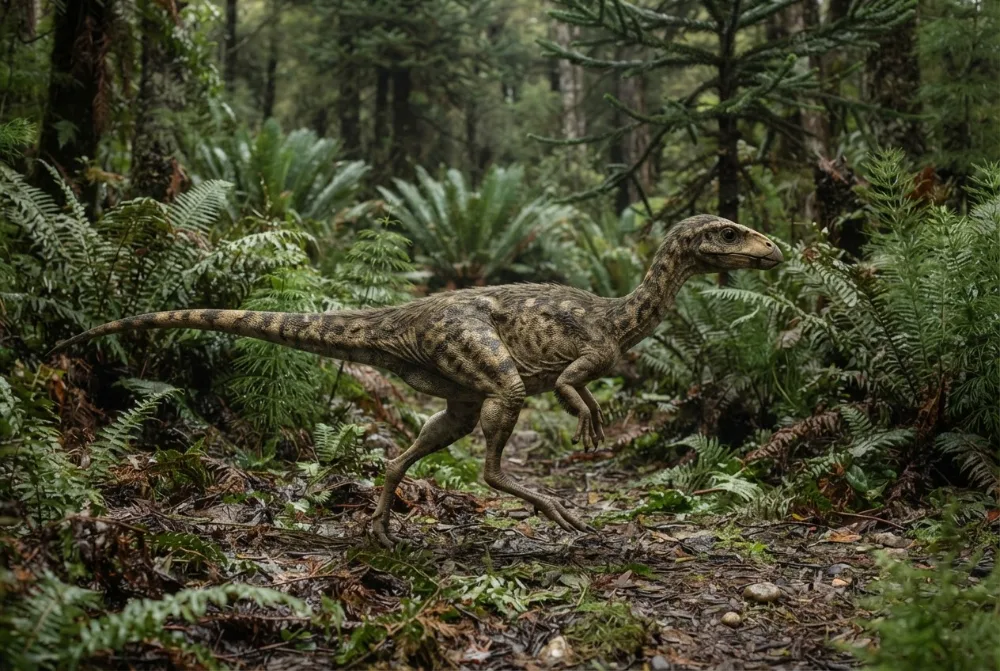
Ibibazo bibazwa cyane kuri Manidens
?How big was Manidens?
Manidens was about 60 cm (2.0 ft) long and weighed around 500 g (1.1 lb), smaller than later heterodontosaurids.2
?What did Manidens eat?
Manidens was a plant-eater. It had high-crowned teeth for chewing plants, but it lacked the heavy wear facets seen in more advanced relatives.21
?When did Manidens live?
Manidens lived during the Early Jurassic, about 179 to 178 million years ago, in what is now Argentina.2
?Did Manidens have feathers?
Scientists think it might have. A close relative called Tianyulong had filamentous structures, so Manidens may have had them too.2
Ku bazobereye muri dinozore
- Izina rya siyansi
- Manidens
- Yiswe na
- Pol et al. 20113
- Itsinda
- Izirya ibimera zifite umunwa w'inyoni
- Umuryango / ishami
- Heterodontosauridae3
- Ishyirwa mu byiciro
- Ornithischia > Heterodontosauridae3
- Imyaka y'amabuye
- imyaka miliyoni 184 kugeza 171 (Toarcian / Aalenian)3
- Inzego z'amabuye
- Cañadón Asfalto3
- Ibihugu
- Arijantine3
- Ibisigazwa byanditswe
- 2 muri The Paleobiology Database3
- Ivumburwa
- Manidens was named in 2011 by Diego Pol, Oliver Rauhut, and Marcos Becerra. The fossils were found at the Queso Rallado site near Cerro Cóndor, Argentina, in the Cañadón Asfalto Formation.13
- Biracyagibwaho impaka
- Scientists are still debating exactly how Manidens chewed its food, since its teeth were high and close together but lacked the heavy wear seen in more advanced plant-eaters.1
Aho amakuru yakuwe
- A Middle Jurassic heterodontosaurid dinosaur from Patagonia and the evolution of heterodontosaurids (staff.mef.org.ar)
- Manidens (en.wikipedia.org)
- Manidens in The Paleobiology Database (CC BY 4.0): imyaka, ahantu, inzego z'amabuye, ishyirwa mu byiciro.
Buri kintu kiri kuri uru rupapuro gifite nimero yerekana aho cyakuwe. Niba hari icyo twibeshye, tubabarire, turi abakunzi ba dinozore, ntituri ikinyamakuru cya siyansi. Tubwire kuri [email protected] tuzagikosora.
 Rex arashonje! Dino Wiki ni umushinga wa papa umwe yakoreye umuhungu we ukunda dinozore, ni ubuntu, nta matangazo kandi nta bigukurikirana. Abantu bakuru bashobora guha Rex akantu ko kurya kugira ngo Dino Wiki ikomeze kuboneka kuri interineti.Gaburira Rex
 Iguanodon
 Tenontosaurus
 Thescelosaurus
 Zalmoxes
 Camptosaurus
 Rhabdodon
 Dilophosaurus
 Stenopterygius
 Dorygnathus
 Lufengosaurus
 Scutellosaurus
 Yunnanosaurus